
Best AI Call Center Software 2025: 9 Picks Updated for 2026
Compare Best AI Call Center Software 2025 across AI agents vs CCaaS. See real pricing, pros/cons, and picks for every team. Start with the right fit.
IN this article

Evolve with Sigma Mind AI
Build, launch & scale AI agents
TL;DR
The AI call center software market splits into two distinct categories that most comparison articles ignore: AI-native voice agent platforms (where AI handles calls autonomously) and CCaaS platforms with AI features (where AI assists human agents). The right choice depends on whether you want AI to be your agent or help your agent. This guide covers 9 platforms across both categories with real pricing, practitioner feedback, and honest tradeoffs so you can pick the right tool without wading through vendor marketing.
The call center AI market is projected to grow from $4.2 billion in 2025 to $11.8 billion by 2030, according to Mordor Intelligence. Over 80% of call centers are already using or planning to use AI. The question is no longer whether to adopt AI but which software to pick.
Here’s the problem: most “best AI call center software 2025” lists throw Genesys (a $75-240/user/month enterprise CCaaS platform) into the same comparison as Retell AI (a $0.07/min voice agent builder). That’s comparing apples to orangutans. These tools solve fundamentally different problems for fundamentally different buyers.
This guide fixes that by splitting recommendations into two clear categories:
- AI-native voice agent platforms that autonomously handle calls, priced per minute of conversation
- CCaaS platforms with AI features that assist human agents, priced per seat per month
Pick your category first, then pick your tool. If you want a deeper dive into the broader contact center AI space, the buyer’s guide for AI contact center solutions covers the evaluation framework in more detail.
At-a-Glance Comparison Table
PlatformStarting PricePricing ModelBest ForAI Autonomy LevelFree TrialSigmaMind AI$0.03/min platform fee + provider costsPer-minute (usage)AI voice agents with existing dialer integrationFully autonomousYes (free tier)Retell AI$0.07/minPer-minute (usage)Production-ready AI voice agents with managed telephonyFully autonomousYes ($10 credit)Five9$119/user/monthPer-seat (36-mo contract)Enterprise outbound sales with predictive dialingAgent-assist + AI agentsNoGenesys Cloud CX$75/user/monthPer-seatComplex omnichannel journey orchestrationAgent-assist + virtual agentsNoTalkdesk$105/user/monthPer-seatMid-market teams wanting fast AI deploymentAgent-assistNoNICE CXone$110/agent/monthPer-seatCompliance-heavy industriesAgent-assist + autopilotNoCloudTalk$25/user/monthPer-seatBudget SMB sales teamsConversational intelligenceYes (14 days)Dialpad$15/user/monthPer-seatReal-time agent coachingAgent-assistYes (14 days)Aircall$30/license/monthPer-seatSMBs wanting intuitive phone system with AIVirtual agents + assistYes
How We Evaluated
Every platform was assessed across six dimensions:
- Pricing transparency. Can you calculate your monthly cost without a sales call?
- AI capability depth. Does the AI only transcribe, or can it actually resolve a customer issue end to end?
- Integration flexibility. Will it work with your existing dialer, CRM, and telephony stack?
- Latency performance. Practitioners on Reddit and AI builder forums consistently report that 600ms voice-to-voice latency feels like a natural conversation, while 1,000ms feels like talking to someone on a bad international connection. Anything above 2.5 seconds kills calls outright.
- User sentiment. Aggregated from G2 reviews, Reddit discussions, and practitioner blogs, not just vendor testimonials.
- Compliance posture. SOC 2, HIPAA readiness, encryption standards.
The simplest decision framework: per-seat platforms make sense when human agents are doing the talking and AI helps them do it better. Per-minute platforms make sense when you want AI to handle calls autonomously, with humans stepping in only for complex situations.
AI-Native Voice Agent Platforms
These platforms are built from the ground up to deploy AI agents that handle calls. They don’t route calls to humans as the default; humans are the escalation path, not the starting point.
This category matters because 60 to 80% of contact center call volume involves routine, repetitive tasks that AI can handle autonomously. If most of your calls are password resets, order status checks, appointment confirmations, or refund requests, an AI-native platform will likely deliver better economics than adding AI features to a per-seat CCaaS tool.
1. SigmaMind AI
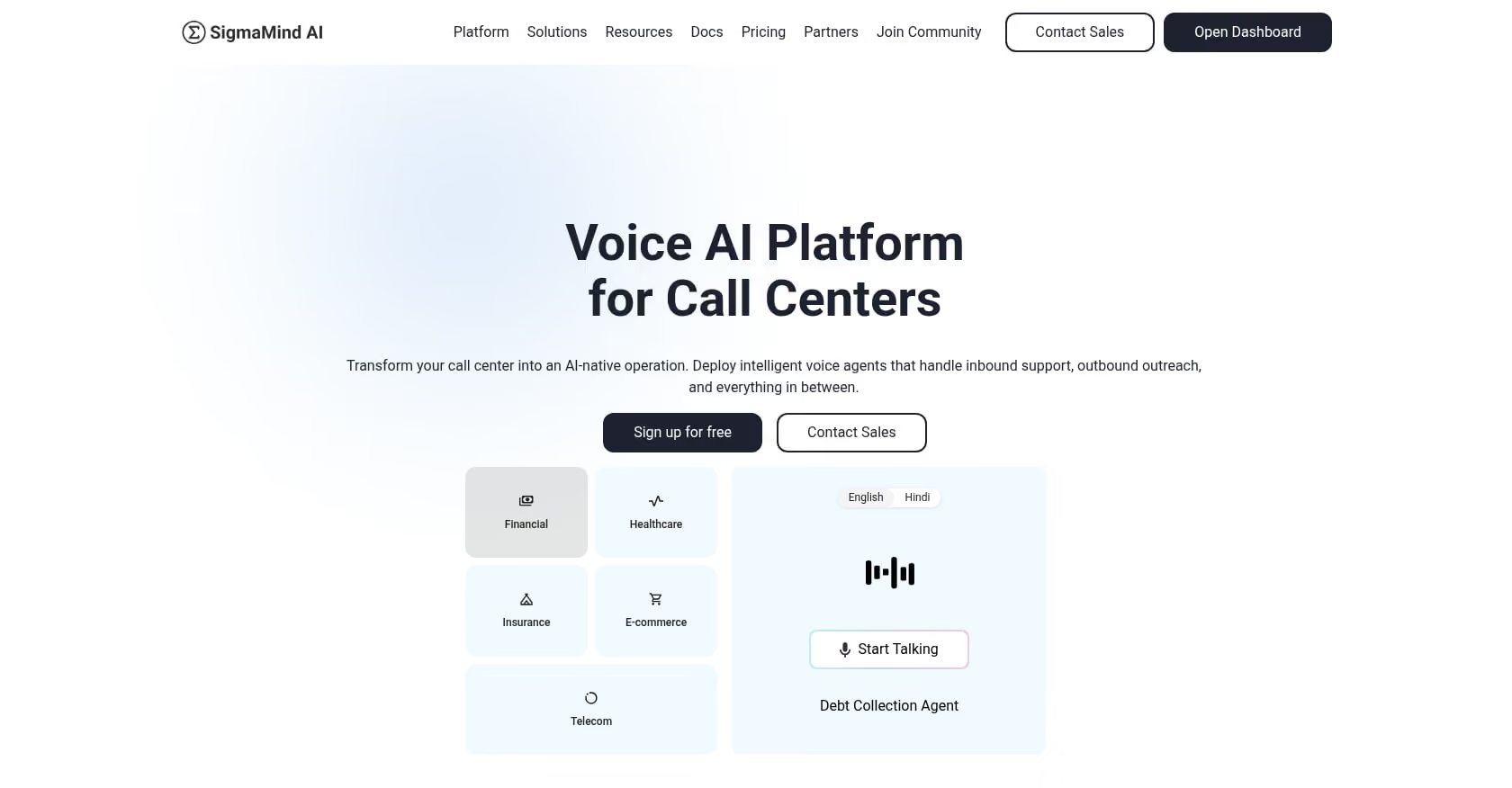
Best for: Call centers and BPOs that want autonomous AI voice agents layered onto their existing dialer and CCaaS infrastructure without rip-and-replace.
Pricing:
- Pay-as-you-go: $0.03/min platform fee plus provider costs for STT, TTS, LLM, and telephony at actuals
- Chat agents: $0.005/message platform fee plus LLM costs
- Enterprise: custom volume pricing
- Free tier available to start building
Key features:
- No-code Agent Builder with branching logic, API actions, variables, and escalation rules
- Model-agnostic architecture: choose your own STT (Deepgram), TTS (ElevenLabs), and LLM (GPT-4o, Claude, Gemini) to optimize for cost, quality, or latency
- Sub-800ms voice-to-voice latency target
- Native integration with existing CCaaS and dialers: VICIdial, Five9, NICE, Genesys, and Asterisk-based systems
- Warm transfer with structured context headers (AI summary plus machine-readable intent and customer data), so human agents never start cold
- Built-in US telephony plus BYOC via SIP with Twilio or Telnyx
- Omnichannel deployment: voice, chat, and email from one canvas
- Outbound campaigns with CSV upload, scheduling, and concurrency caps
- Analytics with per-layer cost breakdowns (see exactly what you’re spending on STT vs. LLM vs. TTS vs. telephony)
- Multi-client workspaces with full agent import for BPO and agency workflows
- SOC 2, encryption, SSO, private cloud options
Proof points:
- 1M+ calls handled, 1,500+ live agents in production
- One e-commerce brand automated 4,000+ refunds per month with 43% cost savings and sub-60-second turnaround (see the full case study)
- Gardencup achieved 80% reduction in refund processing time and a 20% CSAT lift
- YC-backed, Product Hunt 4.9 rating
Tradeoffs:
- Direct phone number purchase currently limited to US. International deployments require bringing your own carrier via SIP (Twilio or Telnyx), which adds configuration steps.
- Modular pricing means you need to understand component costs. The pricing calculator helps, but it’s not as simple as one flat rate.
- Not HIPAA-compliant yet (HIPAA-friendly workflows are in progress).
- Quality depends partly on third-party AI providers (LLM, STT, TTS), which can change pricing or performance with updates.
Why it stands out: The biggest differentiator is integration with existing dialers. Most AI voice agent platforms (Retell, Bland, Vapi) are standalone telephony solutions. SigmaMind works with your VICIdial or Five9 deployment via SIP/BYOC, meaning you don’t have to choose between your dialer and your AI. For call centers with established infrastructure, this is the difference between a weekend deployment and a six-month migration.
The warm transfer implementation also deserves attention. Practitioners across Reddit’s r/ContactCenter consistently cite cold handoffs (where callers repeat themselves) as the number one CSAT killer. SigmaMind’s approach sends structured context headers to the receiving human agent, including an AI-generated summary and machine-readable variables like intent, ticket ID, and customer details. You can read more about how warm transfers work in practice.
Want to test it? Start building for free with pay-as-you-go pricing.
2. Retell AI
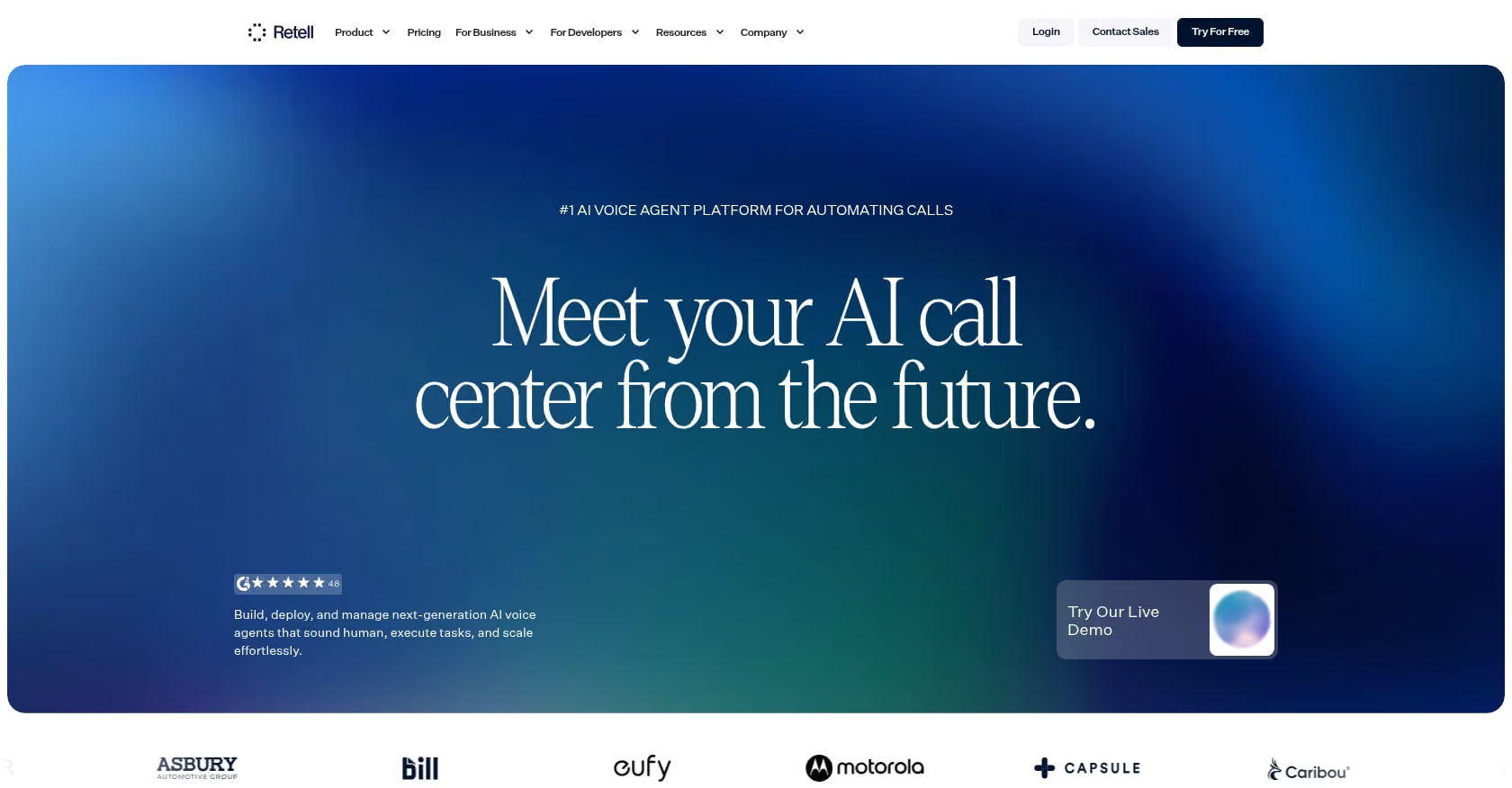
Best for: Teams wanting production-ready AI voice agents with managed telephony and strong defaults, especially in healthcare and regulated industries.
Pricing:
- $0.07/min flat rate
- $2/month per phone number
- Usage-based, no platform licensing fees
- New users get $10 free credit (about 60 minutes of call time)
Key features:
- Proprietary voice AI orchestration engine
- LLM-based humanlike voice agents for inbound and outbound at scale
- Warm transfer, 30+ languages, branded caller ID
- Post-call analysis templates
- Native SIP trunking and batch calling from dashboard with CSV upload
- Unlimited concurrent call capacity
- HIPAA and SOC 2 compliant
Proof points:
- One customer (MDS) handles 100% of inbound calls with only a 30% transfer rate to humans, collecting approximately $280,000 per month through the system.
- Successfully deployed in enterprises with 20,000+ employees.
Tradeoffs:
- No built-in CCaaS features like routing, workforce management, or agent desktop. Best paired with existing call center infrastructure, not usable as a standalone contact center solution.
- Higher per-minute rate ($0.07) compared to SigmaMind’s $0.03 platform fee, though Retell’s rate includes more in the bundle.
- Less flexibility to swap individual STT/TTS/LLM providers since the stack is more tightly integrated.
Practitioner perspective: A practitioner who tested multiple voice AI platforms on the Buildberg blog noted that a typical 4-minute voice agent call with GPT-4o mini and ElevenLabs Turbo lands at $0.40 to $0.80 across any of these platforms once everything is added up. The advice: don’t pick based on the per-minute number alone.
CCaaS Platforms with AI Features
These platforms were originally built as cloud contact center infrastructure: routing, IVR, agent desktops, workforce management. They’ve added AI capabilities on top, ranging from agent-assist (real-time coaching, auto-summaries) to virtual agents that handle simpler interactions.
If you have a team of human agents and want AI to make them faster and smarter, this is your category. The pricing model is per-seat per month, which makes economic sense when humans are doing most of the talking.
1. Five9
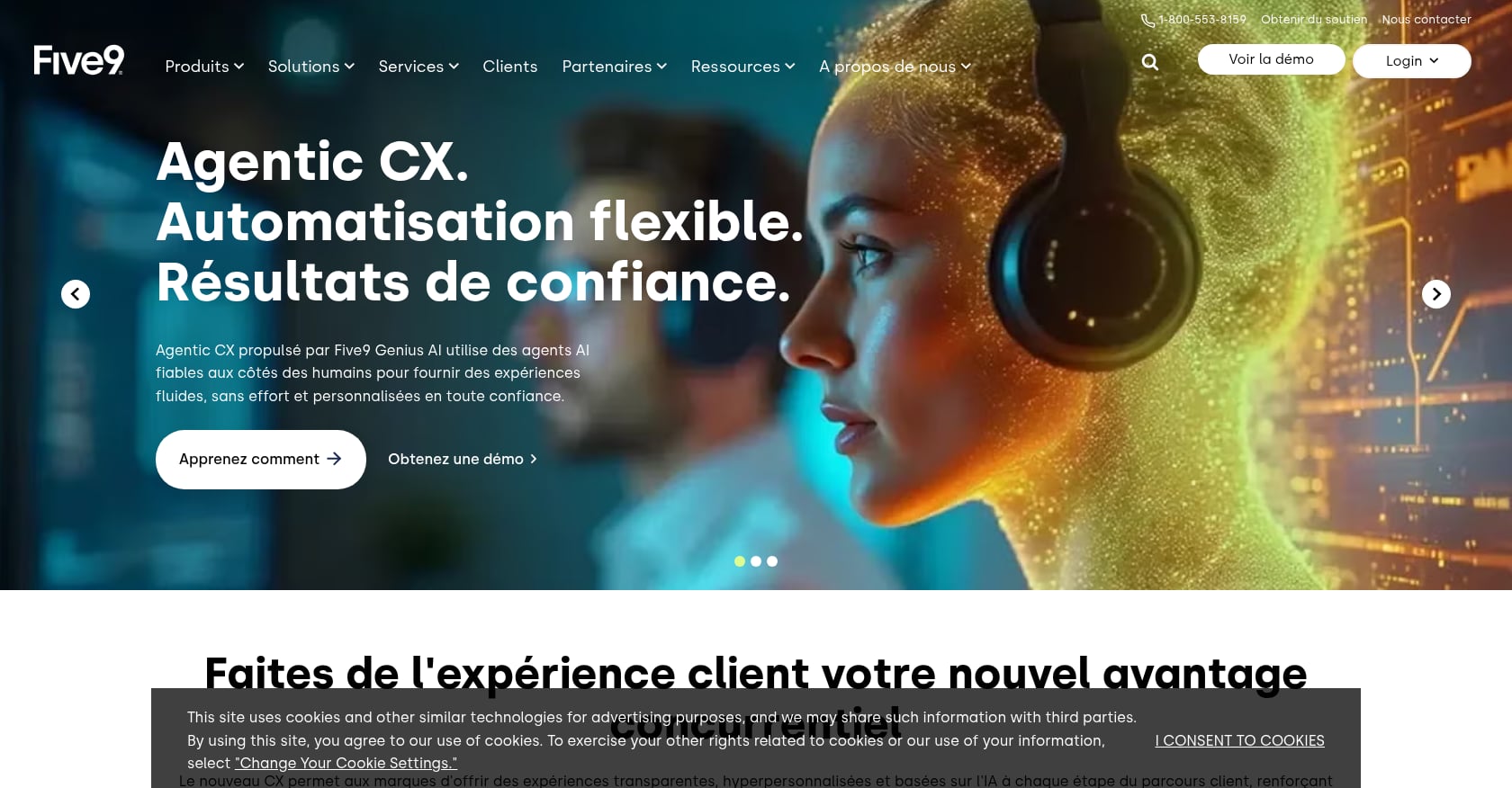
Best for: Enterprise outbound sales operations and blended inbound/outbound environments with 50+ seats.
Pricing:
- Digital and Core plans start at $119/user/month on a 36-month contract
- Premium, Optimum, and Ultimate tiers are custom-quoted
- 50-seat minimum
- No free trial
Key features:
- Predictive and progressive dialer (strongest in category for outbound)
- Genius AI framework: agent assist, AI agents, quality management
- Workforce engagement management via Verint or Calabrio integration
- Omnichannel: voice, email, chat, social
- CRM connectors for Salesforce, ServiceNow, Microsoft, Oracle, Zendesk
Tradeoffs:
- The 50-seat minimum immediately eliminates smaller teams.
- AI features are add-ons, not included in the base price.
- CRM connectors cost extra. One analysis noted that when you add Five9 costs, CRM software fees, the connector charge, and call costs, total spend can reach $600+ per user per month.
- No free trial and agreements typically require a minimum 12-month commitment.
Practitioner perspective: Some users on Reddit’s contact center communities find Five9 expensive relative to the value delivered. Additional expenses for extended data storage, seat adjustments, and feature integrations push the total cost higher than initial quotes suggest.
2. Genesys Cloud CX
Best for: Large organizations managing complex omnichannel customer journeys with high customization needs and fine-grained interaction orchestration.
Pricing:
- CX 1: from $75/user/month
- CX 2: from $115/user/month
- CX 3: from $155/user/month
- CX 4: from $240/user/month
- CRM integrations and collaboration tools are paid add-ons
Key features:
- Agentic Virtual Agent with Large Action Models
- Agent Copilot with real-time recommendations
- Built-in workforce management (most competitors bolt this on)
- Journey orchestration across channels
- AppFoundry marketplace with 600+ integrations
Proof points:
- Won G2’s 2026 Best Agentic AI Software and Best Customer Service Software simultaneously.
Tradeoffs:
- Learning curve for advanced configuration is steep. Fully using the platform often requires specialized technical resources or a certified integration partner.
- CRM integrations are paid add-ons on top of already substantial per-seat pricing.
- AI “experience tokens” can add unexpected cost at scale, making budgeting tricky.
- Advanced customization extends deployment timelines significantly.
Practitioner perspective: Practitioners on Reddit’s r/ContactCenter describe Genesys as the platform that solved the fragmented systems problem. One user shared that they moved an entire operation to 100% Genesys within 7 months after consolidating from multiple disconnected platforms. The consolidation benefit is real, but so is the price tag.
3. Talkdesk

Best for: Mid-market teams that want a modern contact center with built-in AI and faster time to value than Genesys or Five9.
Pricing:
- Voice plans start at approximately $105/user/month
Key features:
- Talkdesk Studio: no-code visual editor for call flows
- AI Agent Assist with real-time next-best-action suggestions
- 100+ out-of-the-box integrations
- Customer Experience Analytics with sentiment analysis and ML
Tradeoffs:
- Add-ons can push total cost higher than expected. Buyers cite this as a recurring theme.
- The platform can slow down under heavy load, according to multiple user reports.
- Predictive dialer features are not as advanced as Five9’s. Businesses focused heavily on outbound dialing should evaluate this gap carefully.
- Some customers report stability and support concerns during peak usage.
- Usability can feel heavy for non-technical users despite the no-code studio.
4. NICE CXone
Best for: Enterprise contact centers in compliance-heavy industries like financial services, healthcare, and insurance.
Pricing:
- $110 to $249 per agent monthly, depending on tier
Key features:
- Cloud platform combining customer engagement, workforce tools, and AI automation
- Enlighten Copilot (agent assist) and Autopilot (autonomous handling)
- Strong compliance and analytics tooling
- Designed for managing all CX tools in one place at enterprise scale
Tradeoffs:
- Works best with dedicated engineers to manage it. Not a plug-and-play experience.
- Users report lag issues during peak times.
- Dashboard customization is limited compared to competitors.
- The pricing range is wide, and feature access varies significantly between tiers.
Practitioner perspective: Users report excellent call quality and fast onboarding, but the platform demands technical ownership to maintain.
5. CloudTalk
Best for: Budget-conscious SMB sales teams that need a phone-first solution with AI conversation intelligence.
Pricing:
- Starts at $25/user/month
- Additional numbers for $6 each
- 14-day free trial available
Key features:
- AI-powered conversational intelligence
- AI voice agents for routine call handling
- Real-time analytics and automated workflows
- Auto-generated multilingual call summaries (5+ languages)
- 70+ features, 35+ integrations
Tradeoffs:
- Limited enterprise-grade capabilities compared to Genesys or Five9.
- Better suited for phone-first SMB teams than complex omnichannel enterprise operations.
- AI voice agent capabilities are newer and less proven at scale than dedicated voice AI platforms.
6. Dialpad
Best for: Teams that want AI to make human agents measurably faster through real-time coaching, knowledge surfacing, and after-call work elimination.
Pricing:
- Standard: from $15/user/month
- Pro: from $25/user/month
- Contact Center: from $80/user/month
- 14-day free trial
Key features:
- AI included at base price (not an add-on)
- Real-time coaching during live calls
- Built on 6 billion+ minutes of proprietary call data
- Post-call summaries and automated after-call work
- Salesforce integration (Pro tier and above)
- Power dialer (Contact Center tier)
Tradeoffs:
- Autonomous agent capabilities only launched in October 2025, making them newer and less battle-tested than competitors.
- Salesforce integration is gated behind the Pro tier.
- Power dialer requires the Contact Center tier at $80/user/month.
Practitioner perspective: Reddit call center practitioners describe Dialpad’s agent-assist as the clearest productivity differentiator in the per-seat category. Multiple users highlight that automatic post-call summaries eliminate 60 to 90 seconds of after-call work per interaction. Over hundreds of calls per day, that adds up fast.
7. Aircall
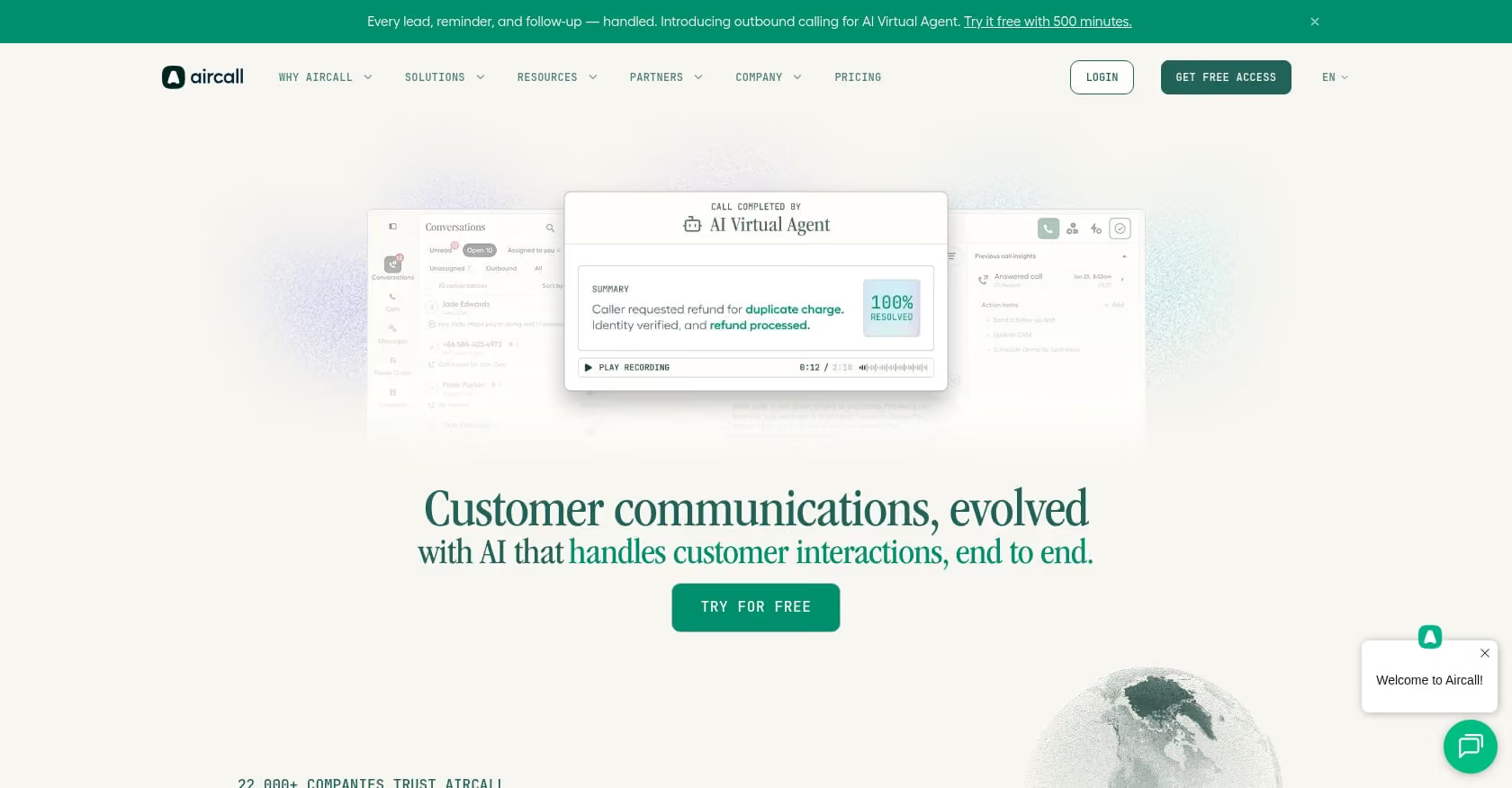
Best for: SMBs wanting an intuitive, affordable phone system with AI capabilities layered on top.
Pricing:
- From $30/license/month (billed annually)
- Free trial available
Key features:
- AI Virtual Agents that answer instantly, resolve routine requests, and escalate complex issues with full context
- Caller intent identification and key detail gathering
- Native integrations with CRM, help desk, and business tools
- Clean, simple interface designed for non-technical teams
Tradeoffs:
- Limited advanced customization compared to enterprise platforms.
- Less suited for high-volume outbound operations.
- AI capabilities are more shallow than dedicated AI-native platforms.
How to Choose the Right AI Call Center Software
The decision tree is simpler than most vendors want you to believe.
Step 1: Do you want AI to handle calls or assist humans?
If your call volume is dominated by routine, repetitive interactions (order status, appointment confirmations, password resets, refund requests), an AI-native voice agent platform will likely deliver better economics and faster resolution times. A Deloitte study reports that AI-driven contact centers can reduce call handling time by up to 40%.
If your calls are complex, emotionally charged, or require judgment, you want a CCaaS platform with strong agent-assist features.
Step 2: What’s your existing infrastructure?
Already running VICIdial, Five9, NICE, or Genesys? You don’t have to rip and replace. An AI-native platform like SigmaMind can layer onto your existing stack via SIP and BYOC, handling the routine calls while your human agents focus on what they do best. This is covered in more depth in the AI call center agent platforms overview.
Starting fresh with no existing infrastructure? A CCaaS platform gives you the full package: routing, agent desktop, workforce management, and AI in one purchase.
Step 3: Per-seat or per-minute economics?
This is where the math matters. A 100-seat Five9 deployment at $119/user equals $11,900/month minimum before add-ons. An AI voice agent handling the same volume at $0.03 to $0.07/min could cost a fraction of that, depending on call duration and volume.
But per-minute pricing only makes sense if AI actually resolves calls. If your transfer rate to humans is 80%, you’re paying for AI minutes and human agents. The goal is a transfer rate under 30 to 40% for routine call types.
Step 4: What compliance requirements apply?
If you’re in healthcare, HIPAA compliance is non-negotiable. Retell AI offers HIPAA and SOC 2 compliance built in. NICE CXone is built for regulated industries. SigmaMind offers SOC 2 with HIPAA-friendly workflows in progress.
For financial services, look at platforms with encryption at rest and in transit, audit trails, and SSO. Both SigmaMind and NICE CXone position strongly here.
Key Metrics to Track After Deployment
Regardless of which platform you choose, track these numbers:
- Cost per call. The average cost per call in a traditional contact center runs $2.70 to $12 per interaction when you factor in agent salaries, infrastructure, and overhead. Your AI deployment should push this down significantly.
- First-call resolution rate. Real-world implementations have documented a 42% improvement in first-call resolution rates with AI.
- Transfer rate. What percentage of AI-handled calls escalate to a human? Below 30% is strong.
- Voice-to-voice latency. Measure this in production, not demos. Sub-800ms is the target for natural-feeling conversation.
- CSAT delta. Compare satisfaction scores before and after AI deployment. Organizations using AI voice technology have seen up to 30% gains in customer satisfaction.
One practitioner on Reddit’s r/ContactCenter put it bluntly: “AI in call centers isn’t a cost-cutting replacement. It’s a capacity multiplier. We didn’t reduce headcount. We handled 40% more volume with the same team because AI took the first pass on every routine call.”
FAQ
What is AI call center software?
AI call center software uses artificial intelligence (speech recognition, natural language processing, large language models, and text-to-speech) to either handle customer calls autonomously or assist human agents during calls. The category spans everything from simple IVR replacements to fully autonomous AI voice agents that can process refunds, schedule appointments, and answer complex product questions. For a deeper breakdown of how these platforms work under the hood, see this guide on choosing the right STT engine for your contact center.
How much does AI call center software cost?
Costs vary dramatically based on category. Per-seat CCaaS platforms range from $15/user/month (Dialpad Standard) to $249/agent/month (NICE CXone top tier). AI-native voice agent platforms charge per minute of conversation, typically $0.03 to $0.07/min for the platform fee plus provider costs for STT, TTS, and LLM. Real-time voice API costs run from roughly $0.06 to $0.15 per minute of total conversation when all layers are included.
Can AI voice agents replace human agents entirely?
No, and they shouldn’t try. Gartner found that 64% of customers would prefer companies not use AI for customer service at all. This doesn’t mean AI is wrong for call centers. It means AI should handle routine, low-complexity calls while humans handle emotionally charged, complex interactions. The best deployments treat AI as the first pass on high-volume routine work, with seamless warm transfer to humans when needed.
What latency is acceptable for AI voice agents?
Based on practitioner testing, 600ms voice-to-voice latency feels like a natural conversation. At 1,000ms, it feels like a bad international phone connection. Above 2,500ms, callers hang up. When evaluating platforms, ask for latency benchmarks in production (not in demos on ideal networks) and test with your actual call flows.
What’s the difference between AI-native voice agents and CCaaS with AI?
AI-native voice agent platforms (SigmaMind, Retell) are built specifically to deploy AI that handles entire calls autonomously. They charge per minute of conversation. CCaaS platforms with AI (Five9, Genesys, Talkdesk) are traditional contact center infrastructure that has added AI features like agent coaching, transcription, and sentiment analysis. They charge per seat per month. The right choice depends on whether your primary goal is autonomous call handling or human agent productivity.
Do I need to replace my existing dialer to use AI voice agents?
Not necessarily. Some AI-native platforms integrate directly with existing dialers and CCaaS systems. SigmaMind, for example, connects with VICIdial, Five9, NICE, Genesys, and Asterisk-based systems via SIP and BYOC, so you can layer AI voice agents onto your existing telephony infrastructure without a full migration. Other voice AI platforms operate as standalone telephony solutions, which may require more significant changes to your setup.
How long does deployment take?
It depends on complexity. AI-native voice agent platforms with no-code builders can have basic agents running within days. Enterprise CCaaS deployments with custom integrations can take 3 to 7 months. One Reddit practitioner shared that moving an entire operation to Genesys took 7 months. Simpler platforms like CloudTalk or Dialpad can be operational within a week for basic configurations.
What ROI should I expect from AI call center software?
Organizations implementing voice AI report 23% annual growth while reducing operational costs by up to 40%, according to industry analysis from AssemblyAI. More specifically, expect 25 to 40% reduction in call handling time, 20 to 42% improvement in first-call resolution, and measurable CSAT gains within 3 to 6 months of deployment.
The Bottom Line
The best AI call center software in 2025 is the one that matches your operational reality, not the one with the biggest feature list. If 60 to 80% of your calls are routine and you’re paying human agents to answer the same questions hundreds of times a day, an AI-native voice agent platform will transform your economics. If your calls are complex and your agents need real-time coaching, a CCaaS platform with strong AI-assist features is the better fit.
Start by identifying which category you belong in. Then narrow based on your existing infrastructure, budget model (per-seat vs. per-minute), and compliance needs. The comparison table at the top of this article gives you the quick-scan view; the detailed reviews give you the tradeoffs nobody else will tell you about.
If you’re running an existing dialer or CCaaS stack and want to layer AI voice agents on top without a migration, explore SigmaMind’s platform or start building for free to test with your own call flows.
Evolve with Sigma Mind AI
Build, launch & scale AI agents
Related Blogs
Ready to transform your call center?

More Conversations.
Less Manual Work.

Building from San Francisco, CA