
Best Conversational AI IVR Platforms in 2026: Top 8
Compare 8 Conversational AI IVR platforms in 2026 with real pricing, latency benchmarks, and trade-offs; pick the right stack for contact centers.

TL;DR
Conversational AI IVR replaces rigid touch-tone menus with natural language voice agents that understand what callers actually want. The best platforms for call centers in 2026 range from per-minute, modular options like SigmaMind AI ($0.03/min) and Retell AI ($0.07/min) to full enterprise suites like Genesys Cloud CX ($75–$240/user/month) and NICE CXone ($94+/user/month). This guide breaks down 8 platforms with real pricing, latency benchmarks, and honest tradeoffs to help you choose between layering AI on top of your existing stack or ripping and replacing entirely.
Why Traditional IVR Is Costing You Customers (and Revenue)
Nobody likes pressing 4 for billing. That’s not an opinion; it’s data. According to research, 83% of callers say IVR is the worst part of calling a business, and a Vonage survey found 35% of users are frustrated by slow, repetitive menus. A Salesforce study revealed that 63% of customers want IVR systems to recognize their unique needs, something traditional IVR simply cannot do.
The financial case is just as stark. Gartner predicts conversational AI will reduce contact center agent labor costs by $80 billion globally in 2026. When you compare AI self-service at $1.84 per contact versus $13.50 for human agents, the math stops being theoretical.
A user study conducted by Boost.ai at a major bank made the dynamic clear: every participant expressed intense dislike of the IVR system, describing it as slow and cumbersome with too many unclear menu options. But when researchers introduced a 5 to 10 minute wait time for a human agent, every participant preferred getting the AI voice bot first. That’s the window conversational AI IVR fills: it’s not replacing humans, it’s replacing the part callers hate most.
Practitioners on Reddit echo this. Users report that traditional IVRs routinely send calls to the wrong place, while AI voice agents can provide 24/7 coverage and scale to handle thousands of calls simultaneously. One Redditor noted that while they usually dislike getting stuck with robotic IVR systems, interacting with a well-built AI agent felt surprisingly natural and efficient.
Traditional IVR vs. Conversational AI IVR
| Dimension | Traditional IVR | Conversational AI IVR |
|---|---|---|
| Input method | DTMF (press 1, 2, 3) | Natural language (speak freely) |
| Routing accuracy | Menu-dependent, rigid | Intent-based, dynamic |
| Personalization | None or minimal | Context-aware, caller history |
| Average handle time | Higher (menu traversal) | Lower (direct intent capture) |
| Customer satisfaction | 83% dislike | Significant CSAT improvements |
| Cost per contact | $13.50 (human escalation) | $1.84 (AI self-service) |
| Scalability | Limited by agent headcount | Unlimited concurrent sessions |
If your call center still runs a traditional IVR, the question isn’t whether to upgrade. It’s which platform to choose and how to migrate without breaking everything. For a broader look at how AI is reshaping call centers, the AI contact center solutions buyer’s guide covers the full evaluation framework.
At-a-Glance Comparison: 8 Conversational AI IVR Platforms
| Platform | Pricing Model | Starting Price | Best For | Voice Latency | Compliance |
|---|---|---|---|---|---|
| SigmaMind AI | Per-minute + provider costs | $0.03/min platform | Call centers with existing CCaaS | Sub-800ms | SOC 2, SSO |
| Genesys Cloud CX | Per-seat/month | $75/user/mo | Enterprise omnichannel | N/A (full suite) | SOC 2, HIPAA, PCI |
| NICE CXone + Cognigy | Per-seat/month | ~$94/user/mo (voice) | Large regulated enterprises | N/A | SOC 2, HIPAA, PCI |
| Five9 | Per-seat/month | ~$119/user/mo | Outbound sales + compliance | 1.5–2s on IVR | SOC 2, HIPAA, PCI |
| Retell AI | Per-minute | $0.07/min | Developer-led AI-native IVR | ~600ms | SOC 2, HIPAA, GDPR |
| Nextiva | Per-agent/month | $75/agent/mo | Mid-market unified comms + CC | N/A | SOC 2, HIPAA |
| Google CCAI | Consumption-based | Contact sales | Google Cloud-heavy enterprises | Custom | SOC 2, HIPAA |
| Telnyx | Usage-based | Pay-as-you-go | Infrastructure-first builders | Low (private network) | SOC 2, HIPAA, PCI |
What to Look for in a Conversational AI IVR Platform
Before diving into individual reviews, here’s the evaluation framework that separates serious platforms from demos.
Latency is king. In voice conversations, anything over 1.5 seconds between a caller’s input and the system’s response creates an awkward pause that feels broken. Five9’s IVR reportedly clocks 1.5 to 2 seconds of delay, which is noticeable. Platforms like SigmaMind AI (sub-800ms) and Retell AI (~600ms) target sub-second response times, which is where conversations start to feel natural.
NLU accuracy determines containment. If the AI misunderstands intent, it either routes wrong or escalates unnecessarily. AI-powered routing has been shown to reduce customer “hunting time” in IVR systems by 54%.
Warm transfer quality separates real platforms from toys. When a caller needs a human, the transition matters enormously. Does the human agent receive context (intent, account info, conversation summary), or does the caller have to repeat everything? This single factor drives more CSAT impact than most feature lists suggest. Understanding how warm transfer with context handoff works is essential when evaluating any conversational AI IVR.
Integration with your existing CCaaS stack. Most contact centers aren’t starting from zero. They have dialers, workforce management tools, CRM connections, and reporting dashboards. The right platform works with what you already have. As one practitioner at Ada.cx put it: “IVR systems are often tied into routing logic, authentication layers, workforce tools, reporting dashboards, you name it. Technical debt with no owner. These systems have been duct-taped together over decades. In some organizations, the only person who understood the stack retired five years ago.”
Pricing model alignment. Per-seat pricing punishes variable workloads. Per-minute pricing punishes high volume. The right model depends on your call patterns, which we’ll break down in Section 5.
Model-agnostic architecture. Platforms that let you swap LLMs, speech-to-text, and text-to-speech providers avoid vendor lock-in and let you optimize for cost, latency, and quality independently. For a deeper comparison of conversational AI agent platforms, including how model flexibility plays out in practice, that guide covers it thoroughly.
The Layer-On-Top vs. Rip-and-Replace Decision
This is the first strategic choice you’ll make. Rip-and-replace means ditching your current IVR/CCaaS entirely for an AI-native platform. Layering on top means keeping your existing infrastructure and routing AI into the right moments.
For most call centers, layering is the smarter starting point. It’s lower risk, faster to deploy, and doesn’t require re-training your entire team. Ada.cx frames it well: “Modern voice AI doesn’t require you to rip and replace your CCaaS or IVR overnight. We layer on top of what’s already there, and we start by intercepting the right moments.”
The platforms below span both approaches.
The 8 Best Conversational AI IVR Platforms
1. SigmaMind AI

Best for: Call centers and BPOs that want to layer conversational AI IVR onto their existing CCaaS/dialer stack without rip-and-replace.
SigmaMind AI is a Y Combinator-backed voice AI platform built specifically for call center operations. Rather than replacing your dialer or CCaaS, it connects directly to platforms like VICIdial, Five9, NICE, and Genesys, deploying AI voice agents that handle inbound support, outbound campaigns, and routing without disrupting existing infrastructure.
Pricing:
- Pay-as-you-go: $0.03/min platform fee + actual provider costs for STT, TTS, LLM, and telephony
- No per-seat fees or minimums
- Enterprise plans with volume pricing available
- Transparent pricing with per-layer cost breakdowns
Key features:
- No-code Agent Builder with branching logic, API/tool actions, variables, and escalation rules
- Model-agnostic stack: choose your own LLM, STT, and TTS providers per use case
- Sub-800ms voice latency (avg. ~970ms voice-to-voice demonstrated)
- Warm transfer with custom headers passing AI summary + structured context to human agents
- Built-in US telephony + BYOC via SIP (Twilio/Telnyx)
- Omnichannel: voice, chat, and email from one brain
- Analytics with per-layer cost breakdowns
- Outbound campaigns with bulk dialing, CSV upload, and concurrency caps
- Multi-client workspaces with full agent import for agencies and BPOs
- SOC 2, encryption at rest/in-transit, SSO
Proof points: Over 1M+ calls handled, 1.5K+ live agents. One e-commerce brand automated 4,000+ refunds per month with 43% cost savings. Gardencup achieved an 80% reduction in refund processing time and a 20% CSAT lift.
Limitations:
- International phone numbers require BYO carrier via SIP (direct purchase limited to US numbers currently)
- Modular pricing means you need to understand provider costs across STT/TTS/LLM layers, though the platform makes this transparent
- Depends on third-party AI providers whose pricing and performance can shift
Verdict: The strongest option for call centers that want conversational AI IVR without the overhead of an enterprise CCaaS license. The per-minute model, combined with native dialer integrations and warm transfer with context, makes it particularly well-suited for BPOs operating on thin margins. Start building for free and pay only for what you use.
2. Genesys Cloud CX
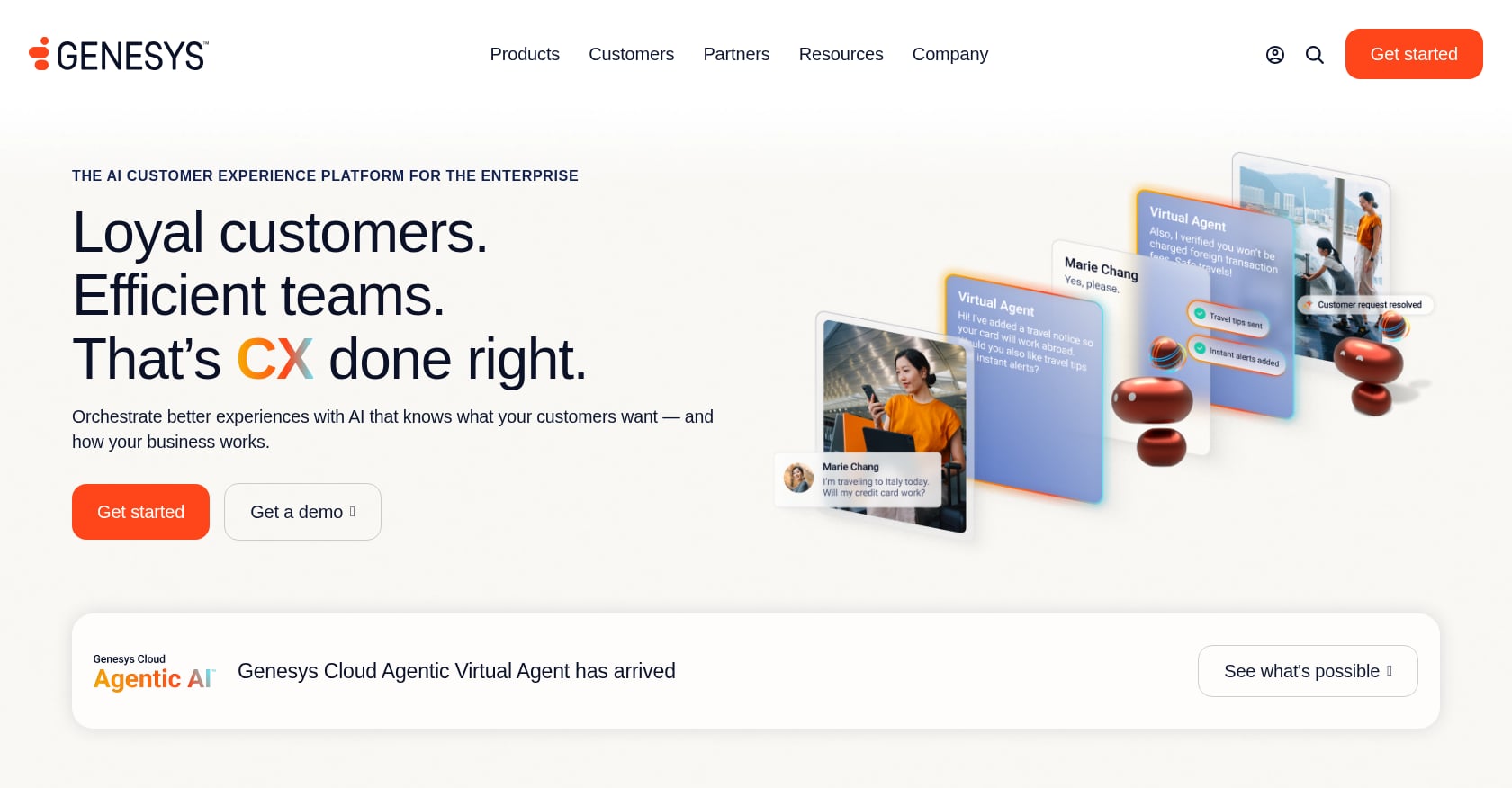
Best for: Enterprise omnichannel contact centers needing a full CX suite with AI layered in.
Genesys is the incumbent choice for large contact centers that need predictive routing, workforce engagement management, journey orchestration, and AI capabilities under one roof. Its conversational AI IVR features come as part of a broader platform, not as a standalone product.
Pricing:
- Four tiers: CX 1 ($75/mo), CX 2 ($115/mo), CX 3 ($155/mo), CX 4 ($240/mo), all billed annually
- Telecom is separate: for a 100-agent center handling 50,000 minutes per agent annually, telecom adds $60,000–$100,000/year
- AI Experience tokens beyond included amounts are extra; Salesforce CRM integration is an add-on
- For a 200-agent center on CX 4, licensing alone runs approximately $576,000/year
Key features:
- Predictive routing and journey orchestration
- Workforce engagement management (WEM)
- Agent Copilot for real-time assist
- AI Experience tokens for automation
- Deep analytics and reporting
User sentiment: Holds a G2 rating of approximately 4.3/5, with users citing reliability and enterprise depth as strengths.
Limitations:
- Compared to voice-first AI platforms, it feels heavier and slower to iterate on conversational logic
- Voice AI features are constrained by the broader contact center framework
- Per-seat costs are prohibitive for BPOs. A TrustRadius reviewer noted it’s “difficult to sell being a BPO as the per seat cost and implementation cost are expensive for a BPO with thin margins”
- Hidden costs add up quickly beyond base licensing
Verdict: If you’re already on Genesys and need conversational AI IVR within a full CX suite, it works. But if your primary goal is deploying voice AI agents quickly and affordably, dedicated platforms offer more agility at a fraction of the cost.
3. NICE CXone (with Cognigy AI)
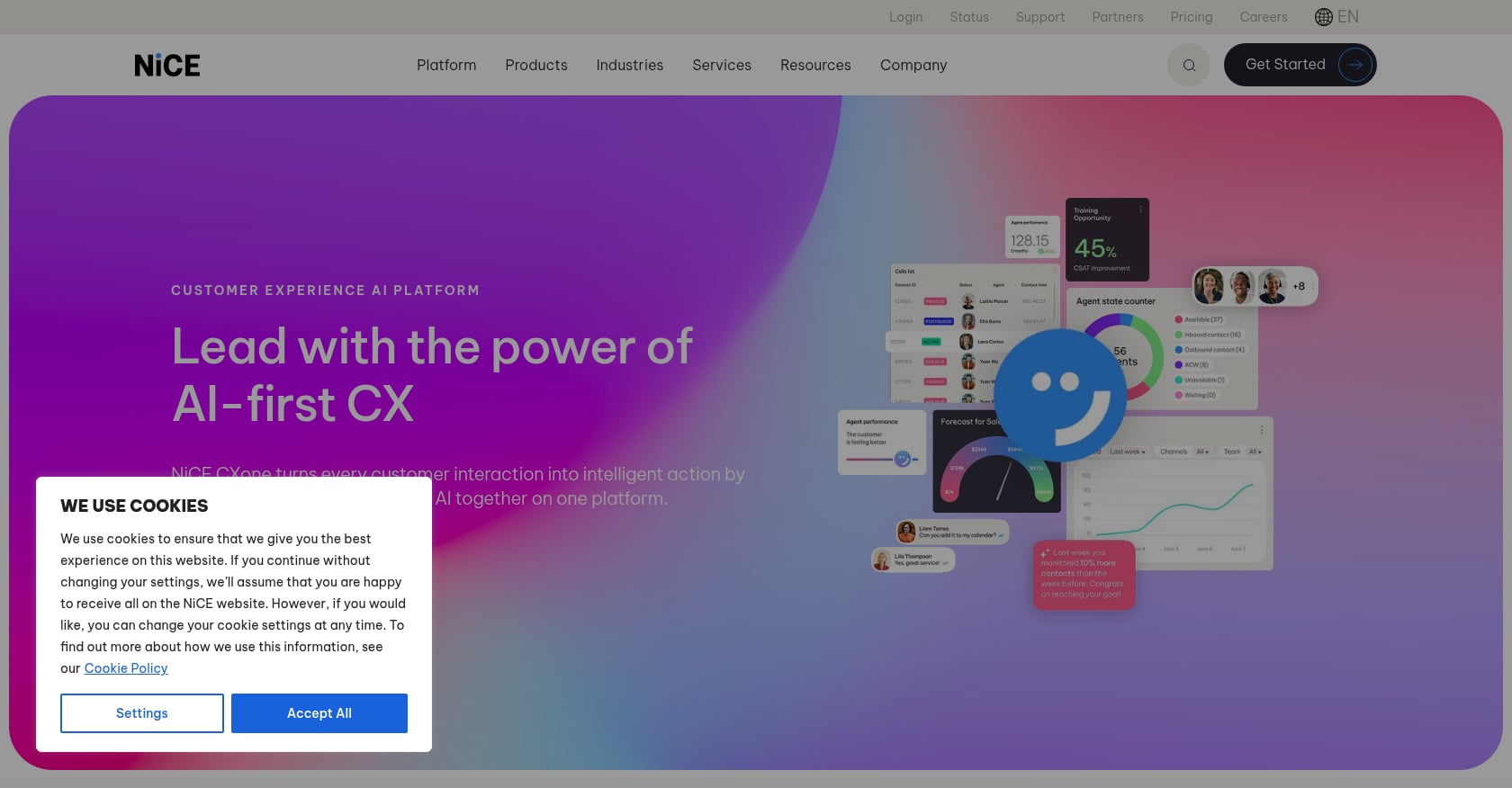
Best for: Large regulated enterprises needing deep analytics, workforce management, and AI-powered voice agents in one platform.
NICE’s acquisition of Cognigy in 2025 reshaped this category. NICE already owned routing, workforce tools, analytics, and desktop automation. Cognigy brought an LLM-agnostic conversational AI platform. The combined offering means one vendor now manages the entire query lifecycle, from conversational AI IVR to resolution.
Pricing:
- NICE CXone Mpower plans start at $71/user/month for digital channels
- Voice suites start at ~$94/user/month
- Full enterprise deployments often reach $100,000–$500,000+/year
Key features:
- AI-powered chatbots with conversational and generative AI
- IVR tools with Cognigy’s native Voice AI Agents for natural, human-like conversations
- Web and mobile engagement
- Workflow optimization and workforce management
- Named a Gartner Magic Quadrant Leader for CCaaS for 11 consecutive years
Limitations:
- Conversational flexibility was limited pre-Cognigy; changes to call logic required careful planning and coordination
- Building or iterating on conversational logic is still slower and more constrained than voice-first platforms
- The NICE-Cognigy acquisition creates uncertainty for organizations using Cognigy with competing CCaaS providers like Genesys
Verdict: Strong for large enterprises already in the NICE ecosystem, especially those in regulated industries. The Cognigy integration adds genuine conversational AI capabilities, but the platform remains heavier than purpose-built alternatives for teams primarily focused on conversational AI IVR.
4. Five9

Best for: High-volume outbound sales teams needing compliance depth and predictive dialing.
Five9 has long been a contact center staple, particularly for outbound operations. Its IVR with speech recognition is available as an add-on, but the platform’s strength lies in ACD, predictive dialing, and compliance tooling rather than cutting-edge conversational AI.
Pricing:
- $119–$159/user/month
- IVR with speech recognition is an add-on to base plans
Key features:
- Automatic call distribution (ACD) and predictive dialing
- IVR with AI-powered self-service
- Omnichannel routing
- Compliance tools for regulated outbound campaigns
User sentiment: G2 rating of approximately 4.2/5, with users highlighting reliability and ease of use for agents.
Limitations:
- IVR latency is noticeably slower than conversational AI platforms, with roughly 1.5–2 seconds between caller input and system response
- Lags behind voice-first platforms in handling open-ended conversations and interruptions
- Automation feels more rule-based and less conversational compared to AI-native tools
- Speech recognition IVR requires additional licensing
Verdict: Five9 is a solid contact center platform, but its conversational AI IVR capabilities trail purpose-built alternatives. Choose it for outbound sales compliance and predictive dialing. Layer a dedicated voice AI platform on top if you need true conversational IVR.
5. Retell AI
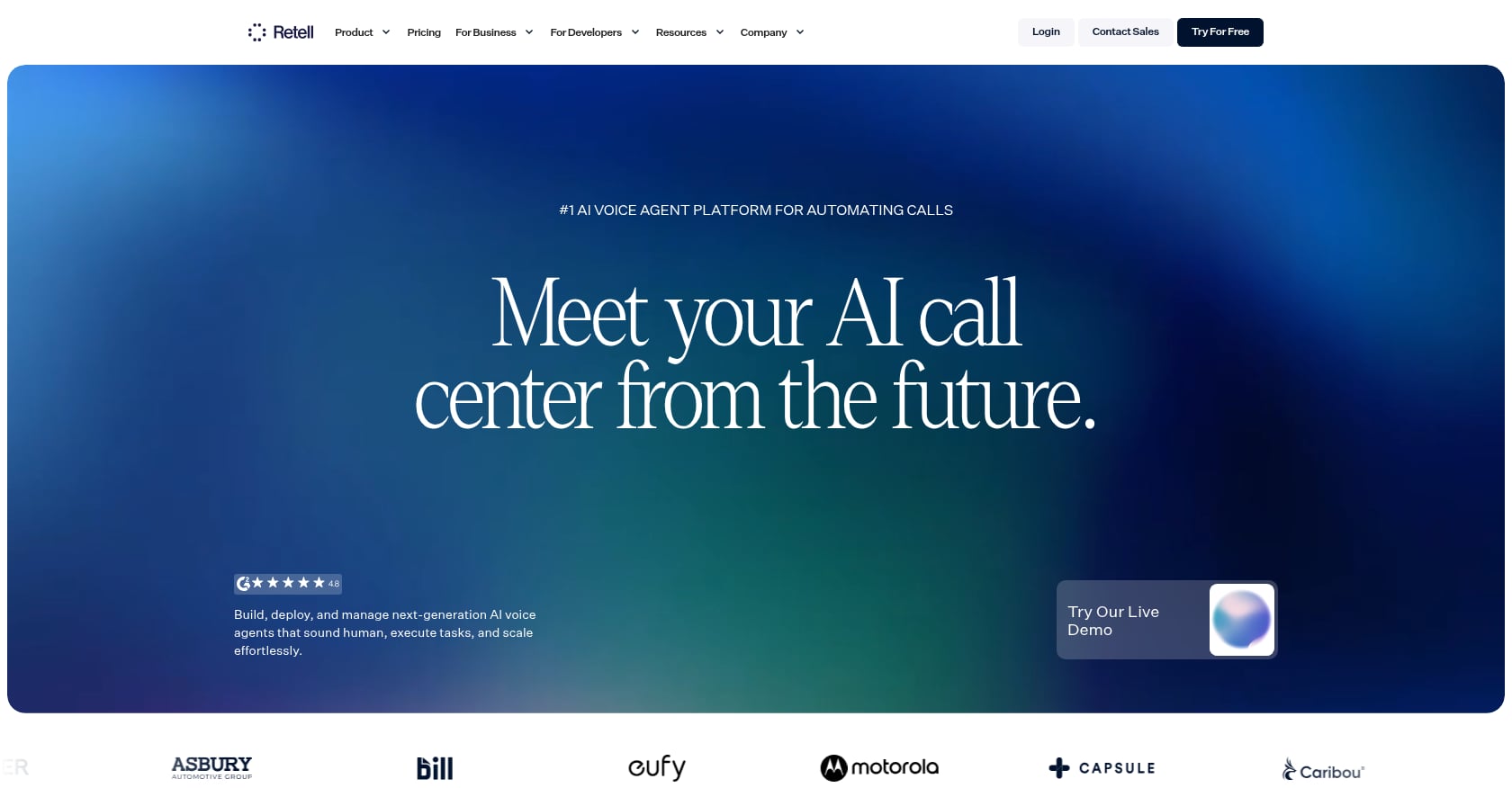
Best for: Developer teams building AI-native IVR replacements with the lowest possible latency.
Retell AI positions itself as infrastructure for building voice AI agents from scratch. It’s aimed at engineering teams that want granular control over conversation design, telephony, and AI model selection.
Pricing:
- Pay-as-you-go at $0.07/min with no platform fees, seat minimums, or contracts
- ~600ms end-to-end latency
Key features:
- AI IVR navigation that automates phone menus and routing
- SIP trunking to keep existing phone numbers
- Batch calling for outbound campaigns
- Branded caller ID and verified phone numbers
- SOC 2, HIPAA, and GDPR compliant
User sentiment: In independent testing, Retell AI scored highest on call quality, latency, and telephony control. It feels closer to an AI-powered call center backbone than a generic chatbot with voice bolted on.
Limitations:
- Does not replace broad CX suites for managing marketing journeys, social care, or cross-channel reporting
- More developer-oriented than no-code platforms; requires engineering resources for complex deployments
- Higher per-minute cost than SigmaMind AI ($0.07 vs. $0.03 platform fee)
Verdict: The best option for technical teams that want maximum control over their conversational AI IVR stack. If you have developers and want low latency above all else, Retell delivers. If you need no-code flexibility or broader contact center integrations, look elsewhere.
6. Nextiva
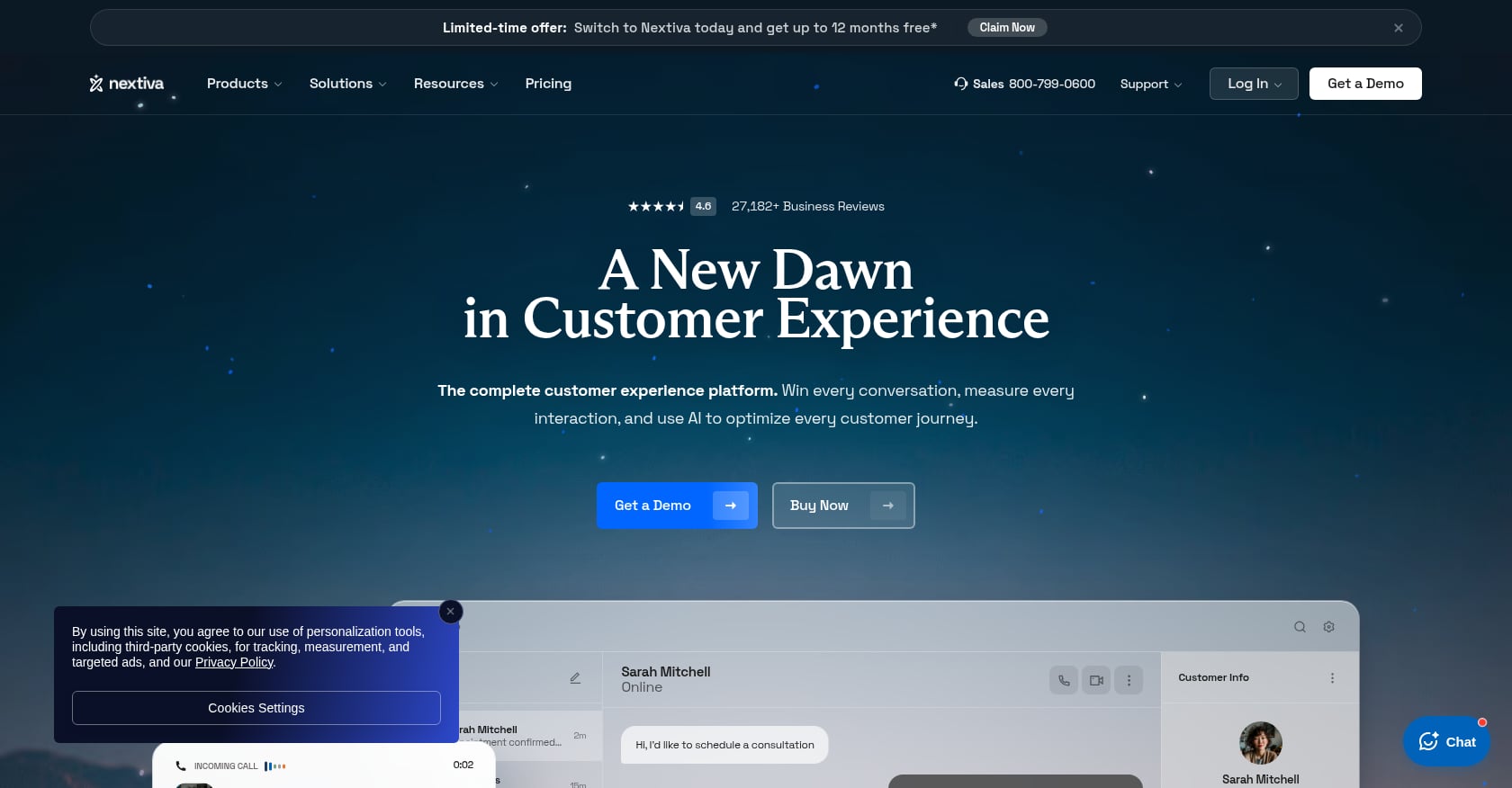
Best for: Mid-market teams wanting unified communications plus contact center with conversational AI IVR in one package.
Nextiva bundles UCaaS and CCaaS together, which appeals to mid-market companies that don’t want separate vendors for phone systems and contact center operations. Its conversational AI IVR uses NLP powered by Google Dialogflow and IBM Watson.
Pricing:
- Essential plan starts at $75/agent/month for an intelligent contact center with omnichannel and advanced AI
Key features:
- Natural language processing so callers can speak freely instead of navigating menus
- Unified communications plus contact center in one platform
- Recognized as a Strong Performer in the 2025 Gartner Peer Insights for CCaaS
Limitations:
- Conversational AI features depend on third-party NLU engines (Dialogflow, Watson), making it less model-agnostic than newer platforms
- Less customization depth for voice AI compared to platforms built specifically for conversational AI IVR
- Primarily positioned as a UCaaS play; contact center AI is a secondary capability
Verdict: Good for mid-market companies that want one vendor for phones and contact center, with conversational AI IVR as a bonus. Not the right choice if voice AI is your primary investment area.
7. Google CCAI

Best for: Companies with deep Google Cloud investment and internal development teams.
Google Contact Center AI excels at customer-facing AI (virtual agents, IVR) and real-time agent assistance. Dialogflow CX provides advanced conversation design, and it integrates with most major CCaaS platforms. But it’s fundamentally a set of building blocks, not a turnkey solution.
Pricing:
- Custom, consumption-based pricing
- Requires an existing Google Cloud relationship
Key features:
- Dialogflow CX for advanced conversation design
- Real-time agent assist
- Integration with most CCaaS platforms
- Google’s speech recognition and NLU models
Limitations:
- Requires significant technical resources to configure and calibrate
- Quality and coaching capabilities need more setup work than purpose-built platforms
- Not a standalone contact center solution; must be paired with a CCaaS provider
- Pricing is opaque and tied to Google Cloud consumption
Verdict: Powerful raw technology, but it’s a toolkit, not a product. Best for organizations with engineering teams and an existing Google Cloud commitment. Most call centers will find purpose-built conversational AI IVR platforms faster to deploy and easier to manage.
8. Telnyx
Best for: Infrastructure-first teams wanting carrier-owned voice infrastructure and AI under one roof.
Telnyx is a CPaaS provider that owns its entire voice stack, from SIP to AI to global network infrastructure. This gives it a latency advantage since traffic doesn’t hop between multiple vendors. Its AI Assistant Builder provides visual conversational flow design.
Pricing:
- Usage-based, pay-as-you-go
- In-house STT engine at lower rates than hyperscaler alternatives
Key features:
- AI Assistant Builder for visual conversational flow design
- End-to-end voice stack ownership (SIP, AI, global network)
- Lower latency due to private network infrastructure
- Cost advantage on speech-to-text through in-house engines
Limitations:
- More of an infrastructure/CPaaS play than a turnkey agent builder
- Requires more technical setup than no-code platforms
- Less focused on contact center workflows compared to dedicated conversational AI IVR platforms
Verdict: A strong choice for technical teams that want to control the entire voice infrastructure stack. Less suitable for call center leaders looking for a deploy-in-days conversational AI IVR solution.
Per-Seat vs. Per-Minute: Which Pricing Model Wins?
This is where most buyers make expensive mistakes. The right pricing model depends entirely on your call volume patterns.
Scenario: 50-agent contact center handling 100,000 calls per month, averaging 4 minutes per call (400,000 minutes/month)
| Platform | Model | Monthly Cost Estimate |
|---|---|---|
| SigmaMind AI | $0.03/min platform + providers | ~$12,000 platform + provider costs |
| Retell AI | $0.07/min | ~$28,000 |
| Genesys CX 2 | $115/seat/mo + telecom | ~$5,750 licensing + telecom |
| Genesys CX 4 | $240/seat/mo + telecom | ~$12,000 licensing + telecom |
| Five9 | $119/seat/mo + IVR add-on | ~$5,950 licensing + add-ons |
| NICE CXone | ~$94/seat/mo | ~$4,700 licensing + add-ons |
At first glance, per-seat looks cheaper for high-volume centers. But these numbers hide critical variables:
Per-seat hidden costs: Telecom charges, AI feature tokens, CRM integration add-ons, and overage fees. Genesys telecom alone can add $60,000–$100,000/year for a 100-agent center. NICE enterprise deployments routinely reach $100,000–$500,000+ annually.
Per-minute advantages show up in three scenarios:
- Variable call volume: If your calls spike seasonally, per-minute platforms don’t charge for idle seats
- Partial AI deployment: If you’re automating only specific call types (refunds, scheduling, FAQs) while keeping humans for complex queries, per-minute pricing means you pay only for what AI handles
- BPOs with thin margins: Per-seat licensing at enterprise CCaaS rates is often untenable for BPOs
The SigmaMind AI pricing page breaks down each cost layer (platform, STT, TTS, LLM, telephony) independently, so you can model your actual spend before committing.
How to Migrate from Legacy IVR to Conversational AI
Ripping out your IVR overnight is almost never the right move. Here’s a phased approach based on what practitioners actually recommend.
Phase 1: Identify high-volume, low-complexity call types. Start with the calls your agents hate handling: order status checks, appointment confirmations, balance inquiries, FAQ-style queries. These have predictable intents and clear resolution paths. Organizations using AI-enabled customer service have seen a 14% increase in issues resolved per hour and a 9% reduction in handling time on exactly these call types.
Phase 2: Deploy conversational AI IVR as the first touchpoint. Route incoming calls through the AI agent before they hit your traditional IVR or hold queue. The AI handles what it can and transfers the rest, with context, to human agents. Companies using this approach have seen AI help reduce escalations by 35% and increase first-contact resolution rates by 10–15%.
Phase 3: Expand and optimize. Use call analytics and per-layer cost breakdowns to identify which call types the AI handles well, which need prompt refinement, and which should always go to humans. Gradually expand the AI’s scope as containment rates improve.
Phase 4: Consolidate or replace. Once conversational AI handles the majority of your call volume, evaluate whether your CCaaS platform is still earning its licensing fees. Many centers find they can downgrade their CCaaS tier or move to a lighter stack.
For teams planning a broader contact center automation initiative, the migration playbook extends beyond IVR into workforce optimization, quality monitoring, and omnichannel orchestration.
FAQ
Can conversational AI IVR work with my existing CCaaS platform?
Yes. Most modern conversational AI IVR platforms are designed to layer on top of existing infrastructure. SigmaMind AI integrates with VICIdial, Five9, NICE, Genesys, and other CCaaS/dialer platforms via SIP. Google CCAI and Cognigy also support multi-CCaaS integration. You don’t need to replace your current system to add conversational AI.
What latency is acceptable for conversational AI IVR?
Anything under 1 second feels natural to callers. Between 1 and 1.5 seconds is noticeable but tolerable. Above 1.5 seconds creates awkward pauses that make callers think the system is broken. The best platforms today target sub-800ms (SigmaMind AI) to ~600ms (Retell AI). Five9’s traditional IVR reportedly runs at 1.5–2 seconds, which sits at the edge of acceptable.
How long does deployment take?
It varies dramatically. No-code platforms like SigmaMind AI can have basic voice agents live in days. Enterprise CCaaS deployments (Genesys, NICE) typically take 3–6 months for full implementation. A phased approach, starting with high-volume, low-complexity call types, lets you get value quickly while building toward full deployment.
Do I need developers to set up conversational AI IVR?
Not necessarily. Platforms like SigmaMind AI and Nextiva offer no-code builders that let operations teams design conversational flows without engineering. Retell AI, Google CCAI, and Telnyx are more developer-oriented. The tradeoff is usually flexibility vs. simplicity: no-code platforms are faster to launch, while developer-first platforms offer more customization.
What happened with the NICE-Cognigy acquisition, and should it affect my decision?
NICE acquired Cognigy in 2025 to fold its LLM-agnostic conversational AI platform into CXone. This gives NICE end-to-end control from conversational AI through routing, workforce management, and analytics. The concern is that Cognigy was previously CCaaS-agnostic and resold through competitors like Genesys. If you’re on a competing CCaaS platform, Cognigy’s future availability outside the NICE ecosystem is uncertain.
What’s the difference between conversational AI IVR and a regular AI chatbot with voice?
Conversational AI IVR is purpose-built for telephony: it handles real-time speech recognition, manages interruptions (barge-in), integrates with contact center routing and agent desktops, supports warm transfers with context, and operates within the latency constraints of live phone calls. A chatbot with voice added is typically designed for web or app interactions and lacks the telephony infrastructure, call routing, and contact center integrations that IVR replacement demands.
How much can conversational AI IVR actually save?
Industry research shows businesses using AI IVR bots reduce operational costs by 20–40%, increase first-call resolution by up to 25–30%, and improve customer satisfaction significantly. At $1.84 per AI-handled contact versus $13.50 for human agents, the savings compound quickly at scale. The conversational AI market is projected to grow from $17.97 billion in 2026 to $82.46 billion by 2034, reflecting how aggressively organizations are investing in these savings.
Should I go per-minute or per-seat for pricing?
Per-minute pricing (SigmaMind AI, Retell AI, Telnyx) favors variable workloads, partial AI deployments, and organizations with tight margins. Per-seat pricing (Genesys, NICE, Five9, Nextiva) favors high-volume centers with predictable call patterns where the per-seat cost is spread across heavy usage. Most BPOs and mid-market centers find per-minute more forgiving, while large enterprises with stable volume may benefit from per-seat economics at scale, provided they account for hidden costs.

