
Why is Voice AI Such a Big Topic Right Now in the Call Center Industry?
Why voice AI dominates call center conversations: mature speech tech, rising labor costs, and Gartner's $80B savings forecast by 2026.
IN this article

Evolve with Sigma Mind AI
Build, launch & scale AI agents
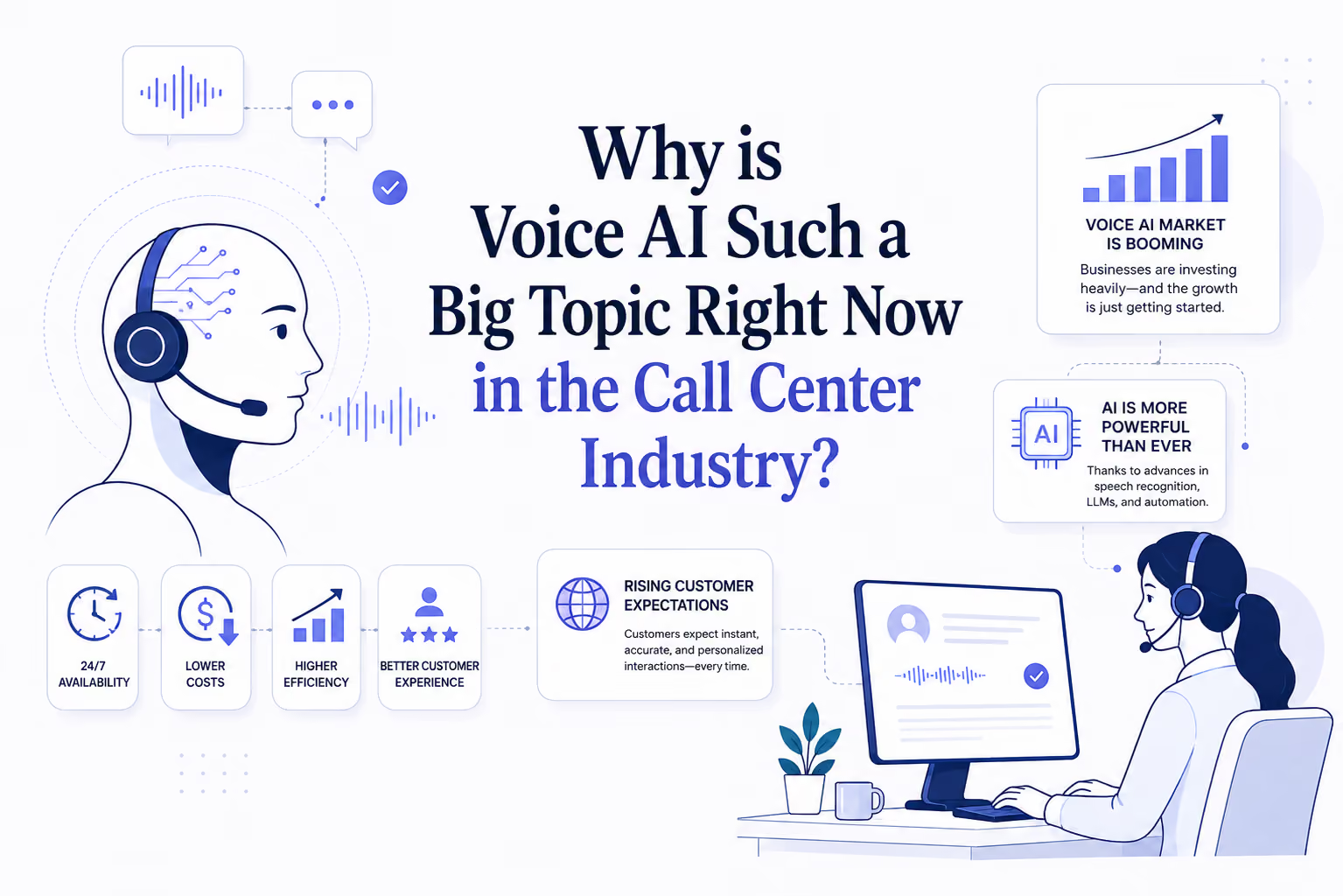
Voice AI is such a big topic in the call center industry right now because three things are converging at once: the underlying technology finally works well enough for real conversations, labor cost pressure on call centers has become unavoidable, and investment capital is flowing into the category fast enough that every call center is at least being forced to evaluate it. None of those three would have created this much momentum on its own.
See Why Call Centers Are Moving on Voice AI Now
Watch SigmaMind AI handle a real call and see what the current generation of voice AI technology actually sounds like.
What changed technically to make voice AI viable now, instead of five years ago?
What changed is latency and naturalness, not the core concept. Older voice AI systems ran on rigid IVR trees or brittle intent-matching that broke the moment a caller phrased something unexpectedly. Current systems run on a pipeline of real-time speech-to-text, large language models for reasoning, and natural-sounding text-to-speech, fast enough that the back-and-forth feels close to a real conversation instead of a request-and-wait exchange.
That latency drop matters more than it sounds. A voice agent that takes two seconds to respond feels broken. One that responds in a few hundred milliseconds feels normal. Getting from the first number to the second is most of what separates the voice AI generation that's driving this current wave from the one that gave the category a bad reputation five years ago.
How much is labor cost pressure actually driving this?
Labor cost pressure is driving this more than any single technology improvement. Labor represents up to 95% of total contact center costs, which means even a modest reduction in agent time per interaction produces an outsized effect on the bottom line. Gartner projects that conversational AI deployments within contact centers will cut agent labor costs by $80 billion by the end of 2026, even while automating only around one in ten agent interactions.
That's the part that gets missed in casual conversation about this topic: the savings estimate isn't built on replacing most of the call center. It's built on a relatively small share of automated interactions producing a large dollar impact, because labor is such a dominant line item to begin with. Two things drive that outsized impact even at modest automation rates:
- Every fully automated call removes not just the call time but the wrap-up, disposition, and quality review time that follows it.
- Automation concentrates on the highest-volume call types first, which means the interactions being removed are disproportionately the ones that were consuming the most aggregate agent hours.
The full cost breakdown of an AI call center walks through where that math actually lands once telephony and compute are counted alongside the labor savings.
How much money is actually flowing into this category right now?
A lot, and it's accelerating rather than leveling off. Voice AI startups raised roughly $2 billion in equity funding in 2024 alone, more than six times what the category raised just two years earlier, and funding has continued at a similar pace through 2025 and into 2026. That capital is funding real product improvement, not just marketing spend:
- Faster, cheaper speech-to-text and text-to-speech models, driving the latency gains call centers actually notice.
- More specialized platforms built for specific verticals, insurance, collections, healthcare, rather than generic assistants.
- Aggressive pricing competition, since well-funded startups can undercut on cost while still improving the product.
None of that funding guarantees any specific vendor survives long term, but it does explain why the category is moving fast enough that a call center evaluating options this year will see a meaningfully different set of platforms than one that looked eighteen months ago.
Is this genuine demand, or just hype cycle noise?
It's genuine demand, evidenced by actual deployment rather than just interest. The distinguishing signal isn't how much attention voice AI is getting. It's how many call centers have moved past evaluation into running real call volume through it, and that number has grown steadily rather than spiking and cooling the way a pure hype cycle usually does. The comparison of the top AI voice service platforms for business calls reflects that shift too, since the category now has enough production deployments to compare on real performance instead of demo quality alone.
Support use cases tend to get most of the attention in this conversation, but sales and lead qualification are actually a cleaner test of genuine versus hype-driven demand, since that work generates revenue rather than just cutting cost. Teams don't keep paying for a tool that doesn't move a number they're already tracking closely, and lead qualification is one of the more directly measurable use cases in the category. The playbook for using voice AI for lead generation reflects the kind of measurable use case that's kept demand growing past the initial hype window rather than fading with it.
What does this mean for a call center evaluating voice AI right now?
It means the timing question matters less than the readiness question. The technology has crossed the threshold where it works reliably for well-scoped use cases, so waiting another year for it to "mature more" isn't really the constraint anymore. The real constraint is whether a given call center has a clear enough picture of its own call types, compliance requirements, and existing infrastructure to deploy it well.
Start with the highest-volume, most repetitive call type, not the hardest one, and treat the current market activity as a reason to move deliberately, not a reason to rush. A crowded, fast-moving vendor category rewards careful evaluation more than a quiet one does, since the gap between a strong platform and a weak one is wider right now than it will be once the category consolidates.
Bottom line: Voice AI is a big topic in call centers right now because the technology, the economics, and the investment all matured at the same time, not because of hype alone. That convergence is real, but it doesn't mean every platform in the category is equally ready for production call volume.
Ready to see what current-generation voice AI actually sounds like? Talk to the team or start building for free to test it on your own calls.
Evolve with Sigma Mind AI
Build, launch & scale AI agents
Related Blogs
Ready to transform your call center?

More Conversations.
Less Manual Work.

Building from San Francisco, CA