
8 Best AI Voice Service Platforms For Business (2026)
See how each AI Voice Service stacks up for 2026 business calls—pricing, latency, workflows, and best fits. Compare our top 8 picks and start faster.
IN this article

Evolve with Sigma Mind AI
Build, launch & scale AI agents
TL;DR
AI voice services have moved past novelty demos and into real business operations. Production-ready platforms in 2026 can answer calls, understand intent, take actions in your systems, and transfer to humans with full context. This guide compares eight services across pricing, production readiness, workflow capability, and best-fit use cases so you can choose the right one without booking eight demos. SigmaMind AI is one strong option for teams that need no-code building and developer-grade workflow control, with a $0.04/min platform fee plus provider costs.
Quick Comparison: Best AI Voice Services
What Is an AI Voice Service?
An AI voice service is software that receives or places phone calls, understands natural speech, decides what to do next, responds in natural language, and triggers actions in business systems. That last part matters most. If the agent can only talk but cannot book appointments, process refunds, check order status, or update your CRM, it is a talking demo, not a business tool.
The technology stack behind every AI voice service includes several layers. telephony (SIP, phone numbers), speech-to-text transcription, a language model or dialogue engine for reasoning, a workflow or state machine for controlling conversation steps, tool calling for integrations, text-to-speech for voice output, and analytics for monitoring quality and cost.
This is different from traditional IVR. Nextiva's guide to AI voice agents explains that these agents can interpret intent and ask follow-up questions instead of routing callers through rigid button-press menus.
The category is growing fast. G2’s 2026 research based on 770 verified reviews found that companies using advanced customer-service workflows reported median cost-per-unit savings of 40% and a median containment rate of 80%. Gartner predicts that agentic AI will autonomously resolve 80% of common customer-service issues by 2029.
But the numbers do not mean you can replace your team tomorrow. Deloitte’s 2026 survey of 3,235 business and IT leaders found that only 25% had moved at least 40% of their AI pilots into production. Around 80% of respondents said their organizations still lacked mature governance for AI agents. ITPro reports that half of agentic AI projects remain at the proof-of-concept stage. Respondents cited security, privacy, compliance, and technical scale as barriers.
AI voice services are most practical when you assign them bounded, high-confidence workflows. Choose a platform based on the actions it must complete, the technical resources available to you, and the full deployment cost.
How We Chose the Best AI Voice Services
We evaluated every platform on this list against nine production criteria.
- Workflow automation. Can the agent actually do things? Book appointments, process refunds, query databases, update CRM records, send confirmations?
- End-to-end latency. Not just component latency, but the full loop from when the caller stops speaking to when they hear a response.
- Telephony flexibility. Native numbers, SIP trunking, Twilio/Telnyx integration, bring-your-own-carrier options.
- Model and provider flexibility. Can you choose your STT, TTS, and LLM providers? Can you swap them without rebuilding the agent?
- Pricing transparency. Is the total cost clear, or is the headline rate just one piece of a complex stack?
- Human handoff quality. Does the platform pass structured context and summaries to human agents during transfers?
- Analytics and observability. Transcripts, recordings, cost breakdowns, node-level logs, escalation tracking.
- Security and compliance. SOC 2, encryption, SSO, audit trails, HIPAA readiness, data residency options.
- Operating model fit. Developer-first, no-code, managed enterprise, CCaaS-native, or self-hosted.
The criteria overlap with those in Vellum’s AI voice-agent platform guide, including latency, pricing transparency, deployment, integrations, compliance, and observability. We also considered the cited reviews from G2 and Gartner Peer Insights. Reddit comments informed qualitative observations only where the article describes them as anecdotal.
The 8 Best AI Voice Services
1. SigmaMind AI
Best for: Production teams and agencies that need both no-code workflow building and developer-level control.
Starting price: $0.04/min platform fee + provider costs for STT, TTS, LLMs, and telephony. Chat agents at $0.005 per AI message. Phone numbers at $2/month. Enterprise custom pricing available. Start building for free.
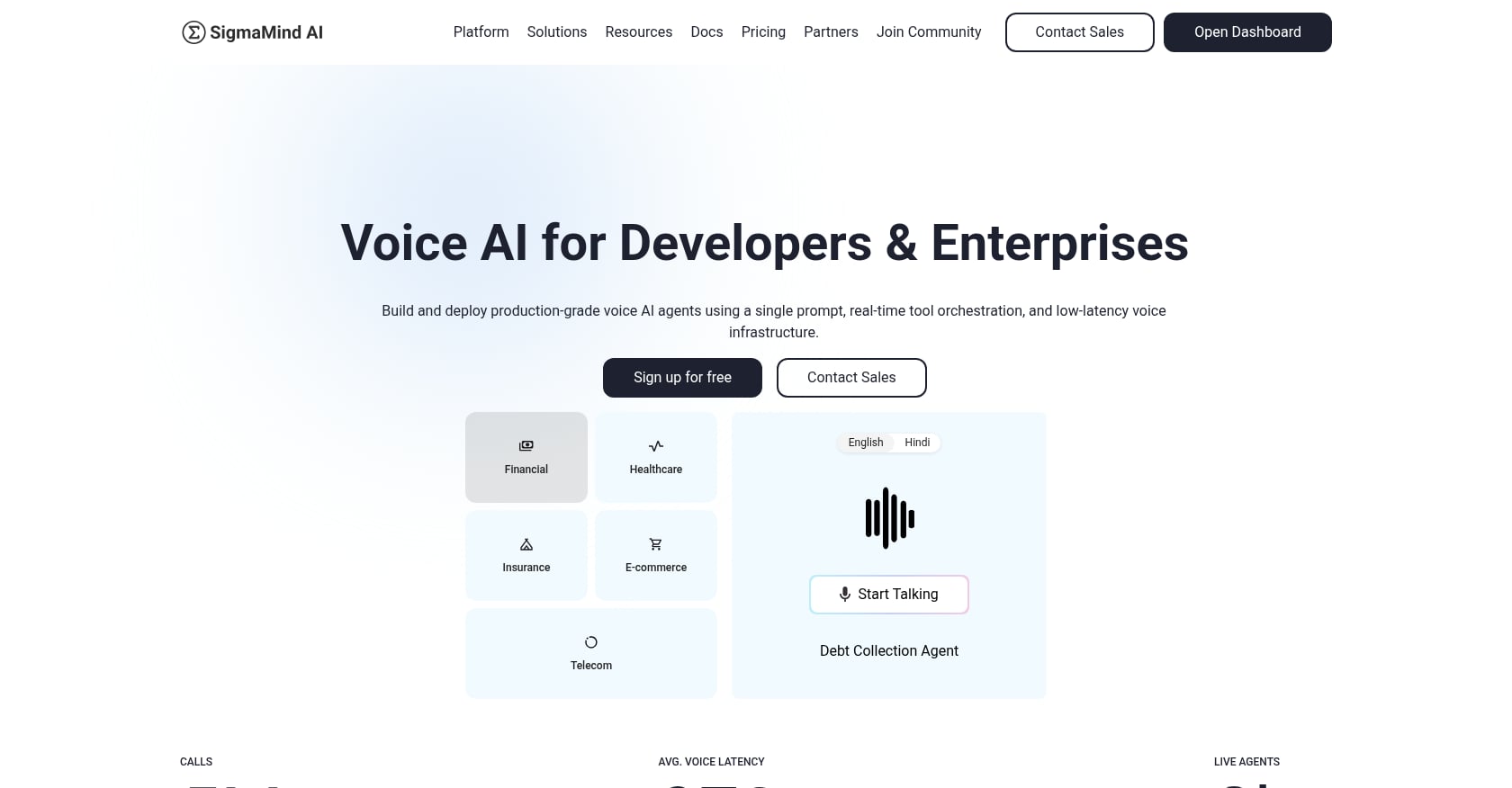
SigmaMind AI is a voice, chat, and email agent platform best suited to production teams and agencies that want visual workflow building alongside APIs, model choice, and telephony control.
SigmaMind AI combines a visual builder and multi-workspace management with APIs, model choice, and telephony controls. Developers can configure the underlying stack, while operations staff and agencies can build and monitor workflows without writing every component in code.
The platform is Y Combinator-backed and built around a no-code agent builder with branching, API/tool actions, variables, waits, and escalation logic. At the same time, it exposes a full API suite and an MCP server so engineering teams can trigger calls, create agents, fetch transcripts, and orchestrate actions from inside their existing development tools.
Key features:
- Model-agnostic stack: choose from Deepgram (STT), ElevenLabs, Rime AI, or Cartesia (TTS), and OpenAI, Claude, Gemini, or Hume AI (LLMs). Swap providers per agent based on cost, latency, or quality needs.
- Built-in telephony with US number purchase, plus BYOC via SIP, Twilio, and Telnyx.
- Warm transfer with AI-generated summaries and structured context via custom headers, so human agents can review the caller’s history before continuing the conversation. Learn more about escalating calls to humans without losing context.
- Tool calling and App Library for CRMs, helpdesks, e-commerce platforms, calendars, and spreadsheets. Agents can check orders, process refunds, book appointments, and update tickets mid-conversation.
- Omnichannel logic across voice, chat, and email from one orchestration layer.
- Analytics with cost breakdowns by layer, showing spend per call across platform, STT, TTS, LLM, and telephony.
- Outbound campaigns with CSV upload, scheduling, concurrency caps, and personalization variables.
- Multi-workspace management and full-agent import for agencies and BPOs.
Proof:
- SigmaMind AI reports more than 1 million calls handled, more than 1,500 live agents, and approximately 970 ms average voice latency. These figures should link to the company data or methodology used to calculate them.
- Case study: automated 4,000+ refunds per month with 43% cost savings and turnaround cut from 2-3 days to under 60 seconds. Read the refund automation case study.
- SigmaMind AI’s Gardencup case study reports an 80% reduction in refund-processing time, a 20% increase in CSAT, and a reduction in resolution time from 15 hours to 1 hour. Add an inline link to the Gardencup case study.
- At the time of review, Product Hunt displayed a 4.9 rating from 14 reviews and 283 followers for SigmaMind AI. Add an inline link to the Product Hunt listing and an access date because these figures can change.
Tradeoffs:
- Direct phone number purchase is currently US-only. International deployments require BYO carriers via SIP.
- Modular pricing is transparent but requires choosing STT, TTS, LLM, and telephony providers to estimate true cost. Use the SigmaMind pricing page to model your real costs.
- Performance depends partly on third-party AI providers, which may change pricing or quality.
- Not yet HIPAA compliant, though the platform supports HIPAA-friendly workflow configurations and offers SOC 2, encryption, SSO, and private cloud options.
Choose it if: You want a production-grade AI voice service with workflow orchestration, model flexibility, transparent costs, and the ability to ship across voice, chat, and email from one platform.
Skip it if: You need an entirely self-hosted, on-premise deployment in a highly regulated environment (consider Rasa instead).
2. Retell AI
Best for: Teams seeking a mature, general-purpose voice-agent platform with usage-based pricing.
Starting price: $0.07–$0.31/min for AI voice agents. $10 free credits. 20 concurrent calls included in the free allowance, according to Retell AI pricing.
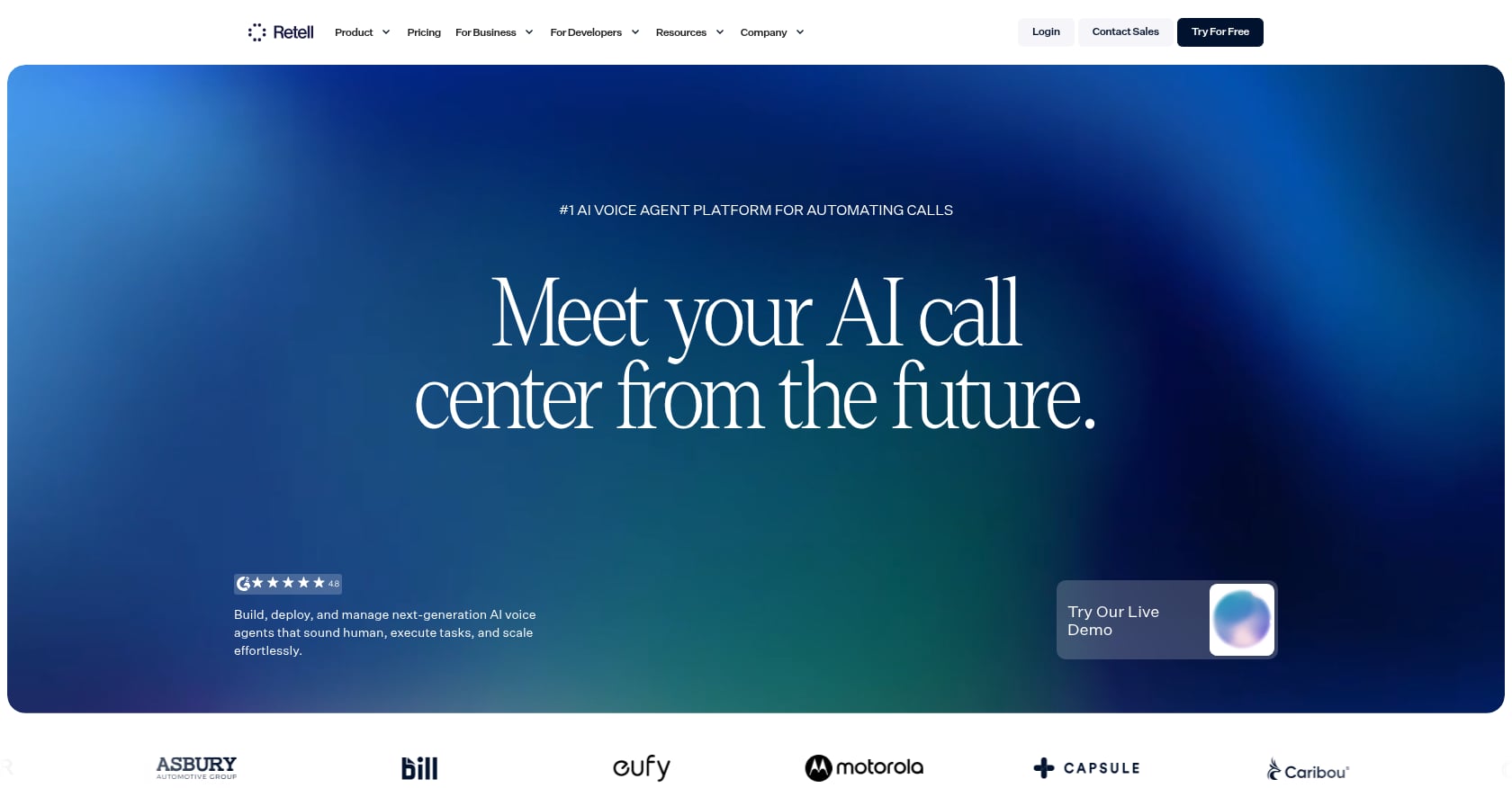
Retell AI is a usage-based voice-agent platform best for teams that want broad voice functionality, templates, APIs, and a mature self-serve experience.
Retell AI offers a self-serve interface with templates, APIs, and itemized usage pricing. The platform breaks costs into visible components: voice infrastructure at $0.055/min, platform voices at $0.015/min, ElevenLabs at $0.040/min, US Twilio at $0.015/min, with add-ons like knowledge base, advanced denoising, and PII removal priced separately source.
Key features:
- Call transfer, appointment booking, knowledge base, IVR navigation, batch calling.
- Branded caller ID and verified phone numbers.
- Post-call analysis, simulation testing, webhooks, API access.
- Templates for common use cases.
- Enterprise tier with dedicated infrastructure, SSO, and compliance features.
User sentiment:
Vellum’s evaluation of Retell AI reports a G2 rating of 4.8 out of 5 from 612 reviews. Practitioners on Reddit describe Retell as easier to control than black-box agents for appointment scheduling, noting that strong prompts and validation logic matter more than speech quality alone. Others mention that pricing can feel high once Twilio and usage minutes are added.
Tradeoffs:
- Pricing is componentized. Buyers need to model LLM, TTS, telephony, concurrency beyond 20, and add-ons to get the true per-minute cost.
- Complex CRM workflows and function calls may still require engineering effort.
- Concurrency beyond 20 calls costs $8 per concurrency per month.
Choose it if: You want a well-established AI voice agent platform and are comfortable calculating component costs.
Skip it if: You need deep multi-step workflow orchestration with tool calling and warm transfer built into a visual canvas.
3. Vapi
Best for: Developers and API-first engineering teams that want provider-level control over the voice stack.
Starting price: $0.05/min platform fee + separate costs for STT, LLM, TTS, and telephony. G2 estimates an average Vapi voice-agent conversation cost of about $0.15 per minute.
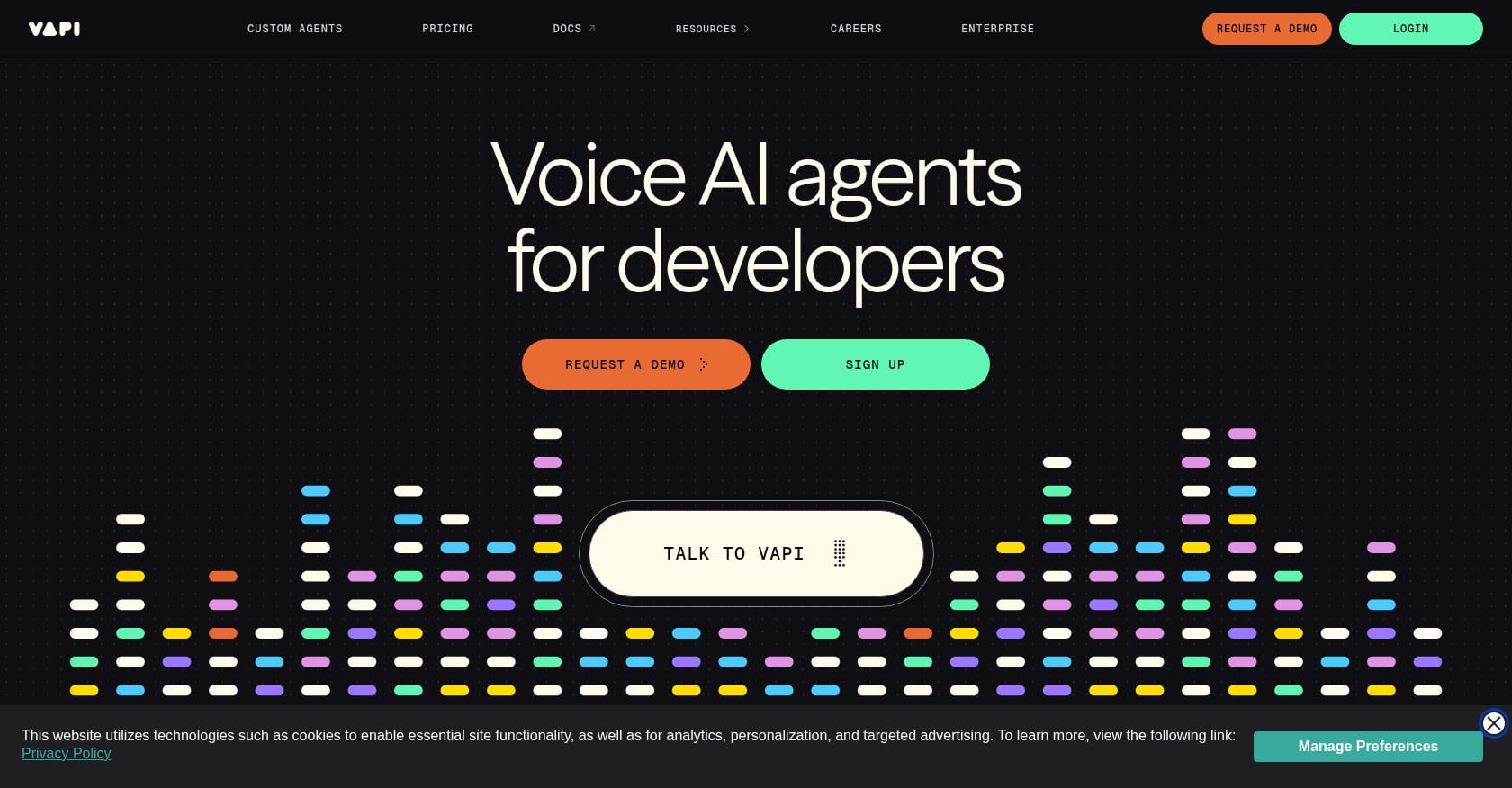
Vapi is an API-first voice orchestration platform best for developers who want to assemble and control their own STT, LLM, TTS, and telephony stack.
Vapi is an orchestration layer, not a turnkey product. You bring (or choose) your own STT, LLM, TTS, and telephony providers, and Vapi ties them together. A Vapi support response explains that the $0.05-per-minute rate covers only the platform fee. Transcription, model, voice, and telephony charges are separate.
Key features:
- Fine-grained API control across every stack layer.
- Provider flexibility for STT, LLM, TTS, and telephony.
- 10 concurrency lines on pay-as-you-go.
- SMS at $0.005/message.
User sentiment:
Reddit discussions about Vapi are frequent and revealing. One user calls the $0.05/min fee “hefty” once AI costs are added. Another reports that Vapi charges during silence, which can eat into budgets on calls with hold time or pauses. A practitioner building agency solutions says their all-in Vapi cost runs $0.10-$0.15/min and that agencies typically mark this up in client packages.
Tradeoffs:
- The headline pricing can mislead nontechnical buyers. You will not spend $0.05/min total.
- No built-in visual workflow builder. Teams need to manage observability, fallback logic, and integrations themselves.
- Confirm whether Vapi bills for silence and hold time when estimating production costs.
Choose it if: Your engineering team wants to assemble and manage every component of the voice infrastructure directly.
Skip it if: You want no-code agent building, built-in analytics, warm transfer with context summaries, or a platform that works for both developers and operations teams.
4. Bland AI

Best for: High-volume outbound teams that prioritize predictable, all-inclusive per-minute pricing.
Starting price: Start plan at $0.14/min (no monthly fee, 10 concurrent calls, 100 calls/day). Build plan at $0.12/min + $299/month. Scale plan at $0.11/min + $499/month, according to Bland AI pricing.
Bland AI is a voice-agent platform best for high-volume outbound teams that prefer bundled per-minute pricing over managing separate model, speech, and telephony providers.
Bland AI bundles LLM, STT, TTS, and telephony charges into its per-minute rate. Buyers can compare that bundled rate without separately estimating each provider cost, although plan fees and transfer charges still affect the total.
Key features:
- Flat per-minute pricing covering the full AI stack.
- Pathways, custom dialing, appointment scheduling, SMS node, warm transfers.
- Guardrails, live translate, and enterprise compliance features on higher tiers.
- Bring your own telephony via Twilio or SIP.
- Enterprise tier with on-prem/VPC deployment, unlimited concurrency, BAA, SSO.
User sentiment:
Practitioners on Reddit mention Bland alongside Retell and Vapi when comparing production platforms. One testing thread reports that Bland worked in test mode, but real customers interrupting or asking unexpected questions caused breakdowns. This is not unique to Bland, but it highlights why production testing matters.
Tradeoffs:
- Daily call caps (100/day on Start, 2,000/day on Build, 5,000/day on Scale).
- Monthly platform fees on Build and Scale plans.
- Transfer fees and concurrency limits still apply.
- Less model and provider flexibility compared to modular platforms.
Choose it if: Predictable, all-inclusive per-minute pricing matters more than provider-level control.
Skip it if: You need to fine-tune cost and quality by swapping individual STT, TTS, or LLM providers.
5. Synthflow
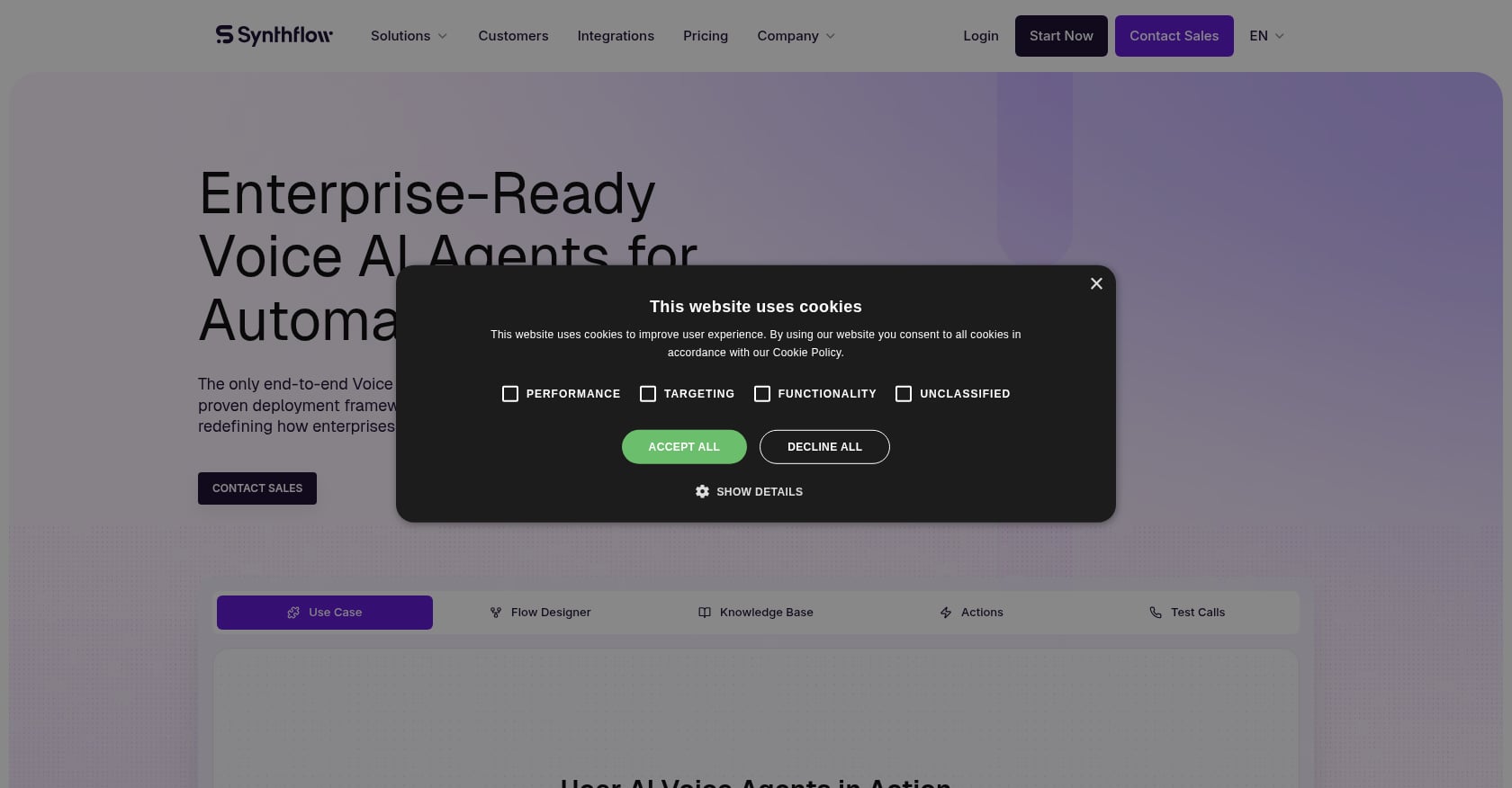
Best for: SMBs and agencies that need to launch and manage voice agents without code.
Starting price: Pay As You Go at $0/month base, effective rates of $0.15-$0.24/min depending on model and telephony. 5 concurrency units included, according to Synthflow’s pay-as-you-go documentation.
Synthflow is a no-code voice-agent platform best for SMBs, agencies, and nontechnical teams that need to launch quickly.
Synthflow is purpose-built for speed. Its no-code interface lets nontechnical users design and launch voice agents without writing code. The visual interface reduces the amount of custom development required for small businesses and agencies managing multiple clients.
PAYG billing breaks down as Synthflow Voice Engine at $0.09/min plus LLM costs varying by model (GPT-4.1 at $0.05/min, GPT-4.1-mini at $0.02/min) source.
Key features:
- No-code voice agent builder with flow design and knowledge bases.
- SOC2, GDPR, and ISO 27001 compliance on PAYG.
- Enterprise tier with 99.99% SLA, unlimited concurrency, SIP trunking.
- Academy and community resources for onboarding.
User sentiment:
G2 users praise Synthflow’s intuitive interface and how quickly they can set up AI voice agents without technical expertise source. A Reddit small-business user reports reducing their daily call burden from 30+ calls to 5-6 needing human attention, but notes pricing gets steep when many minutes are needed. Others caution that real-world interruptions and off-script questions can expose weaknesses in the flows.
Tradeoffs:
- Higher per-minute rates compared to developer-first platforms.
- Additional concurrency units cost $20/month each.
- White-label toolkit is a $2,000/month add-on.
- Log retention is only 1 month on PAYG.
- Limited developer control for complex stateful workflows.
Choose it if: You need an AI voice service running this week with zero coding.
Skip it if: You need deep tool calling, multi-step stateful workflows, or per-layer cost optimization.
6. PolyAI

Best for: Large enterprises seeking a managed, white-glove voice AI deployment for high-volume customer service.
Starting price: Custom enterprise pricing only. No self-serve tier.
PolyAI is a managed enterprise voice AI platform best for large organizations that want vendor-led implementation and ongoing support for high-volume customer service.
PolyAI takes a managed-service approach. The company builds and maintains voice agents on behalf of enterprise clients in banking, hospitality, healthcare, utilities, retail, and telecoms. PolyAI supports customer interactions in 45 languages and integrates with contact-center systems to complete configured actions.
Key features:
- Enterprise Agent Studio for voice, web/app chat.
- 45 language support.
- Deep contact-center integrations.
- Vendor-led implementation and ongoing management.
User sentiment:
Gartner rates PolyAI at 4.7 from 23 ratings. A hospitality enterprise review praises the “authentic, humanlike voice experience” and collaborative onboarding. A critical insurance review says that high costs and slow implementation made the deployment harder to justify, according to Gartner Peer Insights reviews of PolyAI. G2 shows 5.0/5 from 12 reviews, with users praising human-like voice and effective call automation, while noting occasional slowness source.
Tradeoffs:
- No public pricing. Expect enterprise contract minimums.
- Slower implementation and change cycles compared to self-serve platforms.
- Less suitable for teams that want rapid iteration or self-serve experimentation.
- Not designed for startups, SMBs, or agencies managing multiple clients.
Choose it if: You are a Fortune 500 company willing to invest in managed deployment and premium conversational quality.
Skip it if: You need transparent pricing, fast iteration, or the ability to build and modify agents yourself.
7. Cognigy
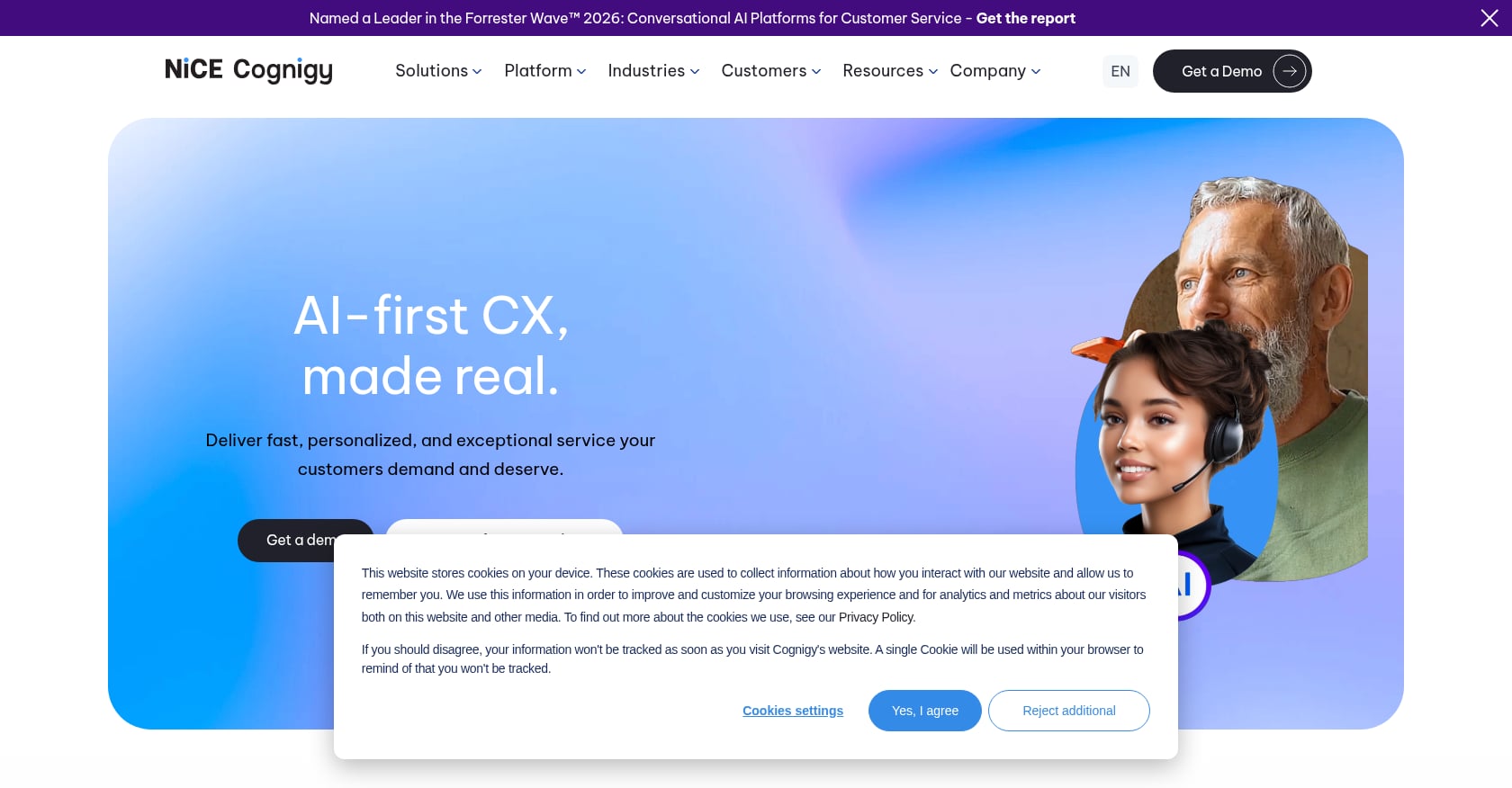
Best for: Large contact centers needing enterprise omnichannel automation across voice, chat, and existing systems.
Starting price: Subscription-based custom pricing by usage volume, interactions, and deployment requirements source.
Cognigy is an enterprise conversational AI platform best for large contact centers that need governed voice and chat automation across existing systems.
Cognigy is a full enterprise conversational AI platform, not just a voice agent tool. It supports 100+ languages, 25K+ concurrent interactions, 30+ omnichannel connectors, and integrates with contact-center platforms through its Voice Gateway, according to Cognigy AI product information.
Key features:
- Voice Gateway and CCaaS/contact-center connectors.
- LLM orchestration, Knowledge AI, NLU.
- Live Agent handoff, Agent Copilot.
- GDPR, SOC2, HIPAA compliance options.
- xApps for custom micro-applications within conversations.
User sentiment:
Gartner rates Cognigy at 4.8 from 139 ratings. A 2026 engineer review describes the platform as “solid and reliable for complex enterprise workflows and high interaction volumes” but notes that “implementation required proper planning and skilled resources” and that “some advanced features have a learning curve” source.
Tradeoffs:
- Its enterprise deployment model may add unnecessary cost and complexity if you only need an AI receptionist or outbound dialer.
- Requires planning, enterprise procurement, and skilled resources to deploy.
- Advanced features have a meaningful learning curve for nontechnical users.
- Pricing is opaque without engaging sales.
Choose it if: You run a large contact center and need omnichannel governance, multilingual coverage, and deep enterprise integrations.
Skip it if: You want a focused AI voice service deployed in days rather than months.
8. Rasa Voice
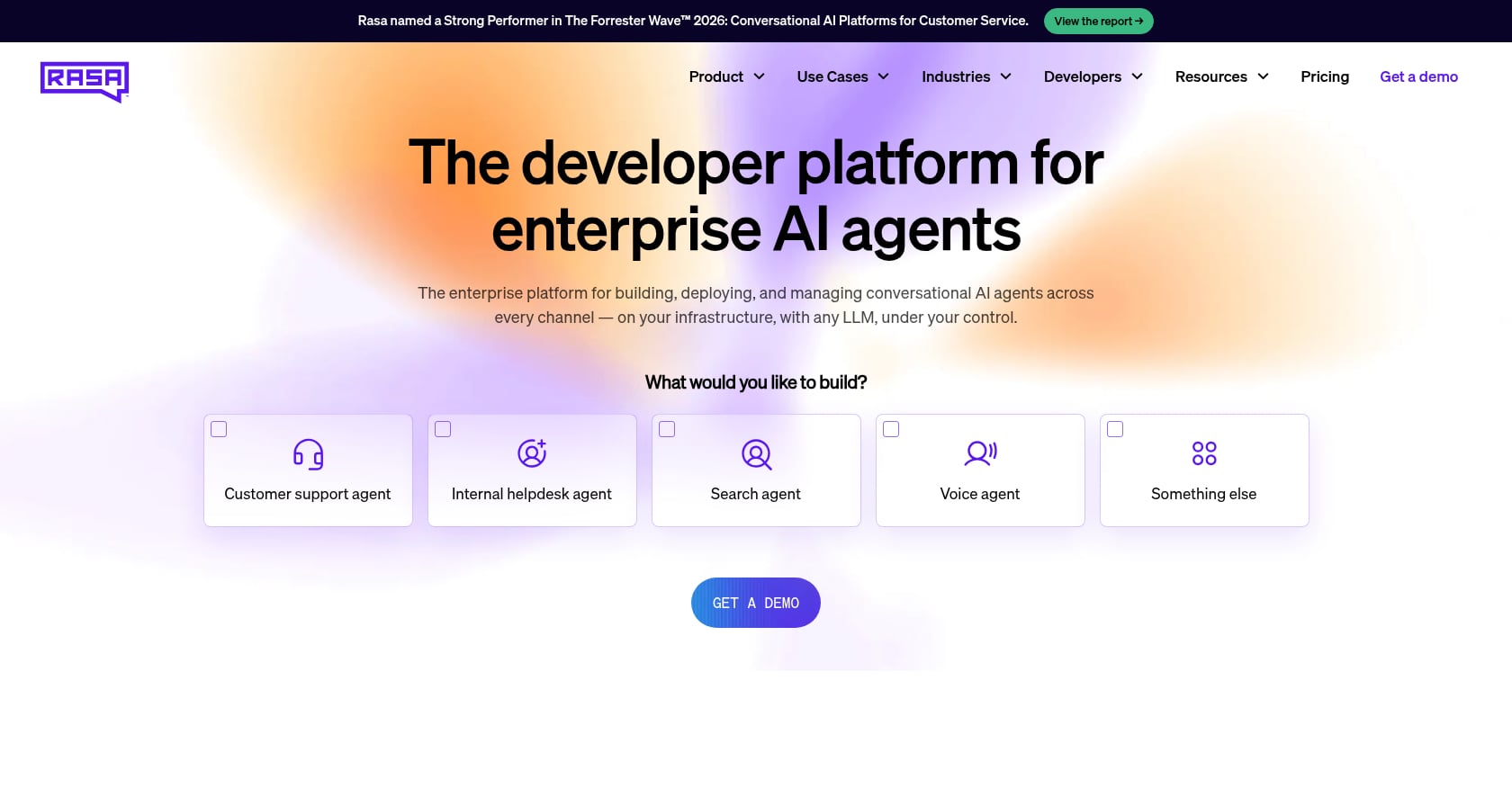
Best for: Regulated organizations requiring self-hosted deployment, data sovereignty, and engineering-level control.
Starting price: Free Developer Edition (1 bot per company, up to 1,000 external conversations/month). Enterprise plan with custom pricing source.
Rasa Voice is a self-hosted conversational AI offering best for regulated organizations that require data sovereignty and deep engineering control.
Rasa supports self-hosted deployment rather than requiring a vendor-managed environment. Voice data can run entirely in the customer’s environment. Rasa does not host customer data, systems, or applications in the self-hosted model source. Self-hosting gives healthcare providers, financial institutions, and government agencies direct control over where customer data is stored and processed.
Key features:
- Voice Stream and Voice Ready for ASR/TTS integration.
- Choice of speech providers, not locked into a single vendor.
- Self-hosted deployment with full data control.
- Cross-channel continuity between voice and other channels.
- Free Developer Edition for prototyping.
User sentiment:
G2 rates Rasa at 4.0/5 from 11 reviews. One reviewer praises Rasa as “an open book” with strong performance potential but says its complexity makes it better suited to machine-learning specialists. Gartner feedback notes open-source flexibility with enterprise-grade support and control over data source.
Tradeoffs:
- Requires engineering resources. Not the fastest path for nontechnical teams.
- Free tier is limited to 1,000 external conversations per month.
- Enterprise pricing requires sales engagement.
- The learning curve is steeper than any other platform on this list.
Choose it if: Data sovereignty, self-hosting, and engineering-level control are requirements, not preferences.
Skip it if: You need to launch a production AI voice service this month without a dedicated ML team.
How Much Does an AI Voice Service Cost?
Per-minute platform pricing represents only part of the total cost for many AI voice services. Your bill may also include speech, model, telephony, concurrency, transfer, and add-on charges.
Platform fee. The base charge for using the orchestration platform. Ranges from $0.04/min (SigmaMind AI) to $0.14/min (Bland AI, all-inclusive) to custom enterprise contracts.
Speech-to-text. Transcribing the caller’s speech. Typically $0.01-$0.06/min depending on provider and accuracy tier.
Large language model. The reasoning engine. Costs vary widely based on model choice (GPT-4.1 vs. a smaller model), token usage, and whether tool calls are involved.
Text-to-speech. Generating the agent’s spoken response. ElevenLabs and premium voices cost more than basic options.
Telephony. Carrying the actual phone call. Twilio, Telnyx, or native carrier charges. Usually $0.01-$0.02/min for US calls.
Concurrency. How many simultaneous calls you can run. Some platforms include a baseline (Retell includes 20), then charge per additional slot.
Transfer minutes. When the AI hands off to a human, does billing stop or continue? Does the transfer itself add cost?
Add-ons. Knowledge base queries, PII removal, denoising, SMS, white-labeling, and compliance features.
The published Vapi pricing cited above shows why buyers should distinguish platform fees from total costs. Add the selected LLM, TTS, transcription, and telephony rates, then verify whether the vendor bills for silence, hold time, transfers, and concurrent calls.
The formula that actually matters for business decisions looks like this:
True cost per resolved call = (platform minutes + STT + TTS + LLM + telephony + transfers + concurrency + add-ons + human review) ÷ number of successfully resolved calls
A low per-minute rate means nothing if it leads to long calls, failed transfers, repeated tool calls, or high human fallback rates. For a deeper breakdown of how to track cost per support call, it is worth modeling cost against outcomes, not just minutes.
Example: 10,000 Minutes Per Month
For a hypothetical 10,000 minutes/month on a modular platform like SigmaMind AI:
This illustrative estimate excludes potential transfer, concurrency, add-on, tax, and human-review costs. Replace each assumed rate with a current vendor quote before using the model for a purchasing decision.
How to Choose the Right AI Voice Service
Choose an AI voice service that fits how you plan to build, deploy, and manage it.
Need production workflows with model flexibility and no-code building? Start with SigmaMind AI. It combines developer control with operational speed, but buyers should compare its modular provider costs and deployment fit with the alternatives above.
Need raw API control and plan to build everything yourself? Consider Vapi.
Need flat, predictable per-minute pricing? Consider Bland AI.
Need no-code speed above all else? Consider Synthflow.
Need managed enterprise deployment with premium voice quality? Consider PolyAI.
Need omnichannel enterprise contact-center orchestration? Consider Cognigy.
Need self-hosted, sovereign deployment in a regulated environment? Consider Rasa Voice.
Choose by Operating Model
A production pilot should test more than voice quality. Measure how the agent handles interruptions and background noise, follows workflow logic, completes tool actions, and recovers when a step fails.
Start with one high-volume, repeatable workflow. After-hours call capture is often the easiest entry point, since it lets a voice agent catch calls a human team would otherwise miss overnight or during peak hours.
For teams considering AI voice agents for customer support or appointment scheduling, the first deployment should be narrow and measurable.
Production Pilot Checklist
Before committing to an AI voice service, test it with representative callers and production conditions rather than relying only on scripted demos.
- Run 100-300 real calls before judging performance.
- Test interruptions. Caller talks over the agent mid-sentence.
- Test silence. Caller goes quiet for 10 seconds.
- Test corrections. Caller changes their date, name, or intent after confirming.
- Test CRM/tool failure. What happens when a lookup times out or returns no results?
- Test transfer summary quality. Does the human agent receive useful context?
- Test concurrent load. Does latency increase at 20, 50, or 100 simultaneous calls?
- Test after-hours and peak-hour patterns.
- Track containment rate (calls resolved without human escalation).
- Track cost per resolved call, not just cost per minute.
- Review transcripts for hallucinated policy answers where the agent sounds confident but gives wrong information.
Rasa recommends running pilots long enough to capture volume patterns and testing a high-volume, repeatable call type rather than a generic sample.
If SigmaMind AI fits your operating model, start a free SigmaMind AI pilot and test it against a defined workflow before committing.
FAQs About AI Voice Services
How much does an AI voice service cost compared to hiring an agent?
Platform fees alone range from $0.04/min (SigmaMind AI) to $0.14/min (Bland AI, all-inclusive), but the real cost per minute after stacking STT, LLM, TTS, and telephony typically lands between $0.10 and $0.25/min for most production deployments. Compare that estimate with your own fully loaded labor cost, average call duration, containment rate, and human-review requirements. The true comparison is not per-minute rate but cost per resolved call, since a cheap rate on a long, failed call can cost more than a slightly pricier rate on a call that resolves fast.
Can an AI voice service fully replace a human call center team?
Not for most operations today. AI voice agents handle bounded, high-confidence workflows well, like appointment booking, order status, and lead qualification, but complex or emotionally sensitive calls still need a human. A practical model uses AI voice agents for repeatable calls and transfers complex or sensitive cases to human agents with the conversation context attached.
Which AI voice service is fastest to deploy without an engineering team?
No-code platforms like SigmaMind AI and Synthflow let non-technical teams build and launch a voice agent through a visual builder rather than code. API-first platforms like Vapi require engineering resources to assemble the STT, LLM, TTS, and telephony stack before a single call can run.
What happens when the AI needs to transfer a call to a human?
Platforms with contextual handoff can create a live summary and pass structured fields such as customer ID and intent. Some also provide the transcript before the human agent accepts the call. Weak handoffs make the human agent start the conversation over, which frustrates the caller more than a plain transfer would. SigmaMind AI handles this through warm transfer with custom headers, delivering both a natural-language summary and structured data to the receiving agent. Ask any vendor for a live demo of the handoff itself, not just a description of the feature.
How is voice AI latency measured, and what number is acceptable?
Latency should be measured end to end, from the moment the caller stops speaking to when the agent's response reaches their phone, not just one component like the language model's response time. Retell AI's analysis puts the perceptible-pause threshold above 800ms. Ask whether an advertised latency figure includes telephony, speech processing, model response time, and tool calls before comparing vendors.
Do AI voice services require a monthly contract?
Most usage-based platforms, including SigmaMind AI, Vapi, and Synthflow's pay-as-you-go tier, charge per minute with no monthly commitment. Bland AI's higher tiers and most enterprise platforms like PolyAI and Cognigy require monthly fees or annual contracts. Check whether concurrency, add-ons, or compliance features push a nominally usage-based platform into an effective monthly minimum.
Final Verdict
Choose an AI voice service based on whether it can complete your target workflow under production conditions. Measure recovery from interruptions and tool failures, handoff context, and cost per resolved call rather than judging only the demo voice.
For teams that want production voice agents with developer flexibility, no-code building, model choice, and transparent modular pricing, SigmaMind AI is a strong option to evaluate alongside the other platforms. Teams that want pure API control should look at Vapi, and teams that want flat pricing simplicity should look at Bland AI. Synthflow fits teams that need no-code speed above all else, PolyAI fits managed enterprise voice deployments, Cognigy fits omnichannel contact-center AI, and Rasa Voice fits self-hosted sovereignty requirements.
Define your operating model before choosing a vendor, and validate the selected service with representative calls before expanding the deployment.
Evolve with Sigma Mind AI
Build, launch & scale AI agents
Related Blogs
Ready to transform your call center?

More Conversations.
Less Manual Work.

Building from San Francisco, CA