
How to use Voice AI for Lead Generation
Voice AI is changing how sales teams generate and qualify leads automatically. See how AI phone agents qualify prospects, run outbound campaigns, and book more pipeline at scale.
IN this article

Evolve with Sigma Mind AI
Build, launch & scale AI agents
Most sales teams are still treating lead generation like they did in 2019.
SDRs dialing cold lists, leaving voicemails nobody calls back, and watching qualified leads go cold while reps are stuck in discovery calls. But Voice AI changes this approach entirely.
This guide breaks down exactly how to deploy voice AI for lead generation: from strategy down to the playbooks that actually move pipeline and get you more leads. We'll cover when to use outbound AI voice agents, how to design qualification flows that don't feel robotic, and what metrics tell you whether your setup is working.
Why is voice AI better than text for lead generation?
Text-based lead generation has a ceiling. Email sequences, chatbots, form fills: response rates on cold email sit around 2 to 5 percent. Website chatbots capture intent only from people who were already curious enough to seek you out. Neither scales well into genuinely new pipeline.
Voice is different.
A phone call gets answered at significantly higher rates than an email gets read. More importantly, a conversation creates enough context to qualify or disqualify a lead in ways that a form simply cannot. You learn tone, urgency, and context. You can handle objections in real time. And you can route the right leads to the right humans while the interest is still hot.
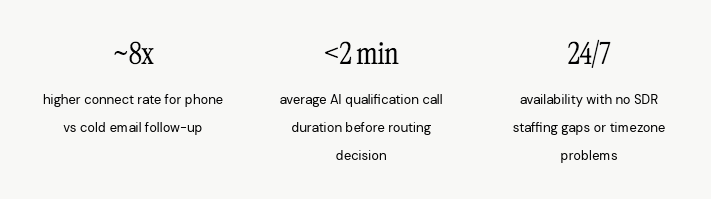
An AI phone agent lets you run qualification at a volume and consistency no human team can match. By doing so it is keeping your actual salespeople focused on relevant conversations that move deals forward.
You see: Voice AI does not replace your sales team. It handles the high-volume, repetitive front of the funnel so your best closers spend their time on ICP-fit, sales-ready leads instead of working through cold lists.
The top four lead generation use cases for Voice AI
Not every voice AI deployment produces the same ROI. After working with teams across B2B, these are the four use cases that consistently deliver measurable pipeline impact:
- Outbound cold outreach
Dial cold or warm lists, introduce your value proposition, and immediately qualify or disqualify based on BANT criteria without an SDR touching it.
- Inbound speed-to-lead
Call back web form submissions within 60 seconds, before a competitor does. The AI qualifies while intent is at its peak.
- Re-engagement of cold leads
Work your CRM's dead opportunities. AI voice agents can re-contact leads that went dark 90 to 365 days ago at scale, surfacing ones whose situation has changed.
- Event and webinar follow-up
After a conference or webinar, the AI calls every attendee, gauges interest, and books discovery calls while the event is still top of mind.
All of these share a common structure: the AI handles the high-volume touchpoint, collects structured data from the conversation, and passes qualified prospects to a human via a live warm transfer or an automatic calendar booking.
How to run an outbound AI voice agent campaign step-by-step
The setup of an outbound AI voice agent campaign is not too complicated, but the sequencing matters. Here is how to structure one that does not get your number flagged as spam and actually converts.
STEP 1: Build a clean, segmented list
The quality of your list is the single biggest variable in campaign performance. An AI voice agent calling unqualified contacts wastes compute and burns your caller ID reputation. Segment by ICP signals first: company size, industry, technology stack, recent funding, hiring activity. The tighter the segment, the more specific your AI's opening can be, and the higher your connect-to-qualified rate.
STEP 2: Write the opening 15 seconds carefully
The first 15 seconds of any cold call decide whether the prospect stays on the line. Your AI agent needs an opener that identifies itself honestly as an AI, states a specific reason for calling rather than a generic pitch, and asks a single low-friction question. "We help [industry] teams cut time-to-hire by 40%. Does that kind of problem show up on your radar?" is far stronger than "I'm calling to introduce our platform."
STEP 3: Set call cadence and timing rules
AI call automation scales instantly, which creates a risk of over-dialing the same contacts. Set hard limits: maximum 2 attempts per contact, a minimum 48-hour gap between attempts, and restricted calling hours mapped to local business hours (typically 8am to 6pm). Time-of-day matters. For example, Tuesday to Thursday, mid-morning and early afternoon, consistently outperforms Mondays and Fridays.
STEP 4: Configure disposition tagging and CRM sync
Every call outcome (answered-qualified, answered-not-interested, voicemail, no-answer) should write back to your CRM in real time. This data feeds your lead scoring model and prevents your team from chasing leads the AI already disqualified. Most modern conversational AI agent platforms handle this via native CRM integrations or webhooks.
STEP 5: Review call recordings weekly
The fastest way to improve your outbound AI voice agent is to listen to the calls where it dropped off, where prospects pushed back, and where it failed to handle an objection cleanly. Treat this exactly like coaching a new SDR: identify the patterns and update your conversation script accordingly.
Setting up the lead qualification process with AI
Many teams try to cram a 20-question BANT framework into a two-minute AI call, and it sounds like an interrogation. But good AI voice agent lead qualification feels like a conversation..
The three-question minimum viable qualification:
If you could only ask three questions to qualify a lead, what would they be? That is your starting point. For most products, those three questions map to:
- Problem fit: Is the pain you solve actually a pain they feel right now?
- Decision readiness: Are they actively looking, passively curious, or not in-market at all?
- Access to decision: Can this person influence or make the buying decision, or do you need someone else?
Everything beyond these three is nice to have. Design your AI voice agent to capture these three first, then branch into deeper qualification only if the prospect is engaged and answering.
Handling objections without sounding robotic:
The most common objections on a cold outbound call are: "I'm not interested," "send me an email," "we already have a solution," and "now's not a good time." Your AI needs scripted responses for each of these that acknowledge the objection, do not argue, and offer a single low-commitment next step.
"Send me an email" is rarely a rejection. It is often a delay tactic from someone who is mildly curious but not ready to commit time. Train your agent to acknowledge it and confirm the email address rather than just promising to send something.
Voice tone and pacing:
With today's voice AI models, the gap between AI and human voice quality is narrow, but pacing and breathing patterns still matter. Test your agent with real people before launching a campaign and pay attention to feedback about whether it felt natural.
On disclosure: Prospects who know they are talking to an AI upfront tend to be more patient and direct with their answers. So do not try to pass your agent off as human.
Getting warm transfer from AI to human right
The warm transfer is one of the most important moments in a voice AI lead generation workflow. Done right, it converts a qualified AI conversation directly into a live sales interaction with no delay, no dropped context, and no re-qualification friction.
The mechanics work like this: when the AI voice agent determines a lead meets your qualification criteria during a live call, it tells the prospect something like: "Based on what you have shared, I would like to bring in [name] from our team right now. They can answer your specific questions about [relevant topic]. Can I put you through?"
If the prospect agrees, the AI bridges a three-way call and hands off with a brief context summary to the human rep.
For a detailed walkthrough of how to configure this technically, the warm transfer setup guide covers the full configuration for major voice AI platforms.
Metrics that matter for AI lead generation
AI call automation generates a lot of data. The risk is drowning in vanity metrics (total dials, total minutes, average call length) while missing the numbers that actually predict revenue impact.
Track these weekly for the first 90 days of a new campaign. The benchmarks above are directional. Your baseline will depend on industry, list quality, and product category. What matters is the trend, not the absolute number.
How to start with Voice AI for lead generation
A VP of Engineering and a Head of Marketing have different priorities, different vocabularies, and different reasons to care about your product. A qualification script that tries to serve both will sound generic to both. Build separate agent configurations for your key segments. It takes more time upfront but dramatically improves conversion rates. Most platforms make this straightforward; see the best AI agent builder platforms review for options that support multi-agent workflows.
If you are implementing voice AI for lead generation for the first time, the best practice is to start small, learn fast, and expand from a working foundation. Our team at SigmaMind is happy to help you along the way. Just book a free demo call to see how our Voice AI can automate your lead generation process and get personal consulting.
Evolve with Sigma Mind AI
Build, launch & scale AI agents
Related Blogs
Ready to transform your call center?

More Conversations.
Less Manual Work.

Building from San Francisco, CA