
What Do Enterprise Buyers Need to Know Before Deploying Voice AI?
What enterprise buyers need to know before deploying voice AI, covering security, integration depth, pricing, vendor lock-in, and proof of ROI.
IN this article

Evolve with Sigma Mind AI
Build, launch & scale AI agents
Quick summary
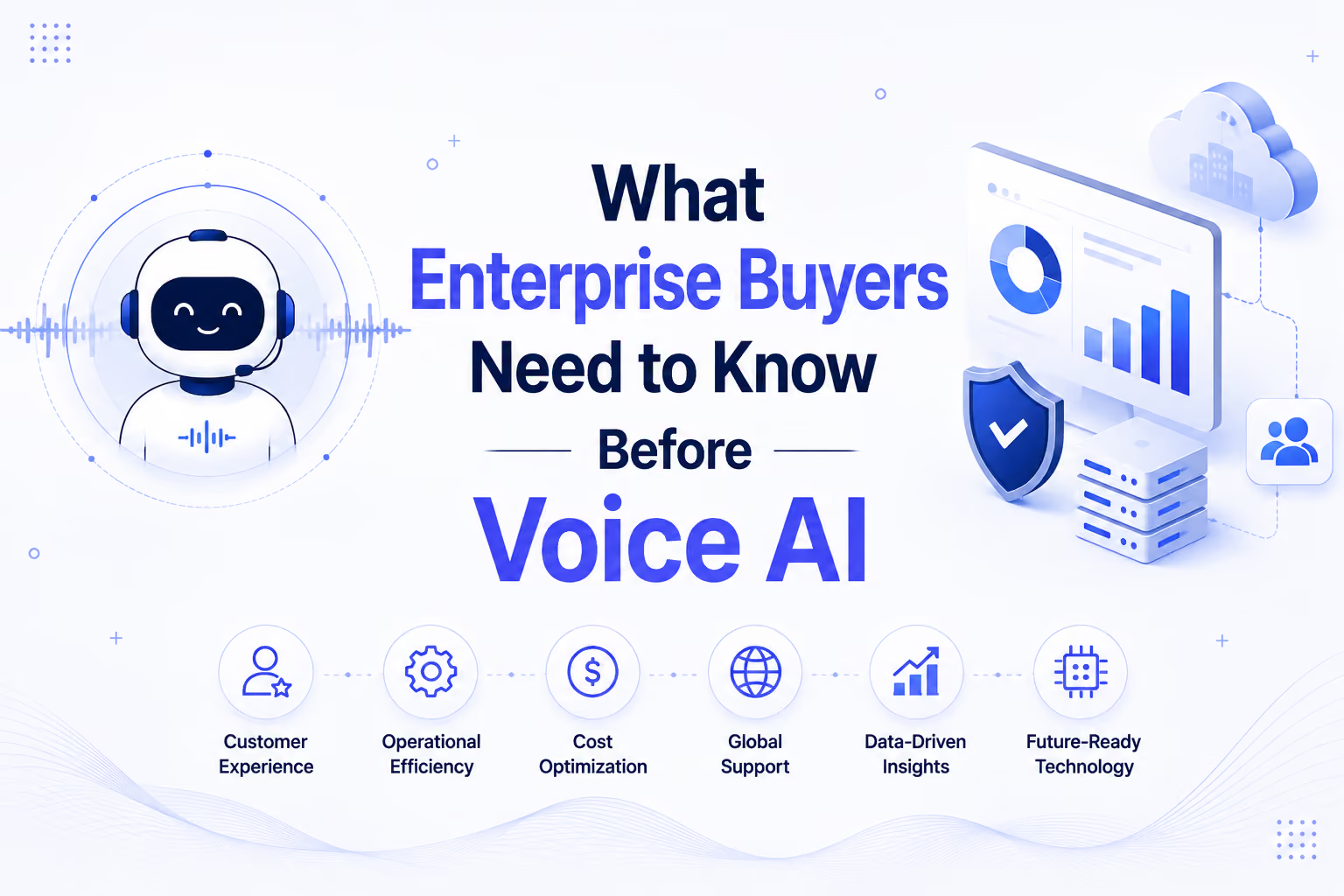
Enterprise voice AI evaluation now centers on five areas: security certifications like SOC 2 Type II and data residency, integration depth with existing telephony and CRM rather than surface-level API access, transparent usage-based pricing instead of hidden fees, a clear answer on vendor lock-in and data portability, and proof of ROI from a comparable deployment rather than a polished demo. AI is now widely flagged as a material business risk at the board level, which has pushed voice AI vendor selection out of the hands of a single department and into a cross-functional review involving security, legal, and IT. Buyers who treat this as a checklist upfront avoid the deployments that quietly stall in security review months into the process.
Enterprise buyers need to evaluate five things before deploying voice AI: security and compliance certifications, integration depth with existing telephony and CRM, pricing transparency, vendor lock-in risk, and proven ROI from a comparable deployment, not just a demo. Skipping any one of these is usually where enterprise voice AI deployments either stall in procurement or fail after launch.
Evaluating voice AI used to be mostly a conversation quality test. It isn't anymore. Enterprise buyers are now running voice AI vendors through the same scrutiny as any other system that touches customer data and live telephony infrastructure.
See What Enterprise-Ready Voice AI Actually Looks Like
Walk through SigmaMind AI's security, integration, and pricing model directly with the team before you build an evaluation scorecard.
Why has enterprise voice AI evaluation gotten so much stricter?
Because AI has moved from an experimental tool to a system with real financial and reputational exposure, and boards are now treating it that way. That shift didn't happen gradually. It tracks closely with how fast AI moved from pilot projects into systems that touch real customer interactions and real revenue, voice AI included, over the past two years.
The Conference Board found that 72% of S&P 500 companies disclosed AI as a material risk in their 2025 annual filings, up from just 12% two years earlier. source That shift shows up directly in procurement: a voice AI vendor evaluation that used to be run by one team is now routinely reviewed by security, legal, and compliance before a contract gets signed.
For enterprise voice AI deployment specifically, this means a vendor with a great-sounding demo but thin documentation on data handling is a much harder sell internally than it would have been two years ago, regardless of how good the conversation quality is.
What security and compliance certifications should an enterprise buyer require?
Require SOC 2 Type II as the floor, not the ceiling, and confirm data handling specifics beyond the certificate itself. Type II matters because it verifies controls operated effectively over a period of months, not just that they were designed correctly at a single point in time, which is all a Type I report confirms.
Beyond the certificate, an enterprise voice AI security and compliance review should also cover:
- Data residency options, and where call recordings and transcripts are actually stored.
- Whether the vendor trains on your data by default, and how to opt out in writing.
- A signed Data Processing Agreement, not a verbal assurance.
- Sub-processor disclosure, since most voice AI platforms route calls through third-party speech and language model providers that also touch your data.
A vendor that answers these vaguely or defers every question to "we'll follow up" is telling you something about how mature their compliance program actually is.
How deep does the integration need to be before signing?
Deep enough that it's a native connection to your telephony and CRM, not a workaround built on generic API calls or a third-party automation tool. A native integration supports the specific fields, call events, and workflows your team already relies on. A shallow one technically connects but breaks the moment your team needs something slightly outside the basic use case it was built to demo.
This distinction matters more in a call center context than most software categories, since voice AI has to plug into telephony infrastructure that's often already complex, layered onto a dialer, a CRM, and sometimes multiple client environments in a BPO setting. The comparison of the top AI voice service platforms for business calls is worth reviewing specifically for integration depth, not just feature lists, since that's where platforms differ most in practice.
What does vendor lock-in actually look like with a voice AI platform?
It looks like your call recordings, transcripts, trained configurations, and custom scripts being difficult or impossible to export if you ever switch providers. Ask directly what happens to your data and configuration at contract end, not just during the relationship. A vendor confident in their product will answer this clearly; one relying on lock-in to retain customers tends to get vague fast.
Lock-in is a compliance risk as much as a commercial one. If your own regulatory obligations require you to be able to produce or delete customer data on request, a vendor that can't cleanly export or delete your data on your timeline creates a problem that outlasts the vendor relationship itself.
How should enterprise buyers evaluate pricing during AI call center procurement?
Look for usage-based pricing tied to actual call volume, and treat opaque or bundled pricing as a red flag worth pushing on directly. A platform charging a flat fee regardless of usage is betting you'll pay whether or not the deployment is actually delivering value, which is a very different incentive structure than a vendor whose revenue scales with your results.
Ask specifically what's included versus billed separately: telephony costs, per-minute speech and language model usage, and any professional setup services. The full cost breakdown of an AI call center is a useful reference to bring into a vendor conversation, since it lays out where costs typically hide beyond the headline per-minute rate.
What proof of ROI should a vendor actually be able to show?
Real numbers from a comparable deployment, not a projected estimate built on generic industry averages. Ask for specifics: average handle time change, resolution rate, and cost per interaction from a customer in a similar industry and call volume range, not just a case study logo without data attached. The approach to reducing average handle time without firing your team is a useful reference point for the kind of specific, measurable outcome a credible vendor should be able to walk through in detail.
A vendor unwilling or unable to get specific about a comparable deployment's actual numbers is asking you to buy on faith, which is a harder position to defend in a procurement review than it used to be.
Getting started with your enterprise voice AI evaluation
Build a single scorecard covering all five areas: security, integration, pricing, lock-in, and ROI proof, and score every vendor against it consistently rather than letting the best demo win the deal informally. Involve security and compliance early rather than after a vendor has already been selected internally, since that's where deployments that looked done stall out for months. A vendor confident in their product will welcome this level of scrutiny rather than resist it.
Bottom line: enterprise voice AI deployment succeeds or stalls in procurement more often than it fails on conversation quality. Buyers who evaluate security, integration depth, pricing transparency, lock-in risk, and real ROI proof upfront avoid the deployments that quietly die in review months after the demo looked great.
Ready to walk through SigmaMind AI's enterprise readiness directly? Talk to the team or start building for free to see it on your own infrastructure.
Evolve with Sigma Mind AI
Build, launch & scale AI agents
Related Blogs
Ready to transform your call center?

More Conversations.
Less Manual Work.

Building from San Francisco, CA