
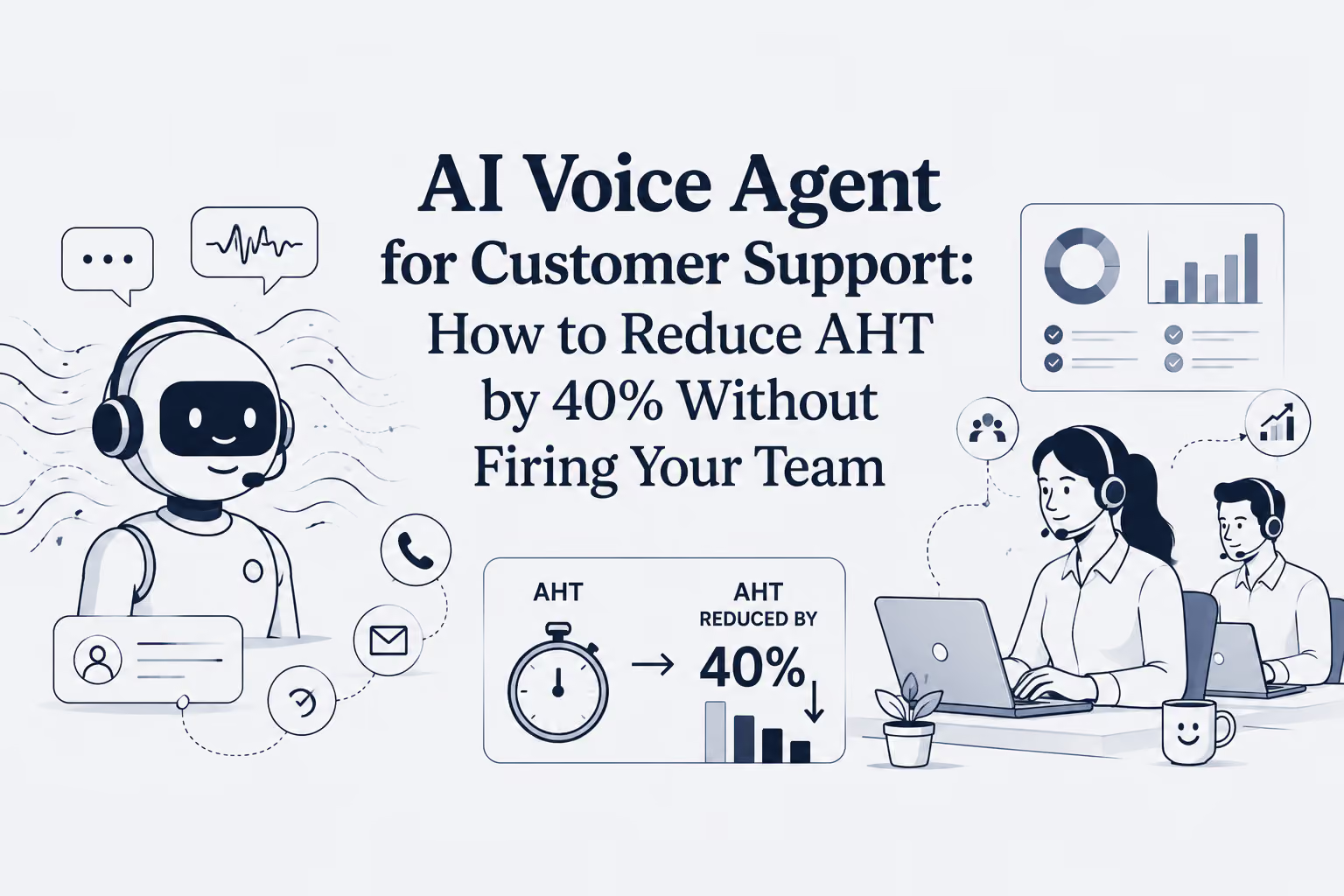
AI Voice Agent for Customer Support: How to Reduce AHT by 40% Without Firing Your Team
Learn how AI voice agents reduce Average Handle Time by 40% without replacing your team covering ACW automation, AI routing, pre-call verification, and a 4-step deployment model.
IN this article

Evolve with Sigma Mind AI
Build, launch & scale AI agents
The industry average for call center Average Handle Time (AHT) sits at around 6 minutes and 10 seconds per call. For a 100-seat customer support operation handling 20,000 calls per month, every 30 seconds shaved off that number is worth hundreds of thousands of dollars per year in recovered agent capacity. And yet most call center leaders have spent years chasing incremental AHT improvements script optimization, desktop tool consolidation, supervisor coaching and seen marginal returns.
The math changed when call center voice AI moved from pilot to production. Call centers deploying AI voice agents on the right call types are now reporting 35–55% AHT reduction on AI-handled interactions. Blended AHT for the full operation accounting for both AI and human-handled calls drops proportionally to how much volume the AI absorbs.
The critical clarification: this is not achieved by rushing customers through calls or sacrificing CSAT to hit a speed metric. It is achieved by removing the structural time wasters that inflate AHT on every call manual data lookups, repeat verification questions, hold time while agents search for information, and the 60–90 seconds of after-call work that follows every human-handled interaction. AI removes all of those. The conversation itself gets faster because the friction is gone.
See AHT Reduction in Action on Your Call Traffic
SigmaMind AI delivers sub-800ms real-time response with automatic CRM logging, built-in TCPA compliance, and native VICIdial integration on your existing infrastructure.
Sign Up Free → See SigmaMind Handle Live Calls
What Is Average Handle Time and Why Does It Matter So Much to Call Center ROI?
Average Handle Time is the total time an agent spends on a customer interaction from the moment they pick up to the moment after-call work is complete. It has three components:
- Talk time the active conversation with the caller
- Hold time time the caller spends waiting while the agent looks up information or consults a supervisor
- After-call work (ACW) time spent logging the call, updating CRM records, and completing disposition tasks after the caller hangs up
AHT matters because it is a direct capacity multiplier. An agent handling calls at 6-minute AHT completes roughly 10 calls per hour. The same agent at 4-minute AHT completes 15. That 50% capacity increase does not require hiring, training, or onboarding a single additional person. It comes from removing the friction that exists in the current process.
The reason AHT is so difficult to move without AI is that the friction is structural, not behavioral. Agents are not slow because they are underperforming. They are slow because they are manually doing things that should be automated: retrieving account data during the call, asking the same verification questions that were already answered in IVR, and logging call notes that the system could write itself.
Where Does AHT Actually Come From and What Can AI Fix?
Before deploying any Voice AI solution, it is worth understanding exactly where the time in each call is going. McKinsey research found that 30–40% of claim-related call time is silent agents searching for information while the caller waits. That is hold time and search time, not conversation time. And it is the single biggest AHT driver in most customer support operations.
The five structural sources of inflated AHT that AI addresses directly:
1. Manual identity verification.
Agents spend 60–90 seconds at the start of every call asking callers to confirm their name, account number, date of birth, and last transaction. AI handles this before the human agent ever joins the call, verifying identity automatically through contextual data and CRM lookup, and delivering a pre-verified caller to the human agent with account details already surfaced on screen.
2. Information retrieval during the call.
Every time an agent puts a caller on hold to look up a policy, check an account balance, or ask a supervisor for approval, it adds 60–180 seconds to AHT. AI resolves this in two ways: for calls handled autonomously, it retrieves data in real time from connected systems without any hold. For escalated calls, it delivers full account context to the human agent before the call connects, eliminating the lookup entirely.
3. After-call work (ACW).
ACW automation is the fastest AHT win available in 2026 because it requires no change to the live conversation. AI generates a structured call summary, updates CRM records, applies the correct disposition code, and triggers any required follow-up actions automatically after every call. For human agents, this eliminates 60–90 seconds of manual logging on every single interaction, a change that shows up in AHT data within the first week of deployment.
4. Misrouted calls.
AI-powered routing reduces misrouted transfer calls that reach the wrong department or the wrong skill level by identifying caller intent before routing. Every misrouted call that requires a transfer adds 2–4 minutes to AHT and resets the verification and context process from the beginning. AI-powered intent recognition eliminates the bulk of these at the front of the call.
5. Repetitive first-touch calls handled by human agents.
The most significant AHT lever is the simplest to state: route the 40–60% of customer support calls that do not require human judgment to AI, and let human agents exclusively handle the interactions that actually need them. Human agents working only on complex, high-judgment calls have structurally lower AHT than agents mixing complex calls with routine ones because routine call patterns reset cognitive load and slow response on the calls that follow.
How Does AI Voice Agent Deployment Actually Reduce AHT Without Replacing Your Team?
This is the question that matters most for call center leaders who hear 'AI reduces AHT' and immediately think 'by replacing agents.' That framing is wrong and it is worth being direct about why.
AI reduces AHT by handling the call volume that does not require a human agent, and by improving the performance of human agents on the calls that do. The result is a team that is smaller relative to call volume, better utilized, and operating at higher AHT efficiency not a team that was fired and replaced with software.
The mechanics in practice:
- AI handles 40–60% of inbound call volume autonomously FAQ resolution, appointment scheduling, balance inquiries, payment processing, and qualification on structured outbound without involving a human agent at all
- Human agents receive only escalated calls interactions that require judgment, empathy, negotiation, or exception-handling with full context already assembled by the AI before the call connects
- Human agent AHT drops on their handled calls because verification is pre-complete, account data is pre-surfaced, and ACW is automated they arrive at the start of the resolution, not at the start of the admin
- Blended AHT for the full operation improves proportionally to how much volume AI absorbs a center moving 40% of calls to AI at 2-minute AI AHT versus 6-minute human AHT sees blended AHT drop from 6 minutes to approximately 4 minutes across the operation
What Are Realistic AHT Reduction Benchmarks for Call Centers Using Voice AI in 2026?
These are production benchmarks from 2026 deployments, not marketing projections:
- AI-handled calls vs human baseline: 35–55% AHT reduction on autonomous AI interactions (IrisAgent, 2026 benchmark data)
- ACW automation alone: 60–90 second reduction per call for human-handled interactions achievable immediately, no change to the live conversation required
- AI pre-qualification for human agent handoffs: approximately 35% AHT reduction on escalated calls due to pre-verified identity and pre-surfaced account data (Goodcall, 2026)
- AI-powered routing reducing misrouted transfers: up to 40% reduction in transfer rates, directly lowering AHT on affected calls
- Blended AHT for a 180-seat health plan moving 40% of tier-1 calls to AI: overall AHT dropped by 2 minutes 45 seconds across the full operation (CallSphere production case study, 2026)
The 40% headline AHT reduction is achievable for most customer support operations when AI handles a meaningful share of first-touch volume and ACW automation is applied to human-handled calls simultaneously. Operations seeing lower results are typically those where AI handles too narrow a call type segment to move the blended average meaningfully.
How Do You Deploy AI Voice Agents for Customer Support Without Disrupting Your Current Operation?
The deployment model that consistently produces fastest AHT results with lowest operational risk follows four steps:
- Audit your current call mix by type and AHT. Identify which call categories have the highest volume, the most structured conversations, and the clearest resolution criteria. These are your first AI deployment targets. For most support operations, FAQ resolution, account balance inquiries, appointment scheduling, and payment processing fit this profile.
- Start AI on 10–20% of one call type. Do not attempt to automate everything in the first deployment. Run AI on a controlled segment of your highest-volume, most structured call type alongside your existing human agents. Measure AI AHT, autonomous resolution rate, CSAT on AI-handled calls, and transfer completion rate. Do not expand until you have baseline data from at least 1,000 AI-handled calls.
- Deploy ACW automation in parallel. Automatic post-call CRM logging and call summarization can go live for human-handled calls at the same time as the AI pilot; they are independent changes. This delivers immediate AHT improvement on human-agent calls while the AI pilot generates data.
- Scale based on results. Once AI is resolving the pilot call type at target AHT with stable CSAT, expand to additional call categories. The expansion decision should be data-driven, not schedule-driven.
For operations running VICIdial, this deployment model integrates directly with existing infrastructure. AI Voice agent with VICIdial via SigmaMind registers as a SIP extension agent on your existing VICIdial server no dialer replacement, no campaign reconfiguration, no carrier changes. AI handles calls within your current campaign structure while your human agents continue operating exactly as they do today.
What Happens to Your Human Agents When AI Reduces AHT and What Should You Tell Them?
This is the question every call center leader is quietly asking, and it deserves a direct answer.
When AI absorbs 40–60% of call volume, your human agent headcount requirement relative to total call volume decreases. That does not mean you fire 40% of your team. It means one of three things depending on your business situation:
- Growing call volume: AI handles the volume growth without proportional headcount growth. Your team stays the same size while capacity scales
- Stable call volume: Human agents shift to higher-value, higher-judgment interactions complex complaints, upsell conversations, sensitive escalations where their skills create more value per call than they do on routine inquiries
- Declining volume or budget pressure: Natural attrition absorbs the capacity reduction without active redundancy. Annual agent turnover of 30–45% means a meaningful headcount reduction through attrition over 12–18 months without a single termination
The conversation with your team should be honest: AI is handling the calls that are currently burning agent time on low-value interactions. The human agents who remain are doing work that matters more, completing fewer routine calls, and operating in an environment where their judgment is actually required, which is where agent satisfaction and retention is highest.
Is a 40% AHT Reduction Achievable for Your Customer Support Operation?
The 40% figure is not a ceiling or a best-case projection. It is a documented production outcome for customer support operations that deploy AI on the right call types, at meaningful volume, with ACW automation running simultaneously. The operations that fall short of this target are typically those that deploy AI on too narrow a call segment or that fail to enable automatic post-call logging, not those that ran the model correctly and found it underperformed.
The ai solution call center model that delivers this outcome is not complicated. AI handles the structured, high-volume, low-judgment calls. Human agents handle the complex, sensitive, high-judgment interactions. ACW is automated on every call regardless of who handled it. And the entire system runs on your existing infrastructure: no migration, no dialer replacement, no months of downtime before the first result.
SigmaMind AI is built specifically for this deployment model in production call center environments with sub-800ms latency, native VICIdial integration, automatic CRM logging, built-in TCPA compliance, and a deployment timeline measured in days, not months.
Ready to Move Your AHT Metrics?
Sign up and run your first AI customer support campaign. No seat minimums, no infrastructure changes, no engineering team required. First ROI data within 30 days.
Evolve with Sigma Mind AI
Build, launch & scale AI agents
Related Blogs
Ready to transform your call center?

More Conversations.
Less Manual Work.

Building from San Francisco, CA