
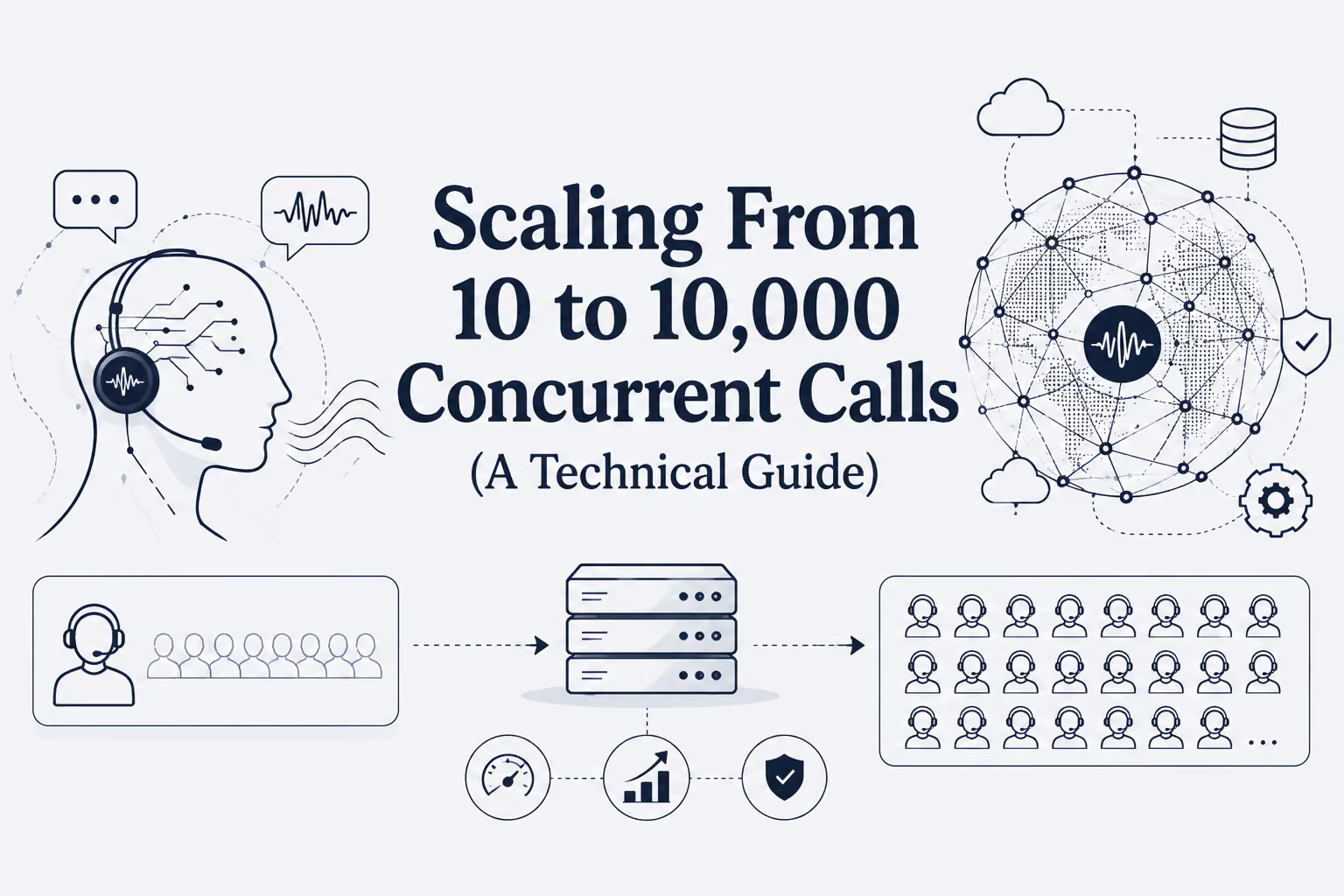
Voice AI for Enterprise: Scaling From 10 to 10,000 Concurrent Calls (A Technical Guide)
A technical guide to scaling enterprise voice AI from 10 to 10,000 concurrent calls, covering telephony, compute, data sync, and compliance limits.
IN this article

Evolve with Sigma Mind AI
Build, launch & scale AI agents
A pilot that handles 10 calls a day tells you almost nothing about what happens at 1,000. Most teams size their deployment around the demo that worked, then find out later the real ceiling was never the AI. It was a SIP trunk provisioned wrong, a speech provider's rate limit, or a compliance rule capping how fast you're allowed to dial.
TL;DR
Voice AI pilots run fine at 10 concurrent calls and usually break between 500 and 2,000. The failure is rarely the language model. It's telephony, a speech provider's rate limit, a data sync queue backing up, or a compliance rule that caps concurrency regardless of infrastructure. This guide covers the four layers that set your real concurrency ceiling, and a staged plan for scaling from 10 calls to 10,000 without a rebuild in between.
What "Enterprise" means for Voice AI at scale
Concurrency and volume aren't the same thing. A call center running 200 simultaneous calls all day has a different load profile than one that spikes to 2,000 calls for a 90-minute enrollment window and drops back to zero. A conversational AI voice agent isn't playing a recorded prompt. Every live call needs an active speech-to-text stream, an active language model context, an active text-to-speech stream, and an open telephony connection, all at once, for the full call. Ten of those running together is trivial. Ten thousand is a different engineering problem entirely.
The four layers that set your concurrency ceiling
Your real concurrency limit is set by whichever layer is weakest, not by a platform's marketing number.
Where it actually breaks first
Telephony
This is the layer most teams underestimate, because it's furthest from the AI itself. Twilio's own scaling documentation draws a useful distinction: calls-per-second and call concurrency are different limits. Concurrency is capped more by your own server capacity and trunk provisioning than by any single API setting.
Peak bandwidth also runs around 100 kbps per simultaneous call on standard codecs. That means 1,000 concurrent calls need real, provisioned network headroom, not just a higher API limit.
If you're layering AI onto an existing dialer rather than replacing it, this is where legacy platforms add their own ceiling too. A media bridge built and tested at 10 calls doesn't automatically hold at 1,000. The architecture behind adding AI to VICIdial is worth reviewing if that's your setup.
Compute
Voice AI is a real-time, stateful workload, which makes it a poor fit for simple autoscaling. A voice agent running 200ms slower under load creates an audible, uncomfortable pause, not just a slower response.
Capacity needs to ramp ahead of known peaks, not react after a queue backs up. Provider-side concurrency caps on STT, TTS, and LLM accounts are often the real ceiling, not your own servers.
Model choice also trades cost against latency in a way that only shows up at volume. That tradeoff is worth modeling against the full cost breakdown of an AI call center before a scale-up.
Data sync
This is the layer that fails most quietly. At low concurrency, writing a disposition back to a CRM after each call is unnoticeable. At high concurrency, thousands of simultaneous writes can hit API rate limits or back up a webhook queue until dispositions arrive minutes late instead of seconds late. Supervisors lose real-time visibility, and nobody notices until a report looks wrong.
Voice AI for lead qualification: A different load pattern
Lead qualification tends to run in bursts rather than flat, sustained load: a form fill triggers an immediate callback, a webinar ends, and every attendee gets called within the hour. That burst pattern is harder on a system than the same total volume spread evenly across a day, since it needs the full concurrency ceiling available all at once.
The playbook for using voice AI for lead generation covers the qualification flow itself, but the scaling takeaway is separate: a system tuned for steady support call volume will often choke on the exact burst that makes speed-to-lead outreach valuable in the first place.
AI outbound dialer for a collections agency: Compliance caps concurrency
Debt collection is the clearest case where scaling isn't purely an engineering decision. An AI outbound dialer for a collections agency in the USA operates under TCPA consent rules for AI-generated voices and the FTC's Telemarketing Sales Rule, which caps any outbound campaign at a 3% abandoned-call rate per day. source
That abandonment cap is the part teams miss when planning capacity around compute and telephony alone. Pushing dial pacing higher to increase throughput raises the abandonment rate right along with it, and once that crosses 3%, you're out of compliance no matter how much infrastructure you have left.
For a collections operation, the real scaling question isn't how many concurrent calls the system can process; it's how many it can run while staying under that ceiling. Review pacing and abandonment monitoring with counsel before scaling any campaign; this isn't legal advice.
A practical scaling roadmap
Pre-scale checklist
- SIP trunk CPS and concurrency limits provisioned above your peak target, not your average.
- STT, TTS, and LLM provider concurrency caps confirmed in writing.
- CRM and disposition writes tested at target volume, including queue backup scenarios.
- Autoscaling triggered ahead of known peaks, not reactively.
- Abandonment rate monitoring in place for any outbound campaign, alerting before 3%.
- A failover path to a human queue if the AI service is unavailable.
Getting started with enterprise voice AI at scale
Enterprise voice AI doesn't fail at scale because the AI stops working. It fails because telephony, compute, data sync, or compliance hits its ceiling first, usually the layer nobody load-tested. Plan capacity in stages, confirm limits with your providers in writing, and treat compliance thresholds like collections' 3% abandonment rate as a hard ceiling, not a suggestion. Get that sequencing right, and the jump from 10 calls to 10,000 is a rollout, not a rebuild.
Ready to see how SigmaMind AI handles concurrency planning for your call volume? Talk to the team or start building for free to test your own scaling scenario.
Evolve with Sigma Mind AI
Build, launch & scale AI agents
Related Blogs
Ready to transform your call center?

More Conversations.
Less Manual Work.

Building from San Francisco, CA