
12 Best Multilingual Text to Speech Engines (2026 Guide)
Compare 12 multilingual text to speech engines for 2026, from Azure to ElevenLabs, plus the orchestration layer to ship real voice agents. Read now.
TL;DR
Multilingual text to speech technology has evolved fast in 2026, with new models from Google, Mistral, and Cartesia reshaping what’s possible for voice agents and content localization. The right engine depends on whether you need broad language coverage (Azure, 140+ locales), studio-grade naturalness (ElevenLabs, 29 languages), or ultra-low latency for live phone calls (Cartesia Sonic, sub-50ms time-to-first-audio). But picking an engine is only half the job. Shipping multilingual TTS into production conversations requires orchestration across STT, LLM, TTS, and telephony, which is where platforms like SigmaMind AI come in.
What Changed in 2026 and Why It Matters
The multilingual text to speech market moved quickly this year. On April 15, 2026, Google rolled out 16 additional languages for voiceovers in Google Vids, powered by Gemini 3.1 Flash TTS with new “audio tags” for expressive control (Google Workspace Updates). Mistral released Voxtral TTS, a 4-billion parameter open-weight streaming model supporting around 9 languages, with human preference scores competitive against ElevenLabs Flash v2.5 (MarkTechPost). And Cartesia’s Sonic-3 models pushed time-to-first-audio claims down to 40ms through partnerships with real-time communication providers (Tencent RTC).
These are exciting developments. But practitioners on Reddit consistently report the same frustration: picking a single multilingual TTS engine doesn’t solve the production problem. You also need ASR that works across your target languages, an LLM that handles prompts without hallucinating, telephony infrastructure, monitoring, and fallback logic for when things break. One developer on r/AI_Agents put it bluntly: latency “claims” and real-world call performance are two different things, and the gap only grows when you add languages (Reddit).
This guide covers 12 multilingual TTS options, an honest framework for choosing between them, and why an orchestration layer often matters more than the individual engine.
At-a-Glance Comparison Table
| Engine | Best For | Languages | Streaming/Latency | Starting Price Context | Practitioner Sentiment |
|---|---|---|---|---|---|
| SigmaMind AI | Production voice agents (orchestration) | Model-agnostic (use any TTS) | Sub-second voice-to-voice target | $0.03/min platform + provider costs; free to start | “Finally, a way to mix engines per locale and ship on real phone lines” |
| Google Gemini TTS | Expressive control, Google-native stacks | Growing; 16 added Apr 2026 | Unidirectional streaming via Vertex | Character-based; verify in console | “Expressive but multi-speaker mode still unstable” |
| Azure Neural TTS | Broadest language coverage, enterprise reliability | 140+ languages/variants | Streaming supported | Character-based with free tier | “Rock solid; some non-English voices lag behind” |
| Amazon Polly | Lowest baseline pricing, AWS-native | Multiple languages | API streaming | Among lowest standard-tier pricing | “Good enough when cost matters” |
| ElevenLabs | Voice naturalness and emotional delivery | 29 (Multilingual v2) | Flash variants for low-latency | Subscription/credit model | “Natural and human-like; latency can surprise you” |
| OpenAI TTS-1 | Teams already on OpenAI | Follows Whisper coverage | API streaming | Per-character | “Simple if you’re all-in on OpenAI” |
| Rime AI | Customer support with low latency | Multiple | Sub-200ms claimed | Contact for pricing | “Purpose-built for support conversations” |
| Cartesia Sonic | Ultra-low TTFA for real-time agents | Expanding | TTFA as low as 40ms | Contact for pricing | “Among the fastest for live agents” |
| Google Cloud TTS (WaveNet/Studio) | Stable classic cloud TTS | Broad | Streaming via API | Standard voices among lowest | “Proven, well-documented” |
| PlayHT | Large voice libraries, voice cloning | Multiple | Streaming supported | Tiered plans | “Great English catalog; mixed multilingual results” |
| Mistral Voxtral TTS | On-prem control, avoiding vendor lock-in | ~9 languages | Streaming-native | Open-weight (self-host costs) | “Competitive quality; you own the infra burden” |
| Community/Open-Source | Experimentation, niche languages | Varies | Varies | Free | “Improving fast but expect rough edges” |
Pricing is directional. Independent trackers like AwesomeAgents and SpeechGeneration.ai normalize costs per 1M characters. Always verify current rates in vendor consoles.
How to Pick a Multilingual Text to Speech Engine
Before jumping into the list, it’s worth building a decision framework. Most comparison pages skip this, and that’s why teams end up switching engines three months into production.
Language Quality vs. Language Count
A vendor advertising “100+ languages” doesn’t tell you how those languages actually sound. Count isn’t quality. Practitioners on Reddit report accent “bleed” on mixed-language utterances even when vendors explicitly advertise multilingual support (Reddit). The only reliable test is to have native speakers evaluate output in your target locales. A TTS engine that covers 29 languages with natural prosody will outperform one that covers 140 languages but sounds robotic in your top five markets.
Code-Switching: The Mid-Utterance Problem
If your callers mix English with Spanish, or Hindi with English, you need to know how the engine handles mid-sentence language switches. Most engines still struggle here. Practitioners report that even the best multilingual TTS models “bleed” accents when switching languages within a single utterance. The practical workaround: segment by language and stitch outputs, or use an orchestration layer that routes different segments to different voices cleanly.
Latency Budget for Real-Time Calls
For voice agents on phone lines, latency tolerance is tight. Callers notice pauses beyond about one second. The metric to watch is time-to-first-audio (TTFA), the time between sending text and hearing the first audio chunk. But TTFA alone is misleading. You also need to account for STT processing time, LLM inference, audio packetization, and network transit. Real sub-second voice-to-voice performance comes from pipelining, streaming each stage in parallel, not from any single model’s speed claims (arXiv).
If you’re building agents that handle live calls, SigmaMind AI’s playground lets you test this pipelining across different TTS and LLM combinations before committing to production.
Reliability at Scale
New TTS models can fail in unexpected ways. Practitioners on r/googlecloud reported that Gemini TTS multi-speaker mode returned errors on 30-40% of API calls during early rollout (Reddit). Silent failures (the API returns 200 OK but the audio is empty or garbled) are even harder to catch. Build retries, exponential backoffs, and model fallbacks into your runtime. This is where orchestration becomes essential.
Price Truth: Per-Character vs. Per Finished Minute
Don’t compare on “per 1,000 characters” alone. For voice agents, estimate end-to-end cost per finished minute, including LLM inference, STT, TTS, and telephony. Independent pricing roundups highlight enormous spreads between vendors, and the cheapest TTS can become the most expensive option once you factor in the full stack (AwesomeAgents). SigmaMind AI’s pricing page breaks down each layer so you can model total cost before shipping.
The 12 Best Multilingual Text to Speech Options in 2026
1. SigmaMind AI

Best for: Shipping multilingual voice agents to production (contact centers, BPOs, agencies)
Pricing: Usage-based at $0.03/min platform fee for voice agents, plus your chosen STT, TTS, LLM, and telephony provider costs. Free to start.
Key features:
- Model-agnostic orchestration: mix ElevenLabs, Rime, Cartesia, Azure, or Google TTS and swap per locale without rebuilding workflows
- Built-in telephony with US number purchase, or bring your own carrier via SIP (Twilio, Telnyx)
- Node-based agent builder with branching logic, tool calling, and variables
- Sub-second voice-to-voice latency targets with streaming across every stage
- Warm transfer passes structured context (AI summary, intent, customer data) to human agents so callers never repeat themselves
- Multichannel deployment from one workflow (voice, chat, email)
- Analytics dashboard with cost breakdowns by layer, call duration, transfer rates, and tool call tracking
Tradeoffs:
- Direct international phone number purchase is limited to the US; international deployments require BYOC via SIP
- You still manage and pay for third-party provider costs (LLM, STT, TTS, telephony) on top of the platform fee
- Modular pricing means you need to model total cost across layers, though the pricing calculator helps
Practitioner perspective: The value here isn’t another TTS engine. It’s the ability to pick the best multilingual text to speech provider for each market, connect it to real phone lines, and handle the operational complexity (fallbacks, monitoring, escalation) that raw APIs don’t address. Teams running multilingual support operations find that the orchestration layer is what actually gets them to production. One case study shows 4,000+ refunds automated monthly with 43% cost savings and zero processing errors (SigmaMind case study).
2. Google Gemini TTS
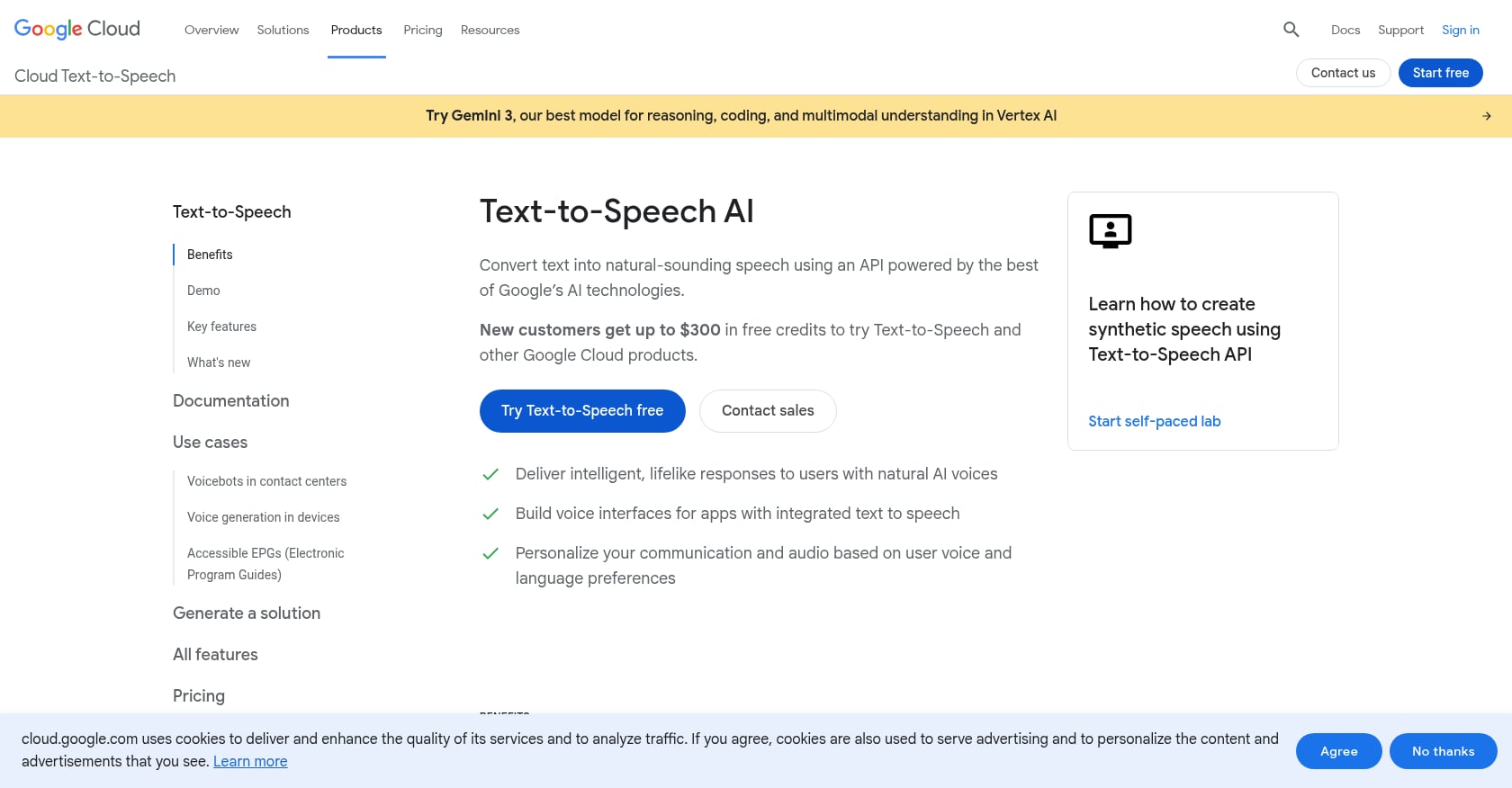
Best for: Expressive control and Google-native workflows
Pricing: Character-based pricing that’s still shifting as of mid-2026. Verify current rates in the Google Cloud console. Third-party trackers compile directional numbers (TokenCost).
Key features:
- New “audio tags” and scenario directions for controlling expressiveness, speaking style, and delivery tone
- Unidirectional streaming via Vertex AI
- 16 additional languages rolled out on April 15, 2026 for Google Vids voiceovers (Google Workspace Updates)
- Native integration with Workspace tools and Vertex AI pipelines
Tradeoffs:
- Production reliability is still maturing, particularly for multi-speaker mode
- Dialect/language mismatches have been reported in certain locales
- Pricing model is less predictable than established cloud TTS options due to ongoing changes
Practitioner perspective: Developers on r/googlecloud report that Gemini TTS expressiveness is impressive, but multi-speaker mode API calls were failing at rates of 30-40% in some production environments (Reddit). Build fallback logic if you adopt this early. The expressive controls are genuinely useful for content creation and dubbing, though.
3. Microsoft Azure Neural TTS
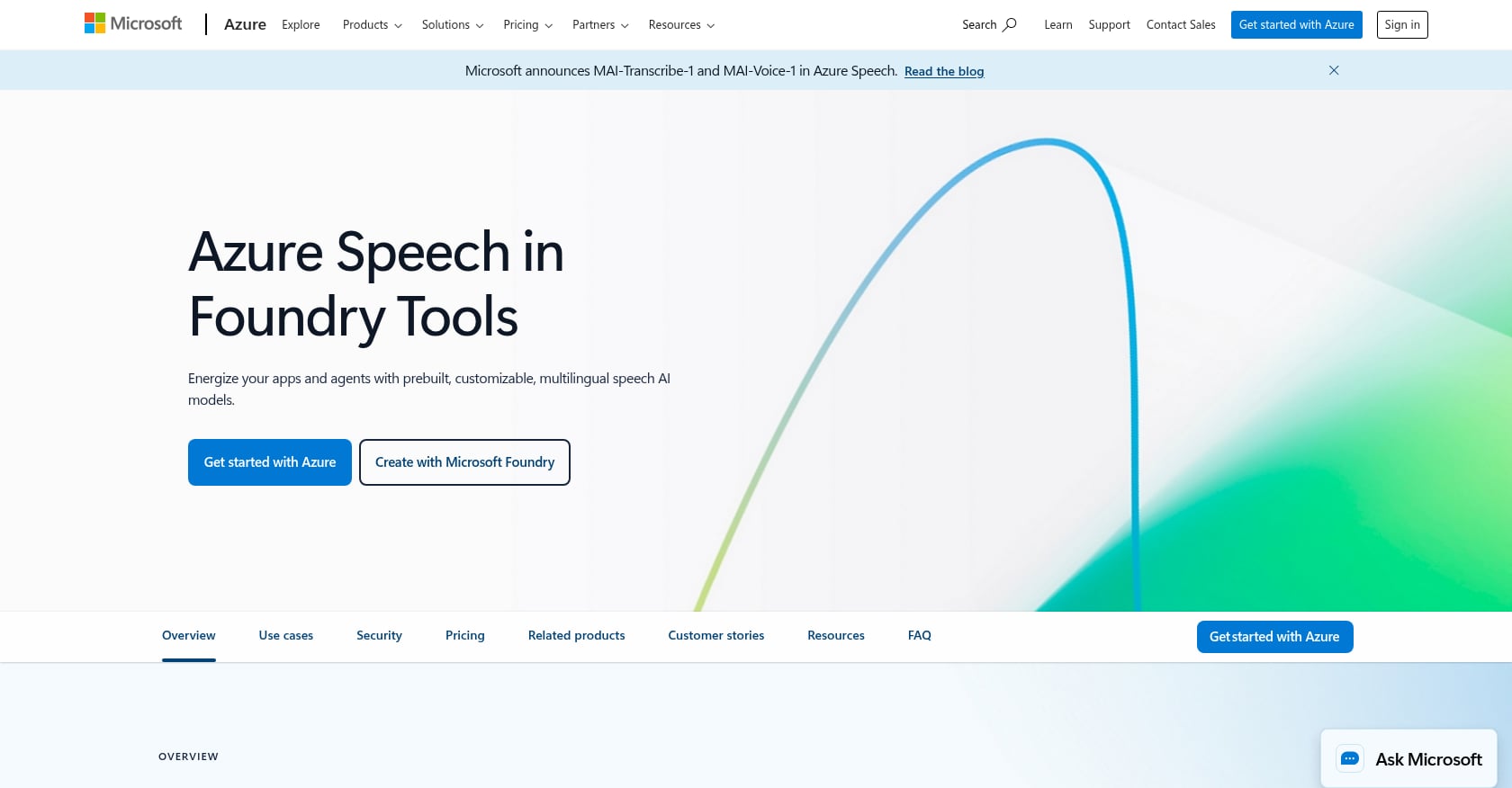
Best for: Broadest language coverage and enterprise-grade reliability
Pricing: Pay-per-character with historically available free monthly allowances for some voice types. Check current metering in the Azure portal. Independent comparisons show it sits in the mid-range for cost (SpeechGeneration.ai).
Key features:
- 140+ languages and regional variants with hundreds of neural voices (Microsoft Learn)
- Full SSML support for pronunciation control, pauses, emphasis, and speaking rate
- New HD and Dragon voice families for higher naturalness
- Strong enterprise compliance (SOC, ISO, regional data residency)
Tradeoffs:
- Voice quality in some non-English languages lags behind creator-focused tools like ElevenLabs
- SSML tuning for natural-sounding output requires effort and testing
- Can feel overwhelming to navigate the voice catalog without clear best practices
Practitioner perspective: Practitioners on r/artificial describe Azure Neural TTS as “rock solid” for production, citing good latency and competitive pricing (Reddit). If you need a multilingual text to speech engine that covers obscure locales and won’t surprise you at 3am, Azure is the safe bet.
4. Amazon Polly
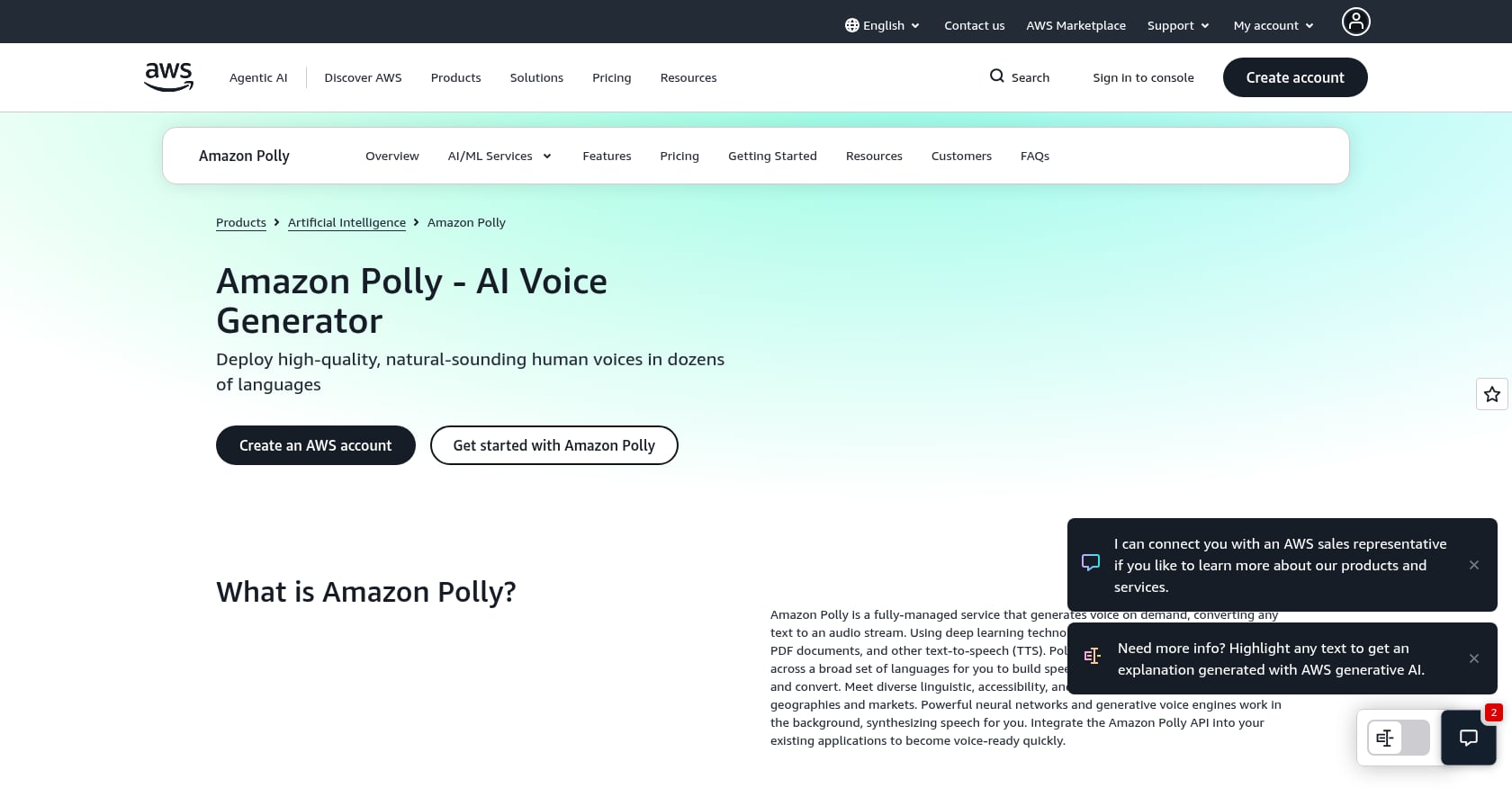
Best for: Lowest baseline pricing and AWS-native integration
Pricing: Character-based with standard-tier pricing typically among the lowest in the market. Independent trackers confirm Polly consistently sits at the budget end of multilingual TTS pricing (AwesomeAgents).
Key features:
- Mature API with SDK, CLI, and console access
- Multiple output formats (MP3, OGG Vorbis, PCM)
- Generative and long-form voice tiers for more natural output on longer reads
- Deep AWS service integration (Lambda, S3, Connect)
Tradeoffs:
- Voice quality is functional but rarely described as “studio” or “human-like”
- Fewer expressive controls compared to Gemini or ElevenLabs
- Language quality varies, with some locales sounding noticeably synthetic
Practitioner perspective: G2 reviewers highlight easy integration within the AWS ecosystem and pragmatic quality, noting Polly is “good enough when cost matters” (G2). It’s a sensible default for teams already running on AWS who need multilingual text to speech without premium pricing.
5. ElevenLabs
Best for: Voice naturalness and emotional delivery across languages
Pricing: Subscription and credit model with per-character overage rates that vary by model tier. Third-party comparisons compile per-1M character equivalents for planning (AwesomeAgents).
Key features:
- Widely considered the benchmark for natural, emotionally expressive TTS
- Multilingual v2 model supports 29 languages (ElevenLabs Help Center)
- “Conversational” voice variants and Flash options designed for interactive, low-latency use
- Voice cloning capabilities for brand consistency across languages
Tradeoffs:
- Real-time latency can lag expectations in live voice agent scenarios, especially on longer utterances
- Subscription/credit model can get expensive at scale compared to pay-per-character cloud options
- Code-switching is better than most, but still imperfect at language boundaries
Practitioner perspective: Creators and developers on r/TextToSpeech praise the quality, with one user noting voices are “natural and human-like,” but others flag that latency surprises in real-time agent deployments require tuning chunk sizes and punctuation strategies for consistency (Reddit).
6. OpenAI TTS-1

Best for: Teams consolidating their stack on OpenAI
Pricing: Per-character through the OpenAI API. Not the cheapest at scale, but simplifies billing for teams already paying for GPT models.
Key features:
- Multiple voice options through a straightforward API
- Language support generally follows Whisper’s coverage (OpenAI Docs)
- Clean documentation and simple integration for OpenAI-centric stacks
- Consistent quality across supported languages
Tradeoffs:
- Fewer studio controls (no SSML, limited expressiveness tuning) compared to specialized TTS vendors
- Not price-competitive for high-volume production workloads
- Language coverage details are less explicitly documented than Azure or Google
Practitioner perspective: Developers appreciate the simplicity. If you’re already using OpenAI for LLM inference and Whisper for transcription, adding TTS-1 keeps the vendor surface area small. But for multilingual text to speech at scale, you’ll likely want more control over pronunciation and voice characteristics.
7. Rime AI
Best for: Customer support voices with low latency and human-like delivery
Pricing: Contact Rime directly for pricing. Positioned as enterprise-grade.
Key features:
- Sub-200ms latency claims, with sub-100ms achievable in on-prem deployments
- Purpose-built for conversational customer support, not just content narration
- Published best practices on production TTS, covering pronunciation lexicons, end-to-end latency budgeting, and reliability under load (Rime Resources)
Tradeoffs:
- Smaller language catalog than Azure or Google
- Less brand recognition means fewer community resources and third-party integrations
- On-prem deployment option requires infrastructure investment
Practitioner perspective: Rime’s published production guidance on pronunciation dictionaries and latency budgeting is unusually practical. For teams building AI voice agents for customer support, the operations-first mindset is refreshing compared to vendors focused primarily on demo quality.
8. Cartesia Sonic

Best for: Ultra-low time-to-first-audio for real-time conversational agents
Pricing: Contact Cartesia for pricing. Positioned for real-time agent deployments.
Key features:
- Sonic-3 models with TTFA claims as low as 40ms in partnership with Tencent RTC, delivering sub-300ms end-to-end network latency (Tencent RTC)
- Language support expanding with recent model updates
- Designed for overlap-free turn-taking in live conversations
Tradeoffs:
- Language coverage narrower than cloud giants
- Fewer voice options compared to ElevenLabs or PlayHT catalogs
- Newer entrant with less production track record at enterprise scale
Practitioner perspective: Builders on r/TextToSpeech frequently mention Cartesia among the latency leaders for real-time voice agents (Reddit). If your primary constraint is turn-taking speed (preventing awkward pauses or talk-over), Cartesia is worth testing.
9. Google Cloud Text-to-Speech (WaveNet/Studio)

Best for: Stable, well-documented cloud TTS without adopting Gemini-specific features
Pricing: Traditionally among the lowest for standard voices, with premium tiers for WaveNet and Studio voices. Independent trackers confirm competitive pricing (AwesomeAgents).
Key features:
- Broad language support via the Cloud TTS API with extensive voice type documentation (Google Cloud Docs)
- WaveNet and Studio voice families for higher quality
- SSML support for pronunciation and prosody control
- Long production track record and stable API
Tradeoffs:
- Less expressive than newer Gemini TTS models
- Studio voices are region-limited for some languages
- Innovation is shifting toward Gemini; unclear how long classic Cloud TTS will receive major updates
Practitioner perspective: For teams that want proven multilingual text to speech with thorough documentation and don’t need the latest expressive features, classic Google Cloud TTS remains a solid, predictable option.
10. PlayHT
Best for: Very large voice libraries and cross-language voice cloning
Pricing: Tiered subscription plans with API access. Third-party comparisons show mid-range per-character pricing.
Key features:
- Extensive stock voice catalog, among the largest in the market (PlayHT Docs)
- Streaming support for real-time applications
- Voice cloning for creating consistent brand voices across languages
- English quality rated highly by reviewers
Tradeoffs:
- Multilingual quality is inconsistent, with some languages significantly weaker than English
- Reliability issues on longer reads reported by some users
- Fewer enterprise-oriented features (compliance, SLAs) compared to Azure or Google
Practitioner perspective: Users on r/automation noted reliability concerns that led some to evaluate alternatives, particularly for production workloads outside English (Reddit). Strong for content creation with a huge voice selection, but test thoroughly in your target languages before committing.
11. Mistral Voxtral TTS

Best for: On-prem control, avoiding vendor lock-in, and self-hosted cost optimization
Pricing: Open-weight (free to download). Costs are infrastructure: GPU hosting, scaling, and maintenance.
Key features:
- 4-billion parameter open-weight model with streaming-native architecture
- Supports approximately 9 languages with competitive human preference test results versus ElevenLabs Flash v2.5 (MarkTechPost)
- Full control over model weights, fine-tuning, and deployment
- No per-character fees, attractive for high-volume use cases
Tradeoffs:
- You own performance, scaling, uptime, and audio quality tuning entirely
- Language coverage is significantly narrower than cloud providers (verify your locales before committing)
- Requires GPU infrastructure and ML operations expertise
Practitioner perspective: Voxtral is the first open-weight multilingual text to speech model that realistically competes with commercial options on quality. For regulated industries (healthcare, finance) where data can’t leave your infrastructure, or for teams running millions of minutes monthly, the economics are compelling. But the operational burden is real.
12. Community and Open-Source Options (Kokoro, Fish Speech, CosyVoice, XTTS)
Best for: Experimentation, POCs, niche languages, and budget-constrained projects
Pricing: Free and open-source. Infrastructure costs for hosting.
Key features:
- Rapidly improving quality across multiple projects
- Some variants offer low-latency streaming
- Active community development and frequent updates
- Useful for languages underserved by commercial providers
Tradeoffs:
- Pronunciation dictionaries and consistency require manual work
- Stability and error handling are your responsibility
- Documentation varies wildly between projects
- Production readiness is still an ongoing effort for most
Practitioner perspective: Builders on r/AIVoice_Agents cite open-source TTS options as increasingly viable for prototyping and specific use cases (Reddit). If you’re building a proof of concept or need a language that commercial providers don’t cover well, these are worth exploring. For production voice agents handling real calls, pair them with proper monitoring and fallback logic.
Why an Orchestration Layer Beats a Single TTS Pick
Here’s what most multilingual text to speech comparison articles miss: the TTS engine is one piece of a much larger system. A voice agent making or receiving phone calls needs speech-to-text, an LLM for reasoning and tool calls, text-to-speech for output, and telephony infrastructure connecting everything to actual phone lines. Each layer introduces latency, cost, and potential failure points.
When you operate across multiple languages, the complexity multiplies. Your best TTS for Spanish might not be your best for Mandarin. Your ideal STT engine for German might be a different provider than your English one. And your latency budget shrinks every time you add a processing step.
This is where orchestration platforms earn their place. SigmaMind AI, for example, lets you assign different TTS providers per language or locale, route through a shared LLM reasoning layer, connect to CRMs and booking systems via tool calling and integrations, and monitor cost and quality per layer. When a TTS provider has an outage or starts returning empty audio, the orchestration layer can fall back to an alternative automatically.
The warm transfer capability matters more than people expect. When a multilingual voice agent can’t resolve an issue, it needs to hand the caller to a human, along with the conversation summary, detected intent, and relevant customer data. Without structured context passing, the human agent starts from scratch. That’s a terrible experience in any language. SigmaMind’s approach to escalating calls without losing context addresses this directly.
Quick Recipes for Common Multilingual Deployments
US + Mexico Support Hotline
- TTS: ElevenLabs (Multilingual v2) for EN/ES naturalness, or Azure Neural TTS if you need broader Latin American dialect coverage
- STT: Deepgram for real-time English and Spanish transcription
- Orchestration: SigmaMind AI for workflow logic, tool calling (refund processing, order lookup), and telephony
- Code-switching note: If callers frequently mix English and Spanish mid-sentence, segment by detected language and route to the appropriate voice. Avoid relying on a single multilingual voice for mixed-language utterances, as accent bleed remains an issue across providers.
EMEA E-Commerce Returns
- TTS: Azure Neural TTS for coverage across German, French, Italian, Dutch, Polish, and more (Microsoft Learn)
- Custom lexicons: Build SSML pronunciation dictionaries for brand names and product terms per language
- Orchestration: SigmaMind AI for refund workflows, order status lookups, and e-commerce integrations
On-Prem Regulated Deployment
- TTS: Mistral Voxtral TTS self-hosted on private GPU infrastructure
- Telephony: SigmaMind AI with BYOC SIP trunking for call routing
- Why: Data never leaves your infrastructure, no per-character vendor fees, and full model control for compliance-sensitive industries
For teams that want to prototype these setups quickly without writing code, SigmaMind’s no-code agent builder can get a working multilingual flow running in minutes.
FAQ
Why does my bilingual voice agent sound “off” when switching languages mid-sentence?
This is called accent bleed, and it happens because most multilingual TTS models were trained to produce one language at a time with high quality. When forced to switch mid-utterance, the phonetic patterns of the first language leak into the second. Practitioners on Reddit confirm this remains a challenge even with top-tier engines (Reddit). The most reliable fix is to detect language boundaries, segment the text, synthesize each segment with the appropriate language-specific voice, and stitch the audio. An orchestration layer makes this practical at scale.
What is “good enough” latency for multilingual text to speech in voice agents?
Target under one second for total voice-to-voice latency (the time from when the caller stops speaking to when they hear the agent’s response). This requires streaming at every stage, not just fast TTS. Pipeline your STT, LLM, and TTS with streaming, so each stage begins processing before the previous one finishes. Monolithic architectures that wait for complete outputs at each step will feel sluggish regardless of how fast the TTS engine claims to be.
How should I compare TTS pricing across providers?
Don’t compare per-1,000 characters in isolation. Instead, estimate cost per finished minute of conversation, including STT, LLM inference, TTS, and telephony. A TTS engine that costs half as much per character but requires a more expensive LLM to compensate for quality issues could end up more expensive overall. Independent pricing roundups normalize costs to per-1M characters as a starting point (AwesomeAgents), but always model the full stack.
Can I use different TTS engines for different languages in the same voice agent?
Yes, and for multilingual deployments this is often the right approach. Your best English voice might be ElevenLabs, while Azure covers your Hindi and Arabic needs more reliably. Orchestration platforms like SigmaMind AI support this by letting you configure TTS routing per language or locale within a single agent workflow.
Are open-source multilingual TTS models production-ready?
It depends on your definition of production. Mistral’s Voxtral TTS shows competitive quality benchmarks against commercial options and is genuinely viable for high-volume self-hosted deployments. Community options like Kokoro and Fish Speech are improving rapidly but still require significant work on pronunciation dictionaries, edge case handling, and reliability engineering. For live phone calls, pair open-source TTS with robust fallback logic and monitoring.
How do I handle TTS failures in production?
Build retries with exponential backoff, and configure fallback to an alternative TTS provider. Practitioners report that even established providers have failure modes: silent audio returns, timeouts, and dialect mismatches (Reddit). Monitor audio output quality (not just HTTP status codes) and alert on anomalies. This is especially important with newer models, which tend to have higher and less predictable failure rates.
What’s the difference between Google Cloud TTS and Google Gemini TTS?
Google Cloud TTS (WaveNet/Studio) is the established, well-documented service with broad language support and stable APIs. Gemini TTS is the newer offering with expressive audio tags and deeper integration with Google’s generative AI features, but it’s still maturing in terms of production reliability. For stability, classic Cloud TTS is safer. For expressiveness and cutting-edge features, Gemini TTS is more capable.
Is multilingual text to speech good enough for customer-facing phone calls?
Yes, for many use cases. The best engines in 2026 produce output that callers accept as natural in major languages. The gaps show up in less common languages, in code-switching scenarios, and when latency budgets are tight. The key is testing with native speakers in your target markets, measuring end-to-end latency under real conditions, and building operational safeguards (fallbacks, monitoring, human escalation paths) for edge cases. Teams running production multilingual voice agents report that the orchestration and operational layer matters as much as voice quality.
Choosing the right multilingual text to speech engine is important, but it’s only the starting point. Turning that engine into a working voice agent that handles real calls, completes real tasks, and escalates gracefully when needed, that’s the harder problem. If you’re evaluating engines for production deployment, explore SigmaMind AI’s pricing to model your full per-minute cost, or reach out to the team for a walkthrough of multilingual agent deployment.

