
Is AI Replacing Customer Service and Call Center Agents?
Is AI replacing customer service and call center agents? Learn what AI automates, what still requires human agents, and what the latest data shows.
IN this article

Evolve with Sigma Mind AI
Build, launch & scale AI agents
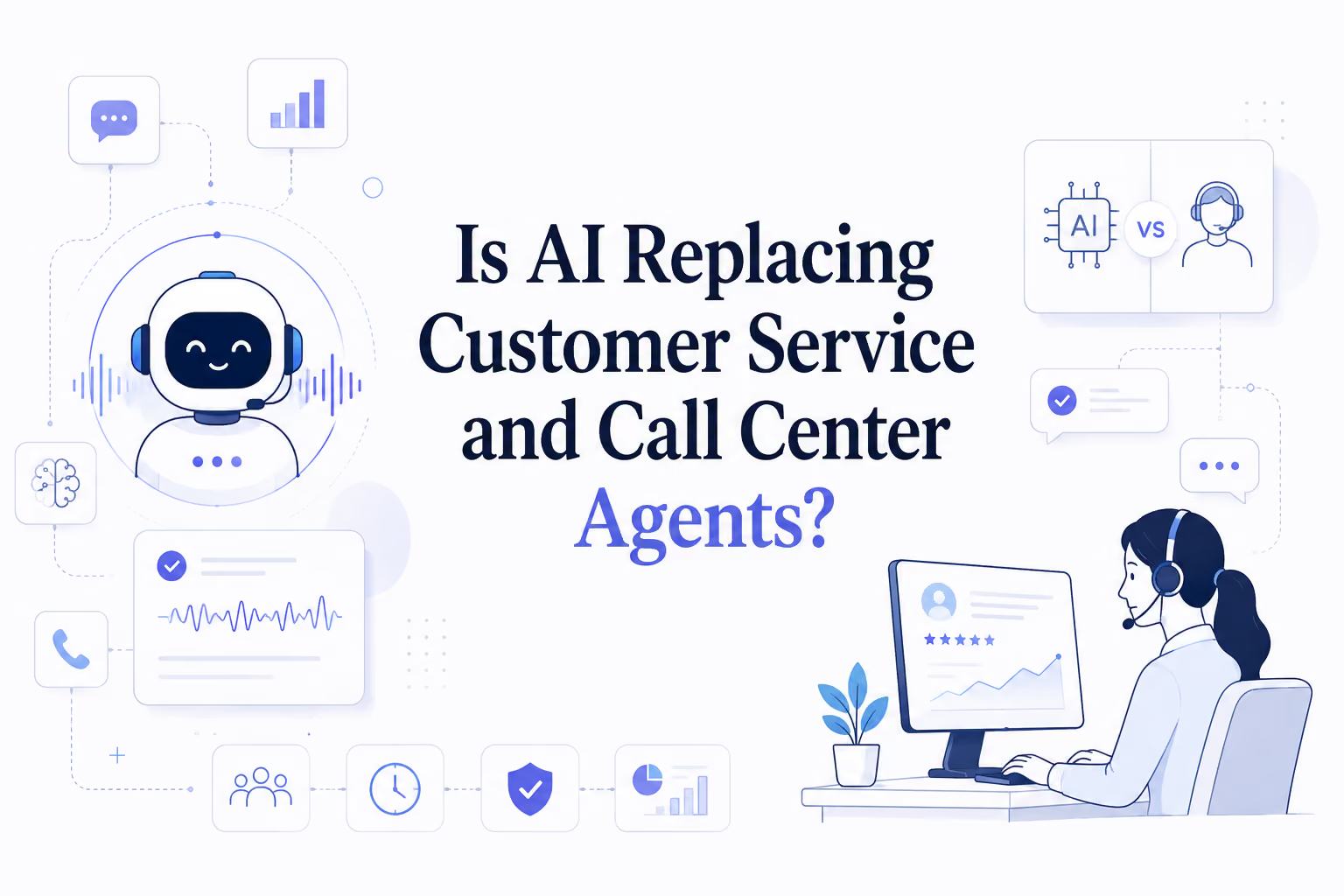
No, AI is not replacing customer service and call center agents wholesale. It's automating the routine share of the work, while agents shift toward the calls that actually need judgment, and the net effect on headcount depends heavily on which role and which team you're looking at. The honest picture is more specific than a yes or no.
This question gets asked with more anxiety than most technology questions do, for a reason. Call center and customer service roles employ millions of people, and a voice AI solution that handles calls competently changes what those jobs look like in a way that's easy to feel and harder to quantify accurately. Most of what gets said publicly on this topic leans toward one extreme or the other, either dismissing the disruption entirely or predicting mass layoffs on a timeline that never quite arrives.
See a Voice AI Solution in Action
Watch SigmaMind AI handle a routine support call and an escalation, back to back, and see exactly where the handoff happens.
What does the data say about AI replacing customer service jobs?
The data shows net job growth overall, with customer service specifically named as a role in decline. That distinction matters more than either half of it on its own, since quoting the net growth number without the category breakdown, or quoting the decline without the broader context, both leave out the part that actually answers the question.
The World Economic Forum's Future of Jobs Report 2025, based on a survey of over 1,000 employers representing more than 14 million workers, projects 170 million new jobs created globally by 2030 against 92 million displaced, a net increase of 78 million. Customer service and related clerical roles are consistently listed among the categories most exposed to that displacement, which is different from most office roles the report covers.
That combination- net growth overall, decline in this specific category- is the accurate answer, and it's why a flat yes or no misrepresents what's actually happening.
Which call center tasks is AI voice technology taking over?
AI voice technology is taking over the tasks that are repetitive, well-defined, and don't require reading a person's emotional state to handle well:
- Order status, account verification, and billing questions
- Password resets, PIN changes, and simple account updates
- Appointment scheduling, confirmations, and rescheduling
- Routine troubleshooting with a known resolution path
- Outbound reminders, follow-ups, and lead qualification calls
An AI call center solution built for these tasks can run them at any hour, without a queue, and log everything automatically. The approach to reducing average handle time without firing your team covers this exact distinction: automating the task doesn't have to mean automating the job out of existence, if the coverage strategy is built around freeing agents for other work rather than just cutting headcount.
What kind of work still needs a human agent?
Work that requires reading a situation, not just following a resolution path, still needs a human agent. That includes calls involving genuine emotional distress, complex account issues without a clean resolution, negotiations, and edge-case policy exceptions a script was never written to handle. Call center voice AI can recognize when a call has crossed into this territory. It generally can't handle the territory itself.
The quality of that handoff matters as much as the automation itself. The same warm transfer logic that makes an escalation feel seamless to a caller is what determines whether the human agents on a team experience AI as something that removes their worst calls or something that dumps every difficult one on them without context.
Is voice AI customer support shrinking teams, or changing what agents do?
Both, depending on the team, and the honest answer is that it's rarely a clean split between the two. Some organizations are reducing headcount as AI absorbs routine volume. Others are holding headcount steady while redirecting agents toward the calls that need real skill, upselling, retention, complex troubleshooting, work that tends to pay better and burn people out less than Tier-1 volume did.
Which outcome a given team lands on tends to track more with how deliberately the rollout was planned than with the technology itself. Teams that automate a call type and immediately cut the exact number of hours it used to take tend to end up shrinking. Teams that automate a call type and then measure what the freed-up time is actually worth, in retention, in upsell, in faster resolution on harder calls, more often end up holding or growing headcount around higher-value work.
The inbound call center specifically is where this shows up first, since inbound volume tends to be the most repetitive and the easiest to automate cleanly. The breakdown of the voice AI stack for inbound calls covers which industries are moving fastest on this and what their staffing decisions have actually looked like in practice, rather than what a vendor pitch predicts.
How should a call center plan for this instead of guessing?
Plan around task automation, not headcount targets set in advance. Map which call types are repetitive enough to automate cleanly, automate those first, and watch what happens to the remaining workload before deciding whether the team gets smaller, gets redirected, or grows into new work AI created rather than eliminated, like managing and auditing the AI system itself.
Agents closest to the phones usually know which calls are actually repetitive and which only look that way on a call-type report. Involving them in the transition, rather than announcing a rollout after the fact, tends to produce a better automation plan and less resistance to it, since the people running the calls every day are usually the first to spot where an AI call center solution will actually save time versus where it will just create a new kind of rework.
Bottom line: AI isn't replacing customer service and call center agents wholesale. It's absorbing the routine share of the work, and the honest question for any team isn't whether that's happening; it's whether the transition gets planned deliberately or discovered after the fact.
Ready to see where a voice AI solution actually fits your team? Talk to the team or start building for free to test it on your own call types.
Evolve with Sigma Mind AI
Build, launch & scale AI agents
Related Blogs
Ready to transform your call center?

More Conversations.
Less Manual Work.

Building from San Francisco, CA