
Voice AI for Inbound Calls: What's Your Tech Stack and Which Industries Are Adopting It Fastest?
What the voice AI agent stack looks like for inbound calls, why hosting and integrations matter, and which service businesses are adopting it fastest.
IN this article

Evolve with Sigma Mind AI
Build, launch & scale AI agents
A caller phones a plumbing company at 7 PM on a Tuesday. Nobody picks up. They hang up and call the next name on the search results page. That's not a story about a bad plumber. It's what happens to almost every service business, on repeat, every single day, and it's the exact gap voice AI agent software was built to close.
See a Live Inbound Call Handled by Voice AI
Watch Sigma Mind AI answer a real inbound call, ask the right qualifying questions, check a live calendar, and book the appointment, all without a human touching the phone.
What does a voice AI agent stack actually look like?
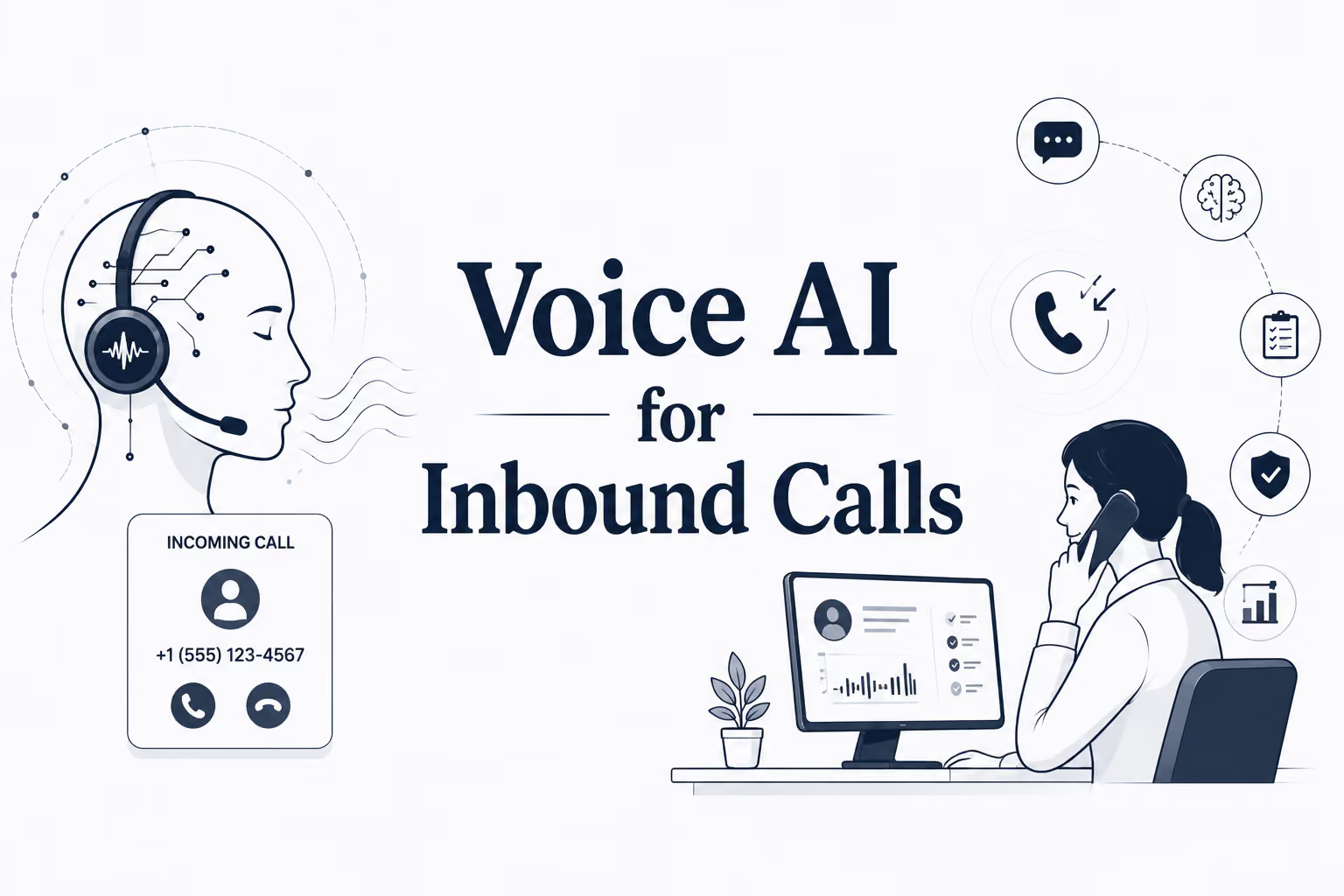
Underneath the conversation, there are four pieces working together on every single call. Telephony receives the call, speech-to-text understands the caller, an LLM decides what to say and when, and text-to-speech turns that decision back into a voice the caller hears. Each of those adds a small amount of delay on its own, and stacked together they decide whether a call feels like talking to a person or talking to a slow, glitchy machine that keeps talking over you.
The part that gets skipped in most sales pitches is what happens between those pieces. A voice AI agent that sounds great in a demo but adds 800 milliseconds of dead air before every response will lose callers fast. Home services callers in particular are usually stressed, standing next to a leaking pipe or a car that won't start, and they don't have patience for pauses that make the call feel like it's thinking too hard.
Why does hosting reliability matter more for inbound calls than most software?
A dropped web form gets resubmitted without much thought. A dropped phone call doesn't work that way. If a voice AI agent's infrastructure hiccups mid-call, the caller just hangs up and dials the next business, and there's no second chance to recover that lead the way there is with email or chat, where a follow-up message can still land.
This is one of the least talked-about parts of call center technology. Redundant call paths and failover aren't a nice-to-have here; they're the difference between an agent that quietly handles thousands of calls a month and one that loses a chunk of them to infrastructure nobody's watching until it's already cost a job. Businesses evaluating voice AI agent software should ask directly about uptime guarantees and what happens when a call comes in during a system hiccup, not just how natural the voice sounds on a good day.
What integrations actually determine whether a voice AI agent works in production?
Handling the conversation is the easy 80%. The harder 20% is what happens after the call. That's what determines whether a business still uses the tool six months later. It means checking real-time calendar availability before offering a slot, booking appointments directly into the scheduling system, automatically logging call outcomes to the CRM, and routing complex issues, like billing disputes, to a human instead of trapping callers in endless menus.
A voice AI agent that talks well but dumps a transcript into an inbox isn't saving anyone time. Someone still has to read it, figure out what happened, and manually update three other systems before the day's done. The integration layer is what actually turns a good conversation into a booked job, and it's usually the least glamorous part of the sales pitch and the most important part of the product.
How much does missed-call recovery actually matter?
More than most businesses expect going in. A voice AI agent that calls a missed inbound back within a minute or two captures a real share of callers who'd already dialed a competitor while the phone was still ringing on the first line. For home services specifically, this matters more than it does almost anywhere else, because the caller isn't casually browsing. They're standing in front of the problem right now, and whoever picks up first usually gets the job.
The data on response speed backs this up outside of voice specifically too. Harvard Business Review's audit of 2,241 companies found that firms contacting a lead within an hour were nearly seven times more likely to qualify it than those who waited even 60 minutes longer, and more than sixty times more likely than companies that waited a full day. Phone calls compress that window even further, since a caller who doesn't get through once usually doesn't try a third time before moving on.
Which business types are showing the most demand for this right now?
Home services, clearly, and by a wide margin. HVAC, plumbing, roofing, garage doors, pest control, electricians- all of them share the same three conditions: every call is a potential job, phones ring constantly during the exact hours nobody's free to answer them, and the caller has no loyalty yet, so a missed call is simply a lost job rather than a delayed one.
Behind that, legal intake and med spas are picking up fast, mostly for the same after-hours and no-show reasons that drive home services demand. What's different in insurance and other regulated categories is that speed to contact and consistent qualification criteria carry real compliance weight on top of the revenue cost, a distinction covered in more depth in our piece on voice AI for insurance lead qualification.
Do AI voice assistants replace the front desk or the dispatcher entirely?
No, and the businesses getting the most value out of this aren't trying to make that happen. Customer service AI is strongest on the repetitive, time-sensitive front end of a call: answering fast, qualifying the caller, checking availability, and booking or routing accordingly. Judgment calls, upset customers, and complicated pricing conversations still go to a person who can actually read the situation.
The shift isn't fewer people answering phones. It's making sure every call gets answered at all, at 7 PM on a Tuesday included, and that the ones worth a human's time actually reach one instead of getting lost in a voicemail nobody checks until Thursday morning.
Getting started with voice AI agent software for inbound calls
The businesses that roll this out well usually start with one call type. Missed-call recovery is the most common starting point, since it's contained, easy to measure, and doesn't touch the main phone line while it's being tuned. Once that's working reliably, most teams expand into full inbound handling and live scheduling, the same phased approach covered in our guide to rolling out voice AI for sales call automation.
Speed and reliability matter more here than almost any other factor in the buying decision. A slick-sounding demo means nothing if the system drops calls during a busy Saturday afternoon, which is exactly when a home services business needs it working the most and has the least patience to troubleshoot it.
Want to see how this handles your actual call volume? Talk to the team or start building for free to test it on your next batch of inbound calls.
Evolve with Sigma Mind AI
Build, launch & scale AI agents
Related Blogs
Ready to transform your call center?

More Conversations.
Less Manual Work.

Building from San Francisco, CA