
How to Handle Escalations From AI to Human Agents (2026)
Learn How to Handle Escalations From AI to Human Agents with 2026-ready triggers, context-rich handoffs, smart routing, and a feedback loop. Get the checklist.
IN this article

Evolve with Sigma Mind AI
Build, launch & scale AI agents
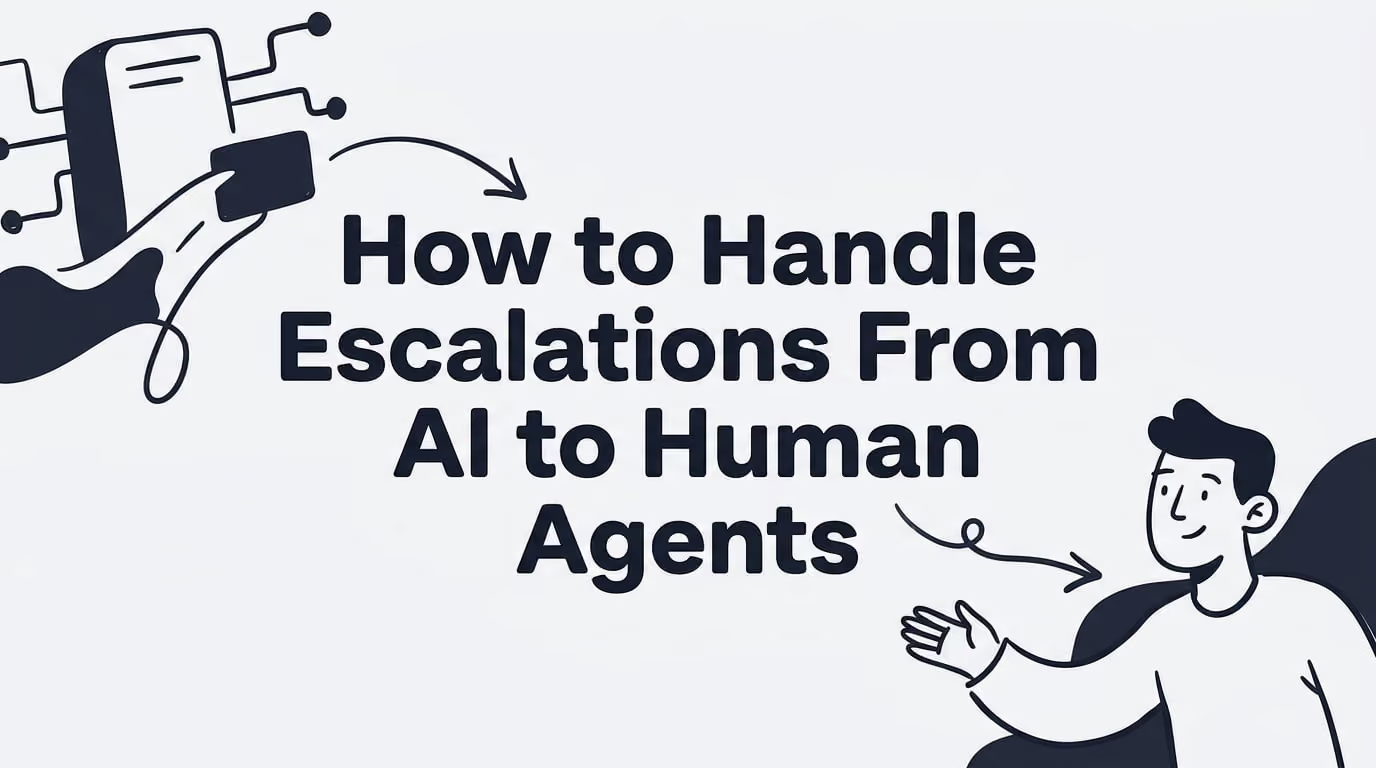
Knowing how to handle escalations from AI to human agents is a critical part of a modern customer experience. To do it well, you must define clear triggers for when a handoff should occur, design a seamless workflow that preserves conversation context, and use every escalation as a learning opportunity. When an AI can’t solve a problem, the transition to a human agent becomes a make or break point. Get it right, and the customer feels supported. Get it wrong, and all the efficiency gains from automation are lost in a sea of frustration.
This guide explores the essential components for building a seamless bridge between automated efficiency and expert human touch, turning potential friction points into moments of customer satisfaction.
Understanding the “When”: Key Escalation Trigger Types
The first step in learning how to handle escalations from AI to human agents is defining exactly when a handoff should occur. A robust system doesn’t rely on a single signal but uses a variety of triggers to catch every scenario where a human is needed.
When the Customer Explicitly Asks
The clearest signal is an explicit trigger. This happens when a customer directly asks for help by typing “talk to an agent,” “I need a human,” or clicking an escalation button. Best practice is to honor this request immediately, no questions asked. Forcing a customer who has already asked for a person to continue with the bot is a fast track to a negative experience. In fact, research shows that 80% of consumers become much more willing to use a chatbot if they know they can easily and quickly transfer to a live person.
When the AI Senses Frustration
Sometimes customers don’t ask for a person directly, but their behavior signals they’re getting stuck. A customer signal trigger uses sentiment analysis and behavioral cues to proactively escalate. These signals include:
- Negative Language: Detecting words like “frustrated,” “useless,” or “angry.”
- Repetition: The customer asks the same question multiple times in different ways.
- Rapid Messages: A quick succession of short messages often means patience is wearing thin.
By monitoring these cues, the AI can intervene before the customer becomes truly upset.
When the AI Knows Its Own Limits
A smart AI understands its boundaries. An AI initiated trigger occurs when the system itself recognizes it’s not equipped to provide a correct answer. This often happens with out of scope questions about a brand new product or when the AI gets stuck in a conversation loop, repeating the same information.
This self awareness is often powered by a confidence based trigger. The AI assigns a confidence score to its potential answers. If the score falls below a set threshold, most users set confidence thresholds between 50% and 70% (Zendesk sets 60%), it will escalate rather than risk giving wrong information. A common rule is to allow the bot two attempts to resolve an issue before escalating on the third try.
When the Conversation’s Context Requires a Human
Finally, a contextual trigger escalates a conversation based on its subject matter or other business rules. Certain topics are simply too sensitive or high stakes for a bot. This includes:
- Keywords like “hacked account,” “overcharged,” or legal concerns.
- High value customers or VIPs who are flagged for priority service.
- Complex issues that have outpaced the bot’s capabilities.
Designing a Seamless Escalation Workflow
Once a trigger is fired, a carefully planned process must unfold. A great escalation workflow design (ideally built in an agent builder) ensures the handoff is a smooth continuation, not an abrupt reset. Failing to plan this journey is one of the biggest mistakes teams make.
Passing the Baton: Context is Everything
The absolute worst customer experience is having to repeat information. The solution is a context transfer element, which is a packet of information that travels with the customer to the human agent. This packet should include:
- A summary of the customer’s intent.
- Key data collected like order numbers or account IDs.
- A log of actions the bot already tried.
- The reason for the escalation.
This information needs to be presented clearly in the agent interface at handoff. A unified view showing the chat history, customer profile, and collected data is critical. When agents have this full context, one business was able to cut customer resolution time by 60%—see this case study on an AI agent handling 4,000+ refunds/month with 43% lower cost.
A more advanced approach is a shared memory architecture, where the bot and human agents work from the same live conversation data. Instead of a “transfer,” the agent simply joins the existing conversation, eliminating any chance of context loss. This is fundamental to platforms like SigmaMind AI, which are built to ensure there is one unified conversation timeline.
Getting the Customer to the Right Person
Simply handing off a customer isn’t enough; they need to land in the right place. In an AI customer support platform, escalation routing matches the customer with the agent or team best equipped to solve their problem on the first try. Instead of a generic queue, smart routing uses the conversation’s context to send a billing question to the billing team or a technical issue to a product specialist. Modern platforms can achieve 95% routing accuracy by using real time agent skill and workload data.
How to Handle Escalations from AI to Human Agents: A Readiness Checklist
Before you enable escalations, run through a checklist to ensure your systems, teams, and processes are ready.
- Provide a Clear Escape Hatch: An obvious “Talk to an agent” option should always be available.
- Define Handoff Messaging: The bot should announce the transfer in a friendly and informative way.
- Plan for Offline Hours: If no agents are available, create a support ticket or offer a callback via automated appointment scheduling.
- Set Rules for Bot Failure: Automatically escalate after two or three failed attempts on the same issue.
- Establish Non Escalation Criteria: Define scenarios where the bot should persist to avoid unnecessary handoffs for issues it can actually solve.
- Ensure Context is Transferred: Verify that your system passes the full conversation history and data to the agent.
- Create a Feedback Loop: Use every escalation as a learning opportunity. An escalation learning loop involves analyzing handoffs to find gaps in the AI’s knowledge, continuously improving the system to reduce future escalations. Every escalation can make the system smarter.
Following this checklist helps you avoid common handoff failure causes like lost context, misrouting, and abrupt transitions, which often stem from the bot and human agent systems operating in separate silos.
The Handoff: Your Customer Experience Moment of Truth
The instant a customer is passed from AI to human is the handoff moment of truth. It’s the single most important interaction in a hybrid support model. A smooth transition reinforces trust, while a clunky one can erase any goodwill the AI has built.
The goal isn’t to eliminate escalations entirely. For a mature system, the AI can achieve containment rates exceeding 80% for tier-one inquiries. The focus should be on making the necessary escalations feel effortless.
Platforms like SigmaMind AI are designed specifically for this moment. With features like Warm Transfer, the system sends the human agent an AI generated summary and key context in real time. This allows the agent to start the conversation with “I see you’re looking for a refund for order #4829,” not “How can I help you?” This is how to handle escalations from AI to human agents in a way that truly puts the customer first.
If you’re ready to build production grade voice agents that can automate tasks and handle escalations with grace, start building for free with SigmaMind AI.
Frequently Asked Questions about How to Handle Escalations from AI to Human Agents
What is the most important part of an AI to human handoff?
The most critical part is preserving context. The customer should never have to repeat information they’ve already given to the AI. A seamless transfer of the full conversation history and any collected data (like an order number) to the human agent is essential for a positive experience.
How do you decide when an AI should escalate to a human?
A robust system uses multiple trigger types. This includes explicit triggers (the user asks for an agent), confidence based triggers (the AI’s certainty is low), contextual triggers (the topic is sensitive), and customer signal triggers (the AI detects frustration).
What is a good escalation rate for a customer service bot?
While it varies by industry, a strong benchmark is that Self-service channels such as mobile apps, IVR systems, and internet sites handle 70–80 percent of interactions. This leaves a handoff rate of 20-30% for more complex or sensitive issues that require a human touch. A highly optimized system might even lower this to 10-15%.
How can I prevent customers from having to repeat themselves?
The key is ensuring your systems can perform a “warm transfer.” This means the bot sends a complete package of information, including a conversation summary and key data points, to the human agent before they join the chat or call. For a walkthrough, see our guide on how to escalate calls to humans without losing context. Using a platform with a shared memory architecture, where the bot and agent access the same data, is the most effective way to solve this.
What is the biggest cause of handoff failure?
The most common cause of failure is lost context, which happens when the bot and human agent operate on separate, disconnected systems. This forces the customer to start over and leads to immense frustration. Proper integration and context transfer are the solutions.
How can I improve my AI’s performance over time?
Implement an escalation learning loop. Regularly analyze the conversations that are escalated to human agents. This data reveals the gaps in your AI’s knowledge or capabilities. Use these insights to train your bot and expand its knowledge base, systematically reducing the number of unnecessary handoffs.
Evolve with Sigma Mind AI
Build, launch & scale AI agents
Related Blogs
Ready to transform your call center?

More Conversations.
Less Manual Work.

Building from San Francisco, CA