
How to Create Omnichannel Conversational Agents in 2026
Learn How to Create Omnichannel Conversational Agents that share context across voice, chat, SMS, and email with RAG, CRM/API integrations, and smart handoffs.
IN this article

Evolve with Sigma Mind AI
Build, launch & scale AI agents
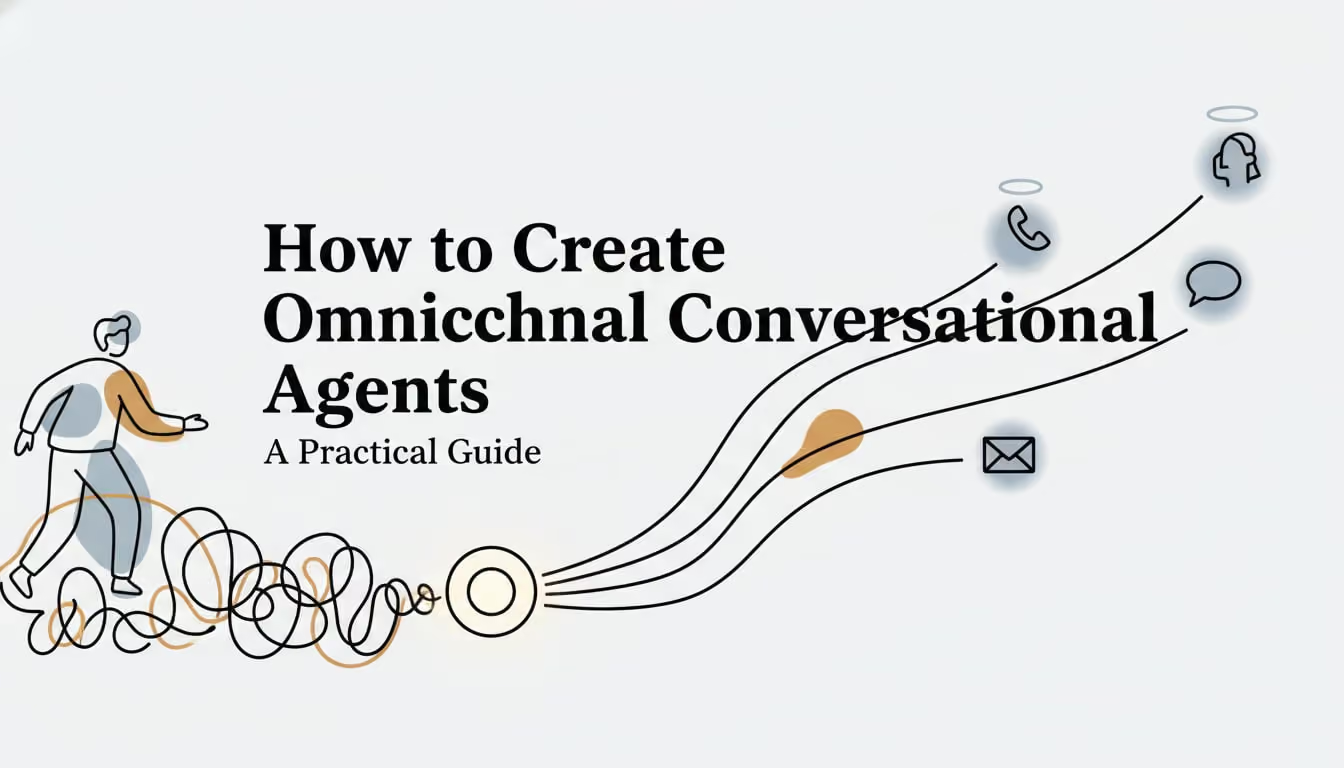
Customer service can feel like a maze. You start a chat on a website, get disconnected, send an email, and then call in only to repeat your entire story for the third time. It’s frustrating for customers and inefficient for businesses. The solution isn’t just about being available on more channels; it’s about connecting them into a single, intelligent conversation.
To create omnichannel conversational agents, you must design a core conversational AI, integrate it with business systems for real-time data and actions, and then deploy that single intelligent brain across all your customer touchpoints, from web chat to voice calls. These AI powered assistants provide a seamless, unified experience that eliminates the frustration of disconnected channels. This guide will walk you through each step of this process, showing you how to build agents that not only answer questions but also solve problems, delight customers, and drive business growth.
Part 1: Understanding the Omnichannel Foundation
Before you can build, you need to understand the core principles. Creating a great conversational agent starts with a solid omnichannel strategy.
What is Omnichannel Customer Service? (And How It Beats Multichannel)
It’s easy to confuse omnichannel with multichannel, but they are worlds apart. Multichannel means you offer support on several channels, like phone, email, and social media. The problem is these channels often operate in silos. An email conversation doesn’t know what happened in a web chat.
Omnichannel customer service, on the other hand, integrates all these touchpoints into one seamless journey. A customer can start a conversation on Twitter, switch to email, and then hop on a call without ever losing context or having to repeat themselves. This cohesive experience has a massive impact on loyalty. Businesses with strong omnichannel strategies retain an average of 89% of their customers, compared to just 33% for those with weak strategies. In short, multichannel is about offering options, while omnichannel is about offering a connected, high quality experience that improves customer experience and ROI.
Why Context and Journey Mapping Are Your Superpowers
At the heart of a great omnichannel experience are two things: context and a deep understanding of the customer journey.
Channel integration and context sharing is the technical backbone. It means your systems are linked so that conversation history follows the customer from one channel to the next. This is critical, because a staggering 31% of customers said having to repeat or provide their information multiple times is the most frustrating aspect of a poor customer service experience. A truly integrated system makes this a problem of the past.
Customer journey mapping is the strategic part. It’s the process of visually outlining every step a customer takes when interacting with your company. By mapping this journey, you can identify pain points and opportunities for improvement. Brands that actively map customer journeys saw a 17.9% year-over-year increase in revenue from customer referrals, while those that don’t saw a 2.2% decline. It helps you step into your customer’s shoes and design a better path for them.
The Tech: Core Features of an Omnichannel Platform
To make all this happen, you need the right technology. An omnichannel contact center platform unifies all your communication channels into a single system. Key features include:
- Unified Channel Integration: All channels (voice, chat, email, social) feed into one system.
- Intelligent Routing: Inquiries are automatically sent to the right agent or bot based on skill, priority, or customer history.
- A Unified Agent Workspace: This is a single screen where human agents can manage conversations from any channel, see customer history, and access tools without juggling multiple apps.
- Analytics and Reporting: You need to measure what matters. A good platform tracks metrics across all channels, giving you a holistic view of performance. Companies with strong omnichannel strategies have seen a 9.5% year over year increase in annual revenue.
Platforms like SigmaMind AI are designed to be the central brain for these operations, allowing you to build your logic once and deploy it everywhere.
Part 2: Blending Automation with the Human Touch
The best systems don’t replace humans; they empower them. Here’s how to create omnichannel conversational agents that work in harmony with your team.
Automation with a Smart Human Handoff
Automation is perfect for handling common, repetitive questions 24/7. An AI agent can instantly answer things like “Where is my order?” or “What’s your return policy?” This frees up your human agents to focus on complex, high value interactions.
However, the key is a seamless human handoff. When an issue is too complex or a customer is frustrated, the AI must intelligently escalate the conversation to a person. And when it does, it needs to pass along the entire context. Customers expect this flexibility; in fact, 89% of people believe companies should always offer a way to connect with a human representative. A platform that supports a warm transfer with full inbound call context, where the human agent receives a live summary before joining, is crucial for a smooth transition.
Empowering Agents with AI and Analytics
AI isn’t just for customer facing bots. It’s also a powerful tool for boosting your human agents’ performance. AI driven speech analytics can evaluate 100% of calls for quality and sentiment, uncovering coaching opportunities that manual sampling would miss.
Real time agent assist tools can pop up suggested answers or relevant knowledge base articles during a live call or chat. This creates a powerful partnership where technology handles the data and agents handle the relationship.
Navigating Implementation and Agent Adoption
Making the switch to an omnichannel, AI powered model is a big change. Key challenges often include integrating siloed legacy systems, securing budget, and managing the human side of the transition.
Proper agent training and adoption are critical. It’s important to frame new AI tools as assistants that are there to help, not replace. Show agents how automation will reduce their tedious tasks, allowing them to focus on more engaging work. With 70% of CX leaders planning to integrate generative AI into customer touchpoints in the next two years, proactive training isn’t just a good idea, it’s a necessity for a smooth transition.
Part 3: A Step by Step Guide on How to Create Omnichannel Conversational Agents
Now for the practical part. Building a powerful AI agent involves a clear, iterative process.
Step 1: Define Your Strategy and Design the Conversation
- Define Use Cases and Goals: What problem will your AI agent solve? Start specific. Are you trying to deflect common FAQs, automate order tracking, or qualify sales leads? Setting measurable goals (e.g., “reduce password reset calls by 40%”) is crucial for success.
- Select Your LLM or NLP Stack: Choose the “brain” for your agent. This involves selecting a Large Language Model (LLM) like GPT 4o or an NLP engine. Consider factors like accuracy, speed, cost, and integration capabilities. A model agnostic platform like SigmaMind AI gives you the flexibility to choose the best tech for each specific job.
- Design Intents and Dialog Flow: An intent is what the user wants to do (e.g., ‘check order status’). A dialog flow is the conversational path the agent follows to fulfill that intent. Map out these flows like a script, planning for different branches and potential user inputs.
Step 2: Make Your Agent Smart and Actionable
- Integrate Knowledge with Retrieval Augmented Generation (RAG): An AI agent is only as good as the information it can access. RAG is a technique that allows your agent to retrieve real time information from your knowledge base, product manuals, or policies to provide accurate, up to date answers. This is how you prevent the AI from making things up (a problem known as hallucination).
- Integrate with Business Systems (CRM, APIs, etc.): To be truly useful, your agent needs to do more than just talk. It needs to take action. By integrating with your CRM, helpdesk, and payment APIs, your agent can process refunds, book appointments, update customer records, and create support tickets directly within the conversation. Automating these tasks can lead to massive efficiency gains; one brand automated over 4,000 refunds a month, cutting costs by 43%.
Step 3: Test, Refine, and Test Again
- Test with Real User Scenarios and Edge Cases: Before you go live, you need to test rigorously. Run through common scenarios (the happy path) and tricky edge cases (e.g., confused users, multiple questions at once, hostile language). A poor bot experience can be costly, as one in three customers will leave a brand they love after just one bad service interaction.
- Ensure Session Integrity and Conversation Memory: Your agent must remember the context of the conversation. If a customer provides their order number, the bot shouldn’t ask for it again two minutes later. Good conversation memory is what makes an interaction feel coherent instead of robotic and frustrating.
Step 4: Launch, Monitor, and Continuously Improve
- Launch and Monitor Performance: Consider a soft launch, perhaps on a single channel or to a small percentage of users. Set up dashboards to monitor key metrics like containment rate (how many issues the bot resolves on its own), user satisfaction, and escalation rates.
- Embrace Continuous Improvement: Launch is just the beginning. Regularly review conversation transcripts to identify areas where the agent struggled. Use this data to train the AI, refine dialog flows, and update your knowledge base. Your AI agent should be treated like a digital employee that gets smarter and more capable over time.
Step 5: Deploy Everywhere Your Customers Are
The final step in learning how to create omnichannel conversational agents is the deployment itself. A true omnichannel agent uses the same core logic across every channel, ensuring a consistent experience.
- Deploy on WhatsApp, SMS, and Web Chat: Deploy your agent on the text based channels your customers already use. Tailor the responses to fit the format; for example, use shorter messages for SMS and richer elements like buttons and carousels for web chat. With 73% of consumers using multiple channels during their journey, being present everywhere is key.
- Integrate with Voice (Replacing IVR): This is a game changer. Replace your clunky, frustrating “press 1 for sales” IVR with an intelligent voice agent that understands natural language. Customers can simply state what they need, and the AI can either resolve the issue or route them to the right human, context included. This creates a faster, more pleasant experience for callers.
For a process this complex, using a unified platform is essential. SigmaMind AI’s no code builder allows you to design your agent’s logic once and then deploy it across voice, chat, and email, saving countless hours of development time.
Conclusion: The Future is a Single, Smart Conversation
Learning how to create omnichannel conversational agents is no longer a futuristic luxury; it’s a modern necessity for delivering exceptional customer experiences at scale. By combining a customer centric strategy with powerful and flexible technology, you can build AI assistants that are helpful, efficient, and available wherever your customers need them.
The journey involves understanding the omnichannel foundation, blending automation with human expertise, and following a structured process of design, integration, testing, and continuous improvement. By breaking down silos and uniting your channels into a single, intelligent conversation, you’ll not only meet customer expectations but also build lasting loyalty.
Ready to build your first agent? Explore the tools and start for free on SigmaMind AI to see how you can bring your conversational AI vision to life.
Frequently Asked Questions (FAQ)
1. What are omnichannel conversational agents?
Omnichannel conversational agents are AI powered bots that provide a consistent and integrated customer experience across all communication channels, including voice, web chat, SMS, and social media. They maintain context, so a customer can switch channels without having to repeat information.
2. What’s the main difference between omnichannel and multichannel agents?
A multichannel agent operates on several platforms, but these platforms are disconnected. An omnichannel agent operates on an integrated system where all channels are connected, allowing for a seamless conversation and shared context for the customer and the business.
3. How do you ensure an AI agent gives accurate answers?
Accuracy is achieved primarily through a technique called Retrieval Augmented Generation (RAG). This allows the agent to retrieve real time, verified information from a company’s internal knowledge base, product documents, or databases before generating an answer, which greatly reduces errors and prevents the AI from making things up.
4. What are the biggest challenges when you create omnichannel conversational agents?
The primary challenges are often technical and organizational. Technically, integrating disparate legacy systems (like old CRMs and phone systems) can be complex. Organizationally, it requires breaking down internal silos between departments and managing the change process, including training human agents to work effectively alongside their new AI counterparts.
5. Can a single AI agent really work on both voice and chat?
Yes. Modern platforms for creating omnichannel conversational agents, like SigmaMind AI, allow you to design the core conversational logic (the “brain”) once. You can then connect that brain to various channel endpoints, including telephony for voice and APIs for chat apps. The platform handles the channel specific nuances, like speech to text for voice or formatting for chat.
6. How important is a human fallback option for an AI agent?
It is absolutely critical. No AI is perfect, and customers expect the ability to speak to a person for complex or sensitive issues. Research shows 89% of consumers believe a human option should always be available. A well designed system includes clear and easy escalation paths to a human agent, ideally with a warm transfer that passes on the full conversational context.
Evolve with Sigma Mind AI
Build, launch & scale AI agents
Related Blogs

Ready to transform your call center?

More Conversations.
Less Manual Work.

Building from San Francisco, CA