
How Real-Time Voice AI Works: STT, LLM, and TTS Explained for Call Center Buyers
Positions the blog as a buyer's education piece; hooks decision-makers who are mid-evaluation
IN this article

Evolve with Sigma Mind AI
Build, launch & scale AI agents
You've heard the pitch a dozen times: deploy a Voice AI technology platform and your call center handles more calls, at lower cost, without adding headcount. But before you sign a contract or run a pilot, there's a question worth asking: how does it actually work?
Understanding the mechanics behind a Voice AI agent isn't just useful for your engineering team. As a CEO, founder, or operations leader, knowing what happens inside each call from the moment a customer speaks to the moment they hear a response helps you ask better questions during vendor evaluations, set realistic performance expectations, and avoid the most common implementation mistakes.
This guide explains the three-stage pipeline that powers every real-time Voice AI call: Speech-to-Text (STT), Large Language Models (LLM), and Text-to-Speech (TTS). No jargon, no code. Just a clear picture of the technology making your calls work.
See the Pipeline in Action
SigmaMind AI delivers sub-800ms real-time Voice AI for call centers with native VICIdial integration, no infrastructure replacement required.
Sign Up Free → Try SigmaMind AI
What Is the STT → LLM → TTS Pipeline?
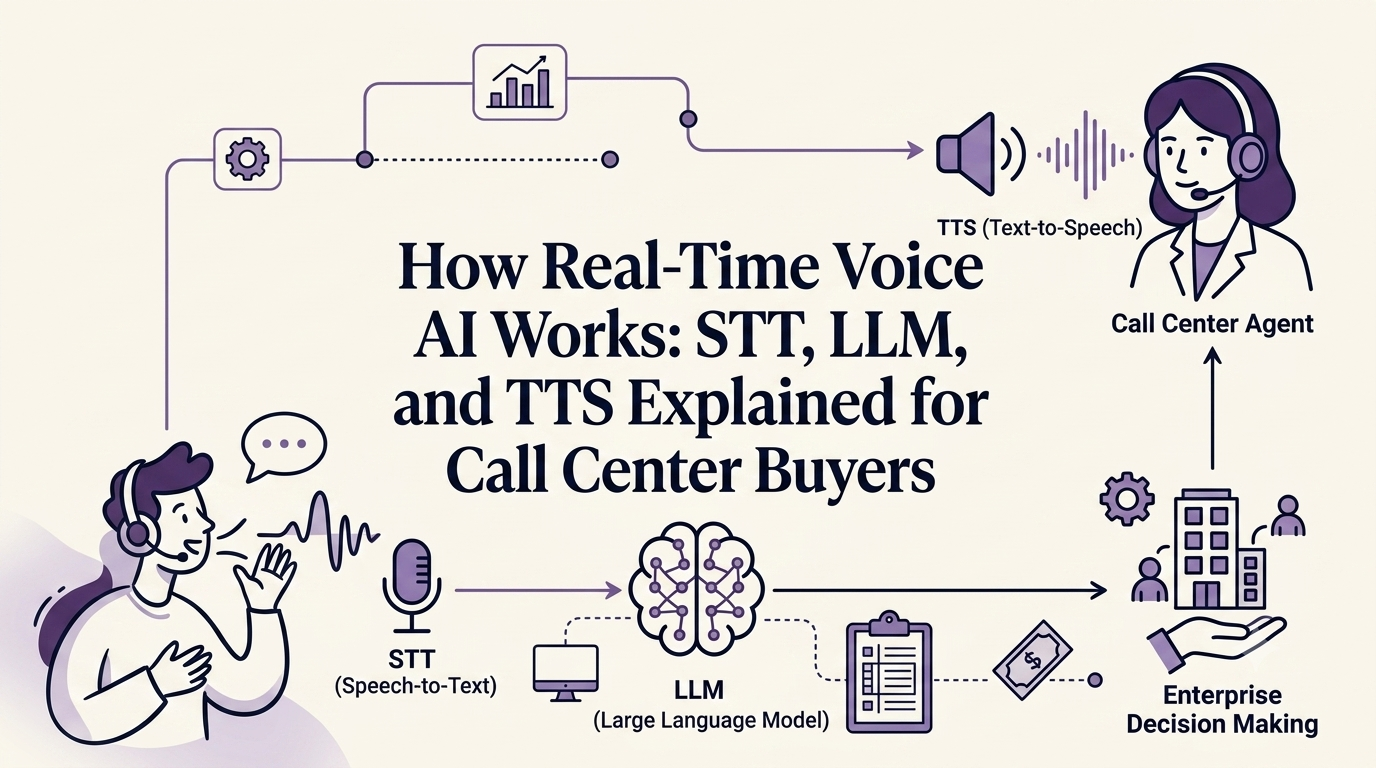
Every real-time Voice AI agent regardless of the platform runs on a three-stage architecture. Think of it as an assembly line that processes a conversation in under a second:
In a basic setup, these three stages run one after another, wait for STT to finish, then send to LLM, then send to TTS. That sequential approach introduces 2–4 seconds of dead air before the caller hears anything, which immediately breaks the conversational feel and frustrates callers.
Production-grade platforms like SigmaMind AI run these stages in a streaming pipeline, where each stage feeds into the next in parallel dramatically cutting response latency to under 800 milliseconds.
Stage 1: What Is Speech-to-Text (STT) and Why Does Accuracy Matter?
Speech-to-Text is the first point of failure or success in any Voice AI call. If the STT engine mishears a caller misreading "schedule a callback" as "cancel my contract" every downstream decision the AI makes will be wrong.
In a streaming architecture, STT doesn't wait for the caller to finish their sentence. It emits partial transcripts every 50 milliseconds while the person is still speaking. These partial results are passed downstream to the LLM immediately, so the AI can start reasoning about the response before the caller has even finished talking.
What matters for call centers: Accuracy on industry-specific vocabulary (insurance terms, debt collection language, home services jargon), noise tolerance on mobile calls, and support for regional US accents. A generic consumer STT model trained on clean audio will underperform in a high-volume outbound environment.
Modern STT engines also handle Voice Activity Detection (VAD) detecting when the caller starts and stops speaking. Poor VAD is what causes AI agents to cut callers off mid-sentence or sit in awkward silence for two seconds before responding. It's one of the biggest differentiators between demo-grade and production-grade Voice AI systems.
Stage 2: What Does the LLM Actually Do on a Live Call?
The Large Language Model is where intelligence lives. But calling it "just a chatbot with a voice" undersells what it's doing on a production call.
The LLM receives the caller's transcript and simultaneously has access to:
- The full conversation history from this call (so it never asks the same question twice)
- Your business rules and call script (pricing, eligibility, escalation triggers)
- Live CRM data (caller name, account status, previous interactions)
- Tool-calling capabilities (book an appointment, update a lead record, trigger a transfer)
It then generates a response token by token and in a streaming pipeline, those tokens are passed to the TTS engine as they arrive, rather than waiting for the complete response. This is why the caller hears the first word of the AI's reply within milliseconds of finishing their sentence, while the rest is still being generated in the background.
The latency reality: In production, LLM time-to-first-token is the biggest variable in end-to-end call latency, not STT, not TTS. Choosing a platform with an optimized LLM layer (fast model selection, concise system prompts, efficient context management) is the single biggest lever for making your Voice AI sound natural.
This is also where barge-in handling becomes critical. When a caller interrupts the AI mid-response which happens constantly on real calls the platform must immediately stop TTS playback, discard whatever the LLM was saying, and restart the full pipeline from the caller's new input. Platforms that handle this poorly leave callers talking over the AI, which damages trust and conversion rates on every campaign.
Stage 3: What Makes Text-to-Speech Sound Human (or Robotic)?
Text-to-Speech is the final mile of the pipeline converting the LLM's text response into audio the caller actually hears. The quality gap between TTS engines has narrowed significantly in 2026, but it still matters enormously in a call center context.
In a streaming pipeline, TTS doesn't wait for the full response to be ready. It converts text into audio in 200–400ms chunks, playing back the first sentence while the LLM is still generating the rest. The caller hears a fluid, natural-paced reply, not a single burst of audio that arrives after a long pause.
What separates human-sounding TTS from robotic-sounding TTS in 2026 is no longer primarily voice quality, it's timing and turn-taking. An AI that pauses at the right moments, varies its pace naturally, and responds immediately when interrupted will sound far more human than one with a premium voice but poor latency management.
What buyers often overlook: The "demo voice" and the "production voice" are often different. Always test TTS quality under realistic call conditions mobile audio, background noise, rapid back-and-forth exchanges not just a clean studio demo.
How Does This Pipeline Apply to High-Volume Call Centers?
For call center operators running hundreds or thousands of concurrent calls, the STT → LLM → TTS pipeline introduces unique infrastructure challenges that consumer-grade Voice AI tools simply aren't built for.
At scale, latency doesn't increase linearly; it spikes. A pipeline that runs at 600ms on 10 simultaneous calls can balloon to 2+ seconds at 500 concurrent sessions when components hit their throughput limits. Production platforms handle this through edge infrastructure, parallel processing, and graceful degradation protocols that maintain quality under load.
This is particularly relevant for teams currently running AI Voice agent with VICIdial integrations. Because VICIdial manages its own dialing and call routing, the Voice AI layer needs to register as a standard SIP agent within the existing infrastructure accepting connected calls, running the full STT/LLM/TTS pipeline, and handing off warm transfers with full call context without touching your VICIdial configuration. SigmaMind AI is purpose-built for exactly this architecture.
What Should Call Center Buyers Ask Before Choosing a Voice AI Platform?
Now that you understand the pipeline, here are the five questions that separate serious platforms from demo-stage tools:
- What is your end-to-end latency in production, not demos? Ask for p50 and p95 latency at 100+ concurrent calls.
- How does your platform handle barge-in and interruptions? Any hesitation on this question is a red flag.
- Which STT engine do you use, and is it tunable for our industry vocabulary? Domain-specific accuracy matters for insurance, debt collection, and home services.
- Can your LLM layer call external tools during a live call? CRM updates, appointment bookings, and real-time data lookups during a conversation are table stakes in 2026.
- How does your platform scale to 500+ concurrent calls without latency degradation? Get infrastructure specifics, not marketing language.
The Bottom Line: Voice AI Technology Is Infrastructure, Not Magic
Understanding the STT → LLM → TTS pipeline gives you a meaningful edge when evaluating Voice AI platforms. The difference between a Voice AI agent that sounds human and one that sounds like an old IVR is not the brand name, it's the quality of each stage, the streaming architecture connecting them, and the infrastructure running it all at scale.
SigmaMind AI is built from the ground up for production call center environments: sub-800ms end-to-end latency, native integration with existing dialers, no infrastructure changes required, and human-like voice quality across high-volume concurrent sessions. Whether you're running outbound insurance campaigns, home services lead qualification, or debt collection workflows, the pipeline powering every SigmaMind call is designed to handle what real callers actually do: interruptions, accents, fast back-and-forth not just what they do in a demo.
Ready to See It Work on Your Calls?
Sign up and deploy your first Voice AI agent in minutes, no infrastructure changes, no engineering team required. SigmaMind connects to your existing stack from day one.
Sign Up Free → Start Your SigmaMind Trial
Evolve with Sigma Mind AI
Build, launch & scale AI agents
Related Blogs
Ready to transform your call center?

More Conversations.
Less Manual Work.

Building from San Francisco, CA