
How AI Voice Agents Perfect Warm Transfers to Human Agents
Learn how AI voice agents make warm transfers seamless by carrying conversation context to human agents, so callers never repeat themselves.
IN this article

Evolve with Sigma Mind AI
Build, launch & scale AI agents
Quick summary
A warm transfer carries full context, everything discussed so far, caller intent, and account details, from an AI voice agent to a human agent, unlike a cold transfer that drops the caller into a fresh conversation. Repeating information is one of the most consistently cited frustrations in customer service research, which makes context-carrying handoffs a real driver of caller satisfaction, not just a nice-to-have feature.
AI chatbot implementation and voice agent deployment both depend on getting this right, since a poorly built handoff can make automation feel worse than no automation at all. The technical requirement is a live summary and structured data passed to the receiving agent's screen the moment the transfer connects, not a recording the human has to relisten to.
AI voice agents are perfecting the warm transfer by carrying full conversation context, everything the caller has already said, into the handoff with a human agent, so the caller never has to repeat themselves when a call moves from AI to human. That single detail is what separates a warm transfer that feels seamless from one that feels like starting over.
Warm transfer isn't a new concept. Call centers have tried to do it well with human-to-human handoffs for years, with mixed results. AI voice agent deployment is making it far more consistent, because the context travels automatically instead of depending on one agent remembering to brief the next.
See a Warm Transfer Done Right
Watch SigmaMind AI hand off a live call to a human agent with full context already on their screen.
What makes a transfer "warm" instead of "cold"?
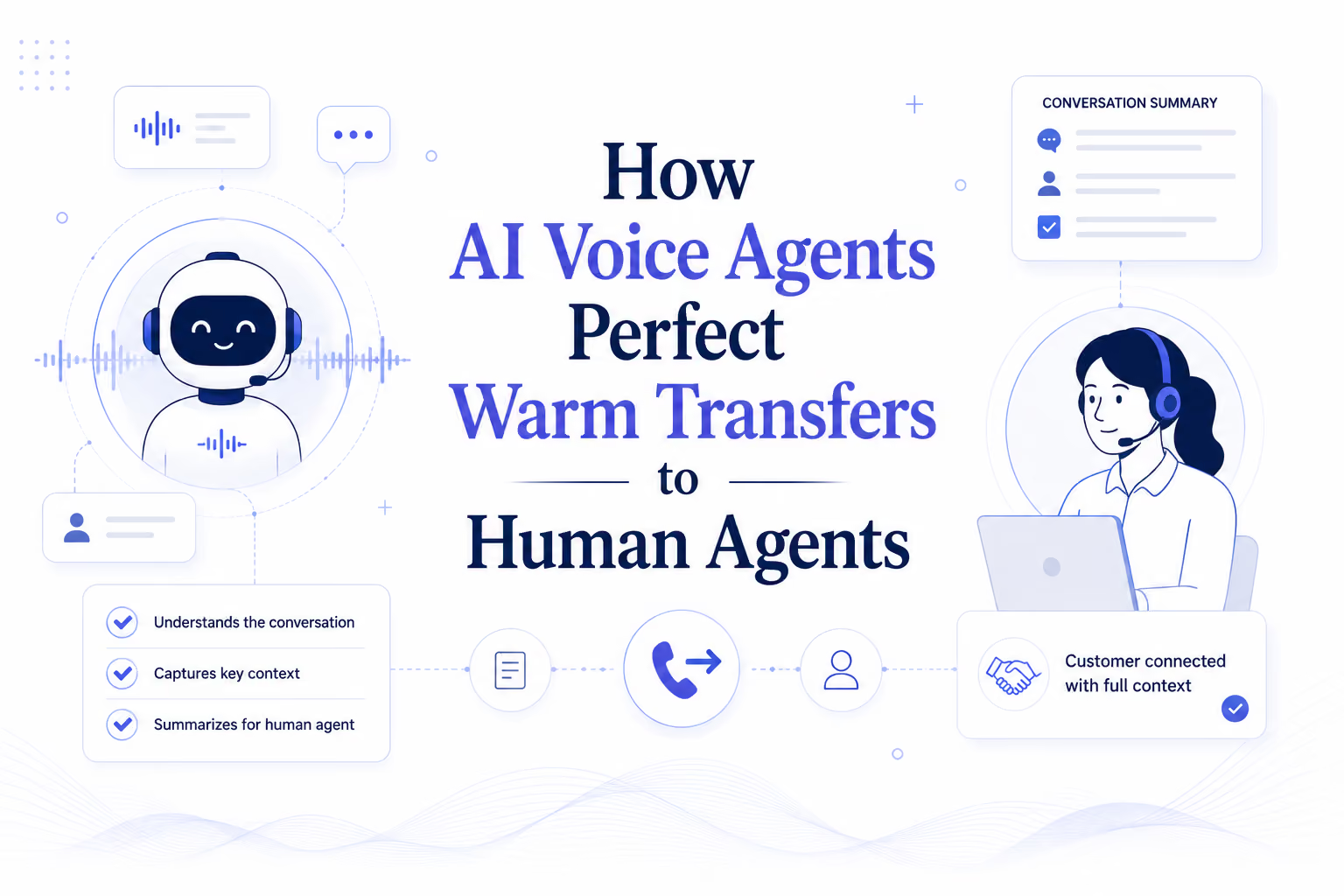
A warm transfer carries context with the caller; a cold transfer doesn't. In a cold transfer, the receiving agent picks up with no information beyond maybe a queue name, and the caller has to explain their situation again from scratch. In a warm transfer, the receiving agent receives a summary of the conversation so far, the caller's intent, and any relevant account details before the caller says a word, so the conversation continues rather than restarts.
For conversational AI for call centers in the USA, this distinction has become the actual measure of whether an AI deployment feels helpful or frustrating to callers, more than any measure of the AI's conversation quality on its own.
Why does repeating information frustrate callers so much?
Because it signals that the company wasn't actually listening the first time, and callers experience that as disrespect, not just inconvenience. iQor's CPX 360 survey found that 77% of consumers said repeating information three times during a support call was more frustrating than being stuck in airport security, and 85% who had to repeat themselves found it extremely or somewhat annoying. source Among those whose information wasn't carried forward, 81% said it delayed their resolution.
That's the real cost of a cold handoff: it's not just an annoyance; it measurably slows down the outcome the caller was trying to get to in the first place.
How does an AI voice agent actually carry context into a human handoff?
It builds a structured summary throughout the call, not just at the moment of transfer, and pushes that summary to the receiving agent's screen the instant the handoff happens. That summary typically includes:
- What the caller has already said, condensed into a few key points, not a full transcript to read.
- Any account or order details the AI already pulled up during the call.
- The specific reason the call is being escalated, so the human isn't guessing why they received it.
This has to happen fast enough that there's no dead air on the line while the human reads a briefing, which means the summary needs to be ready before the transfer completes, not generated after.
What triggers a warm transfer from AI to a human agent?
The clearest triggers are ones the AI can detect directly: a caller explicitly asking for a person, a request outside the AI's defined scope, signs of genuine frustration or distress in tone, or a compliance-sensitive situation the AI is built to escalate rather than handle. Voice AI agent deployment done well treats these triggers as designed decision points, not fallback behavior for when the AI gets confused.
What does a well-built warm transfer require technically?
It requires the AI platform and the human agent's system, whether that's a dialer, a CRM, or both, to share data in real time, not through a delayed sync. This is usually the same integration layer that connects a voice AI agent in call centers to the phone system in the first place. The approach for adding AI voice agents to VICIdial without replacing your infrastructure covers this exact media bridge, since a warm transfer is only as good as the connection carrying both the call and the context underneath it.
That real-time requirement is also where a lot of warm transfer builds quietly fail. A summary that generates correctly but takes three or four seconds to reach the human agent's screen still produces a noticeable gap on the line, one the caller experiences as the call going quiet right at the moment they expected to be connected to someone new.
Platform choice matters here too, since not every conversational AI platform handles structured handoff data the same way. The comparison of the top conversational AI agent platforms is worth checking specifically for how each one handles this, rather than assuming warm transfer works the same everywhere.
Getting started with warm transfer in your voice AI deployment
Map your actual escalation triggers before building the handoff logic, not after. Test the transfer with a real, messy call, not a clean scripted one, and confirm the human agent actually receives context instantly rather than a few seconds late. The same context-carrying discipline applies to outbound sales handoffs too, where a qualified lead handed to a rep with zero context wastes the exact advantage speed-to-contact was supposed to create, a pattern covered in the playbook for using voice AI for lead generation.
Bottom line: a warm transfer is only as good as the context it carries. AI voice agents that pass a real-time summary into the human handoff turn escalation into a continuation of the conversation instead of a restart, which is the difference callers actually notice.
Ready to see a real warm transfer, not a scripted one? Talk to the team or start building for free to test it on your own calls.
Evolve with Sigma Mind AI
Build, launch & scale AI agents
Related Blogs

Ready to transform your call center?

More Conversations.
Less Manual Work.

Building from San Francisco, CA