
Voice AI Fine-Tuning: Practical Strategies to Improve Accuracy (2026)
Learn practical voice AI fine-tuning strategies using transfer learning, production data, and accent optimization. Improve speech recognition accuracy without retraining models from scratch.
IN this article

Evolve with Sigma Mind AI
Build, launch & scale AI agents
Quick summary
Fine-tuning improves a voice AI model on specific vocabulary, accents, or conversational patterns without training a new model from scratch. Transfer learning, starting from a pre-trained model and adjusting it with your own data, is the practical entry point, since it's faster and needs far less data than training from zero. The data that actually moves accuracy is real production audio from your own use case, not generic public datasets.
Custom training on domain-specific vocabulary can improve transcription accuracy by 5 to 15%, often bringing word error rate below 5% in specialized domains. Not every quality problem is a model problem though; latency issues, telephony configuration, and prompt design cause a lot of what looks like a fine-tuning gap.
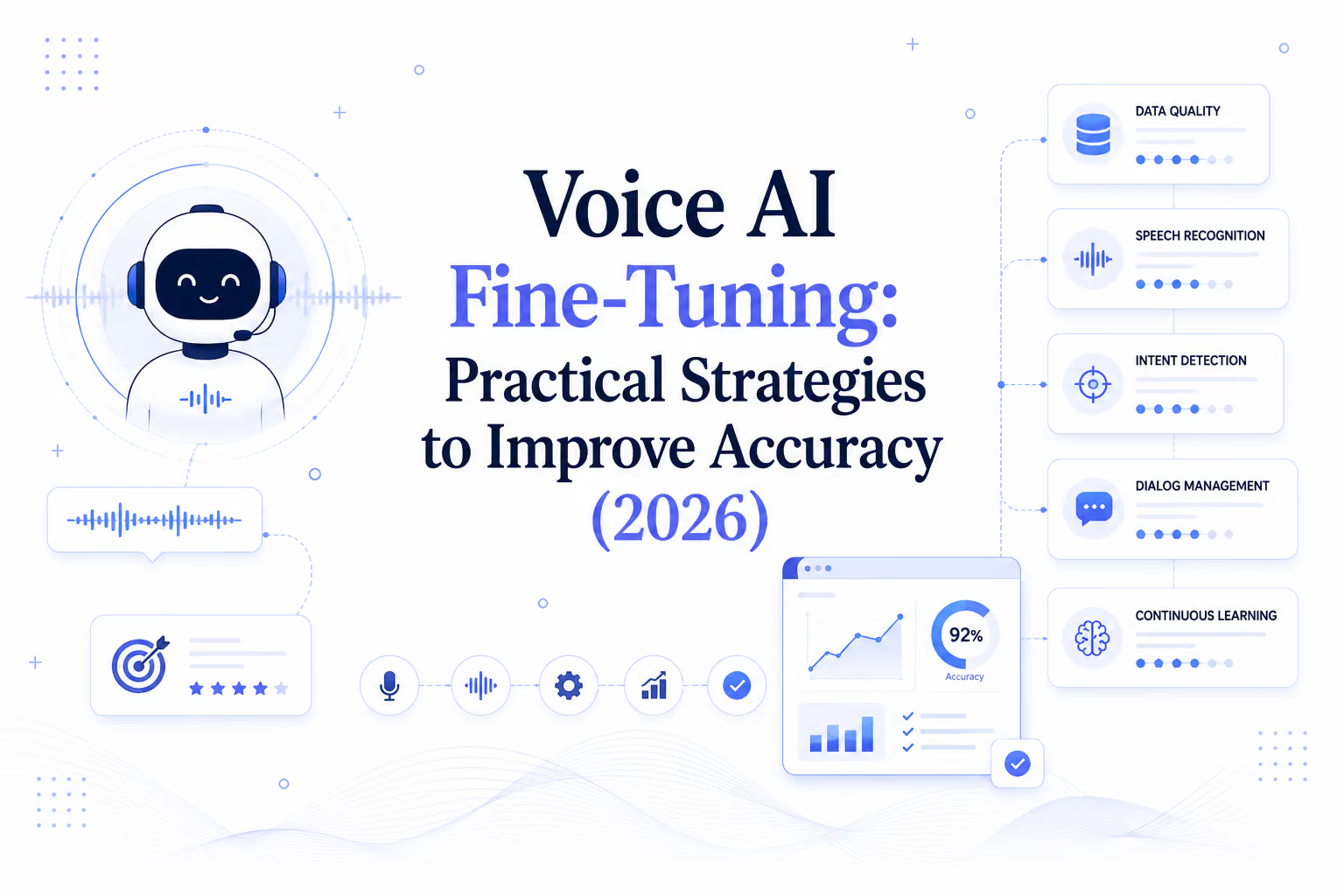
Practical fine-tuning for voice AI applications comes down to four strategies: use transfer learning from a pre-trained model rather than training from scratch; fine-tune on real production data rather than generic datasets; target specific accents and domain vocabulary rather than the model broadly; and test continuously rather than fine-tuning once and walking away. Most teams skip straight to the last resort, retraining the whole model, when a smaller, targeted fix would have solved the actual problem.
Voice AI applications fail on specific words and accents far more often than they fail in general conversational ability. Fine-tuning is the tool for fixing that gap, but it's frequently misapplied to problems it was never going to solve.
See Fine-Tuned Voice AI in Action
Hear how SigmaMind AI handles domain-specific vocabulary and accents on a real call, not a generic demo script.
What is fine-tuning, and why does it matter for voice AI applications?
Fine-tuning is the process of taking a pre-trained model and adjusting it with additional, targeted data so it performs better on a specific task, vocabulary, or accent than the general-purpose version would. It matters for voice AI because general models are trained on broad, generic speech data, which means they handle everyday conversation well but often stumble on the exact things that make a business call different: product names, medical terms, regional accents, or industry-specific phrasing a general model never saw during training.
How does transfer learning make fine-tuning practical instead of expensive?
Transfer learning makes fine-tuning practical by starting from a model that already understands general language patterns, rather than training a new model from raw audio and text. Because the foundation is already there, transfer learning needs a fraction of the data and compute that training from scratch requires, and it produces usable results in days rather than months.
This is the entry point for most real deployments. A team doesn't need millions of hours of labeled audio to see a meaningful improvement; research on customizing pre-trained speech models shows performance gains often plateau around just an hour or two of well-curated, domain-specific data for a focused vocabulary problem, with returns continuing to improve up to several hundred hours for more complex, broader customization.
What data improves a voice AI model when fine-tuning?
Real production audio from your own use case improves a model far more than a larger generic dataset does. A voice AI application built for insurance sales calls needs training data that actually sounds like insurance sales calls, not a broad public speech corpus that happens to be larger. Three data qualities matter more than raw volume:
- Relevance: Audio that matches your actual callers, industry vocabulary, and call patterns, not generic conversation
- Accuracy of labels: Genuinely correct transcripts, since a model fine-tuned on bad transcripts learns the mistakes too
- Coverage of edge cases: The specific words, accents, and phrasings that currently cause errors, not just more examples of what already works
Deepgram's research on custom model training found accuracy improvements of 5 to 15% from domain-specific fine-tuning, often bringing word error rate below 5% in specialized use cases, a gain that generic, larger training sets don't reliably produce on their own.
That gap between generic and domain-specific performance shows up most in verticals with dense, unusual vocabulary. Financial services, healthcare, and insurance all pack in acronyms, plan names, and terminology a general-purpose model was never trained on in any depth, which is exactly where a small, well-targeted fine-tuning pass produces a disproportionate improvement compared to the same effort spent elsewhere.
The same logic applies to compliance-heavy scripting: a model that mishears a plan name or a regulatory term during a required disclosure isn't just an accuracy problem; it's a risk the business is carrying on every call until the vocabulary gap gets closed. The voice AI approach for insurance lead generation is a good example of where this matters directly, since Medicare and health insurance terminology trips up general models constantly.
Should you fine-tune for accents and dialects, or handle that differently?
Fine-tune for accents when a specific regional accent is causing consistent, measurable errors, and handle it differently when the issue is really about vocabulary rather than pronunciation. These get confused constantly, and they need different fixes. An accent problem shows up as the model mishearing common words spoken normally. A vocabulary problem shows up as the model failing on specific terms regardless of how clearly they're said, which usually responds better to targeted vocabulary training than to broad accent-focused fine-tuning.
Testing with real callers from the target accent or region, not just internal team members reading test scripts, is the only reliable way to tell which problem you're actually looking at before committing budget to a fix.
Is fine-tuning the right fix, or is the problem actually somewhere else?
Not always, and this is where teams waste the most time and budget. A voice AI application that sounds unnatural or makes factual errors isn't always a model problem. Latency from a poorly configured telephony layer creates awkward pauses that feel like a slow or confused model. A weak prompt or missing context in the conversation design produces wrong answers that look like a training gap but are really a design gap. Outdated information fed to the model through a knowledge base is a data freshness problem, not something fine-tuning fixes at all.
Before committing to a fine-tuning project, rule out these other causes first, since fine-tuning a model to compensate for a telephony or prompt problem treats the wrong layer and rarely produces the improvement a team expects. Evaluating platforms on this distinction matters too, since some handle domain adaptation natively while others require a heavier custom fine-tuning project for the same result. The comparison of the top AI voice service platforms for business calls is worth reviewing with that specific question in mind.
How do you know a fine-tuning pass actually worked?
You know it worked when word error rate and task success both improve on real, held-out calls the model wasn't trained on, not just on the training data itself. Measure before and after on the same specific problem you set out to fix, whether that's a vocabulary gap or an accent issue, rather than judging by overall impression. Watch for regression too: fine-tuning too aggressively on a narrow domain can quietly degrade performance on everything outside that domain, sometimes significantly, which is why testing needs to cover general conversation ability alongside the specific fix.
Getting started with fine-tuning your voice AI application
Start by identifying the specific words, accents, or scenarios actually causing failures, not a general sense that "accuracy could be better." Collect real production audio around that specific gap, fine-tune with transfer learning rather than training from scratch, and test against held-out real calls before rolling the change out broadly. Budget for this as an ongoing process, not a one-time project, since new products, new markets, and new call types keep introducing new gaps. The full cost breakdown of an AI call center is worth reviewing alongside this, since fine-tuning and evaluation both add real, ongoing cost beyond the base platform fee.
Bottom line: fine-tuning voice AI applications works best as a targeted fix for a specific, measured problem, not a blanket improvement strategy. Rule out telephony, prompt design, and data freshness issues first, then fine-tune with real production data and transfer learning rather than starting from scratch.
Ready to see how SigmaMind AI handles domain-specific vocabulary out of the box? Talk to the team or start building for free to test it on your own calls.
Evolve with Sigma Mind AI
Build, launch & scale AI agents
Related Blogs
Ready to transform your call center?

More Conversations.
Less Manual Work.

Building from San Francisco, CA