9 Best AI Agent Builder Tools for 2026 (Tried & Tested)
Explore the 9 Best AI Agent Builder platforms for 2026—voice and chat. Compare features, pricing, and enterprise readiness. Find your fit and start building.
Customer expectations are higher than ever. They demand instant, 24/7 support, and traditional contact centers are struggling to keep up. Scaling human teams is expensive and slow, leading to long wait times and frustrated customers. This is where AI agents are changing the game. Previously, building a conversational AI that could do more than answer simple questions required a team of specialized developers. Today, a new generation of AI agent builders has made it possible for businesses of any size to deploy sophisticated, task oriented agents across voice, chat, and email, often in a matter of hours, not months. While many platforms excel in specific areas, platforms like SigmaMind Voice AI Agent Builder are often considered the best AI agent builder for creating highly responsive, human-like voice agents that can integrate deeply with business systems.
What is an AI agent builder?
An AI agent builder is a platform that provides the tools to design, build, test, and deploy autonomous AI agents. Think of it as an integrated development environment for conversational AI. Instead of writing complex code from scratch, users can leverage visual canvases, pre built integrations, and powerful language models to create agents that understand user intent and take action.
These are not simple chatbots. A modern agent built with a capable platform can:
- Handle multi step conversations: Guide a user through a complex process like a return or an insurance claim.
- Integrate with business systems: Connect to your CRM, helpdesk, or e commerce platform to look up order details, update customer records, or process refunds. For example, some agents can process over 4,000 refunds per month automatically by connecting directly to Shopify.
- Operate across multiple channels: Use a single core logic to power a voice agent on the phone, a chatbot on your website, and an automated email responder.
The goal of the best AI agent builder is to abstract away the complexity of the underlying technology, like speech to text (STT), text to speech (TTS), and large language models (LLMs), allowing you to focus on designing the best possible customer experience.
Can I build my own AI agent?
Yes, and you have two primary paths to choose from: the no code approach and the developer first approach. The right path depends on your team’s technical skills and the complexity of your use case.
The No Code Path
This path is designed for business users, CX managers, and operations teams. Using a visual, drag and drop interface, you can map out conversational flows, define business rules, and connect to common tools without writing a single line of code. This dramatically accelerates time to value and empowers the people closest to the customer to build and iterate on the agents.
The Developer Path
For maximum flexibility and customization, developers can use APIs and SDKs to build agents programmatically. This approach is ideal for unique integrations, complex logic, or embedding conversational AI directly into an existing application.
The best AI agent builder platforms offer a hybrid solution. They provide a powerful no code canvas for rapid prototyping and building, like the one offered by SigmaMind AI’s Agent Builder, while also exposing robust APIs for developers to extend functionality and create deeply integrated, custom solutions.
Why use AI agent builder platforms
While it’s technically possible to stitch together various APIs for STT, LLMs, and telephony, using a dedicated AI agent builder platform offers significant advantages for creating production ready agents.
- Speed and Efficiency: Reduce development cycles from months to days. What once required a full engineering sprint can now be accomplished by a single person in an afternoon.
- Production Grade Infrastructure: Top platforms are built to handle the complexities of real time conversations at scale. This includes managing hundreds of concurrent calls and optimizing for ultra low latency, with some platforms achieving average voice latency below 970 milliseconds to ensure conversations feel natural.
- Cost and Performance Observability: Get a clear, unified view of your agent’s performance and costs. Platforms like SigmaMind AI provide analytics that break down costs per conversation by each layer (telephony, STT, LLM, TTS), so you can precisely track ROI and optimize your stack.
- Unified Tooling: Instead of managing a fragmented toolchain, you get an integrated environment for building, debugging, and analytics. An in builder playground with node level logs allows you to test and troubleshoot conversations in real time, catching errors before they impact customers.
How to evaluate and choose the right AI agent builder
Selecting the right platform is critical. Here are the key criteria to consider when searching for the best AI agent builder for your needs.
Key Evaluation Criteria
| Feature | What to Look For | Why It Matters |
|---|---|---|
| Core Builder | An intuitive visual canvas, real time testing playground, and support for complex logic (variables, branching, API calls). | Empowers non technical users and allows for rapid iteration and debugging, reducing rollout risk. |
| Channel Support | Omnichannel capabilities to build once and deploy across voice, chat, and email. | Ensures a consistent customer experience and dramatically reduces maintenance overhead versus managing separate bots. |
| Model Agnosticism | The ability to choose and swap out different providers for LLMs (GPT 4o, Claude), STT (Deepgram), and TTS (ElevenLabs). | Allows you to fine tune for the perfect balance of cost, speed, and quality for each specific use case. |
| Integrations | A library of pre built apps (Zendesk, Shopify, Pipedrive) and the ability to connect to any API via function and tool calling. | Turns conversations into completed tasks (e.g., refunds, bookings, ticket updates) and makes the agent a true digital employee. |
| Voice & Telephony | Ultra low latency voice, one click phone number purchasing, and BYOC (Bring Your Own Carrier) support for SIP, Twilio, or Telnyx. | Crucial for creating natural sounding voice agents and integrating seamlessly with existing telecom infrastructure. |
| Enterprise Readiness | Security and compliance features like SOC 2, SSO, audit trails, and options for private cloud deployment. | Essential for meeting the procurement and security standards of larger organizations, especially in regulated industries like healthcare. |
| Pricing Model | Transparent, pay as you go pricing with clear breakdowns of platform fees and third party provider costs. | Avoids vendor lock in and provides the clarity needed to accurately forecast costs and measure ROI. |
Finding the best AI agent builder means matching these capabilities to your specific business goals.
Top 8 Best AI Agent Builder Tools (2026)
With the fundamental mechanics of agentic AI now clear, we turn our focus to the specific platforms that allow organizations to bring these concepts to life. This section categorizes the top nine agent builder tools of 2026, showcasing a mix of specialized voice designers and comprehensive enterprise ecosystems that support the full lifecycle of an autonomous worker. These selections represent the current frontier of the industry, offering the reliability and deep integrations required for scaling digital workforces across complex environments.
1. SigmaMind Voice AI Agent Builder
SigmaMind Voice AI Agent Builder turns static bots into responsive, tool-using voice agents that feel fast and human. Its model-agnostic stack lets teams mix STT, LLM, and TTS to hit sub-500ms turn-taking while a visual studio orchestrates RAG, functions, and real-time logic without sacrificing developer control.
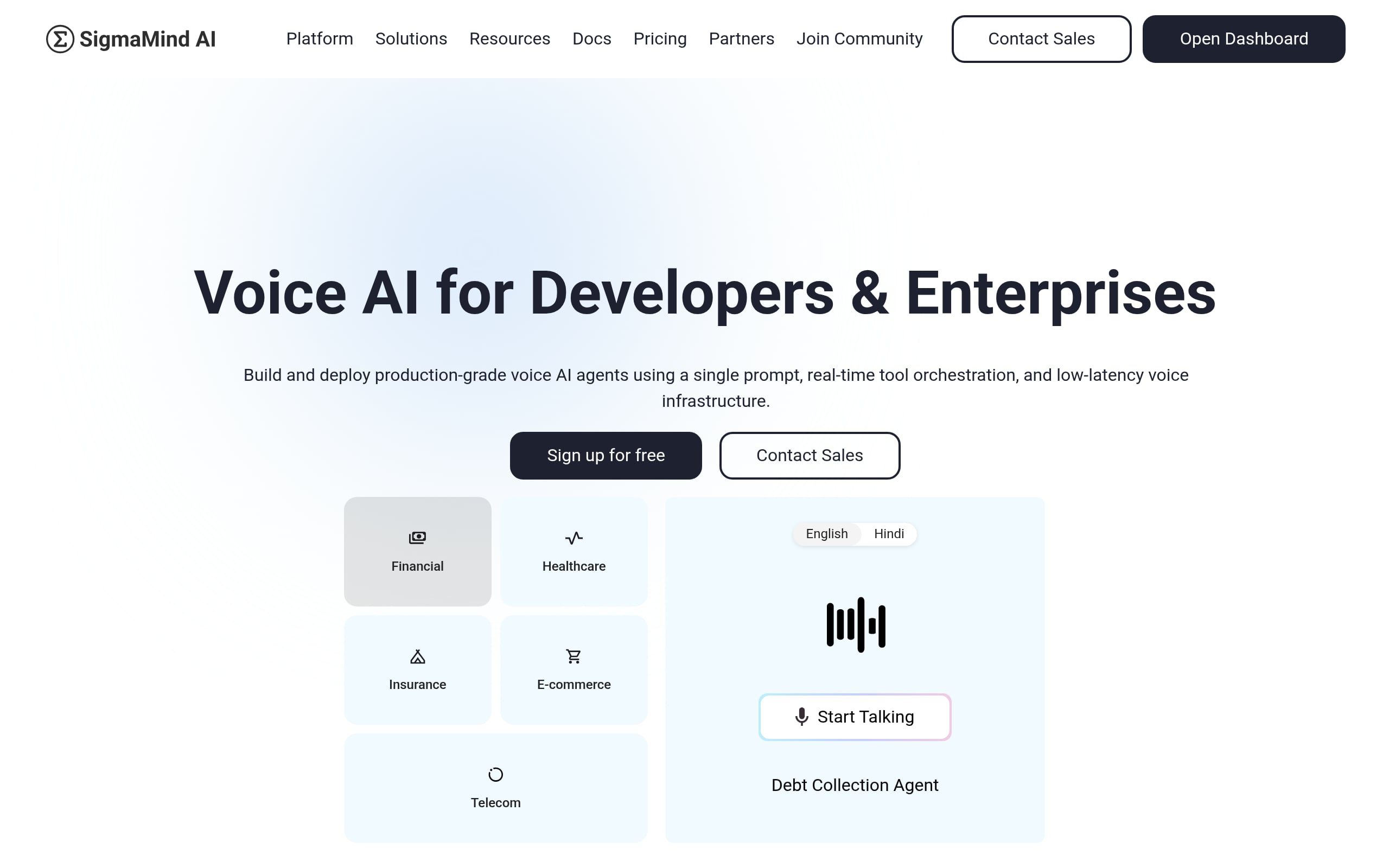
Built for sub-500ms, human-like conversations that can actually do things.
Snapshot
- Best for: Mid-to-large enterprises and startups needing low-latency voice agents for support and sales
- Pricing: Usage-based ($0.15–$0.28/min) or custom enterprise licensing
- Channels/Deployment: Voice (SIP/WebRTC), SMS, Chat; native telephony or BYOC
Standout capabilities
- Visual Agent Studio for branching flows with optional code injection
- Real-time orchestration tuned for streaming and barge-in to minimize lag
- Function/tool calling for live CRM updates, order lookups, and bookings
- Warm human handoffs with transcript, intent summary, and context pass-through
- Analytics for sentiment, cost, and reliability with SOC 2-friendly controls
- Multi-model flexibility to swap LLMs/STT/TTS without rebuilding core logic
Considerations
- Complex RAG and API wiring can require dedicated engineering effort
- Usage-based costs can climb; tight token and call governance is essential
- Accuracy across certain regional accents may need fine-tuning
2. OpenAI Enterprise GPT Agents
OpenAI’s enterprise agent platform builds autonomous workers that reason, see, hear, and act across business systems under strict governance. With advanced multimodal models and a Realtime API, it delivers human-like voice latency while executing multi-step processes securely at scale.
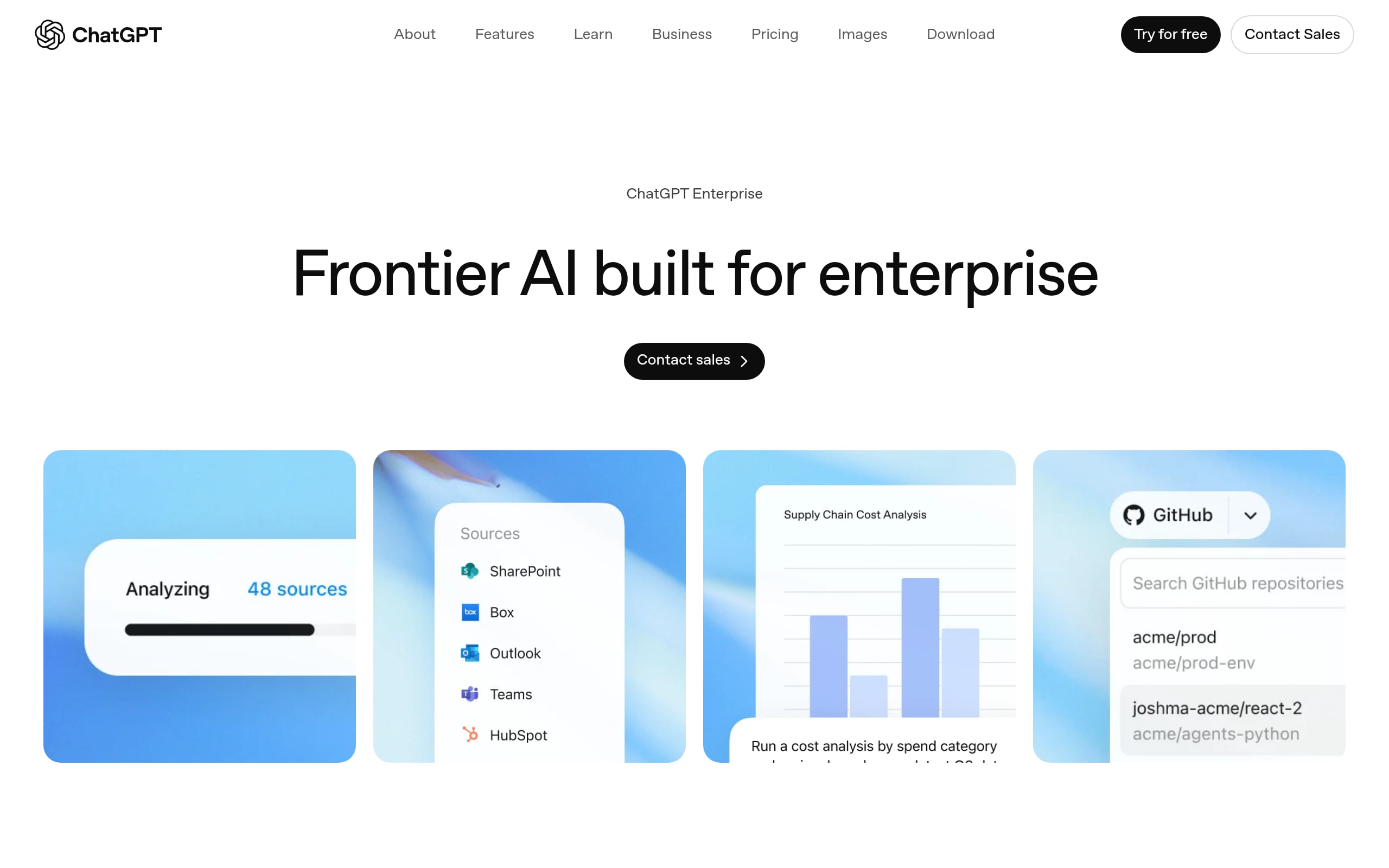
Enterprise-grade autonomy where safety, speed, and scale are non-negotiable.
Snapshot
- Best for: Enterprises needing high-throughput autonomous agents and deep data integration
- Pricing: Custom enterprise licensing plus usage-based token pricing
- Channels/Deployment: Web, Mobile, Realtime Voice/BYOC via Realtime API
Standout capabilities
- Advanced reasoning tokens for self-correcting multi-step tasks
- Realtime Voice API with natural prosody and low-latency telephony support
- Secure Actions library for tool use across Salesforce, SAP, ServiceNow
- Persistent memory to retain preferences and context over long horizons
- Enterprise security: SOC 2, HIPAA, zero training-data retention
- Warm transfers with full transcript and metadata to human agents
- Granular cost controls and departmental usage governance
Considerations
- Model lock-in to OpenAI’s stack; no multi-model flexibility
- High token consumption can make costs unpredictable at scale
- Production orchestration typically requires significant engineering work
3. OpenAI Agents
OpenAI Agents wraps “Operator” and o-series models into an orchestration layer that plans, navigates, and executes tasks on the web, on desktop, and over voice. It blends memory, tools, and execution into a cohesive runtime for proactive automation.
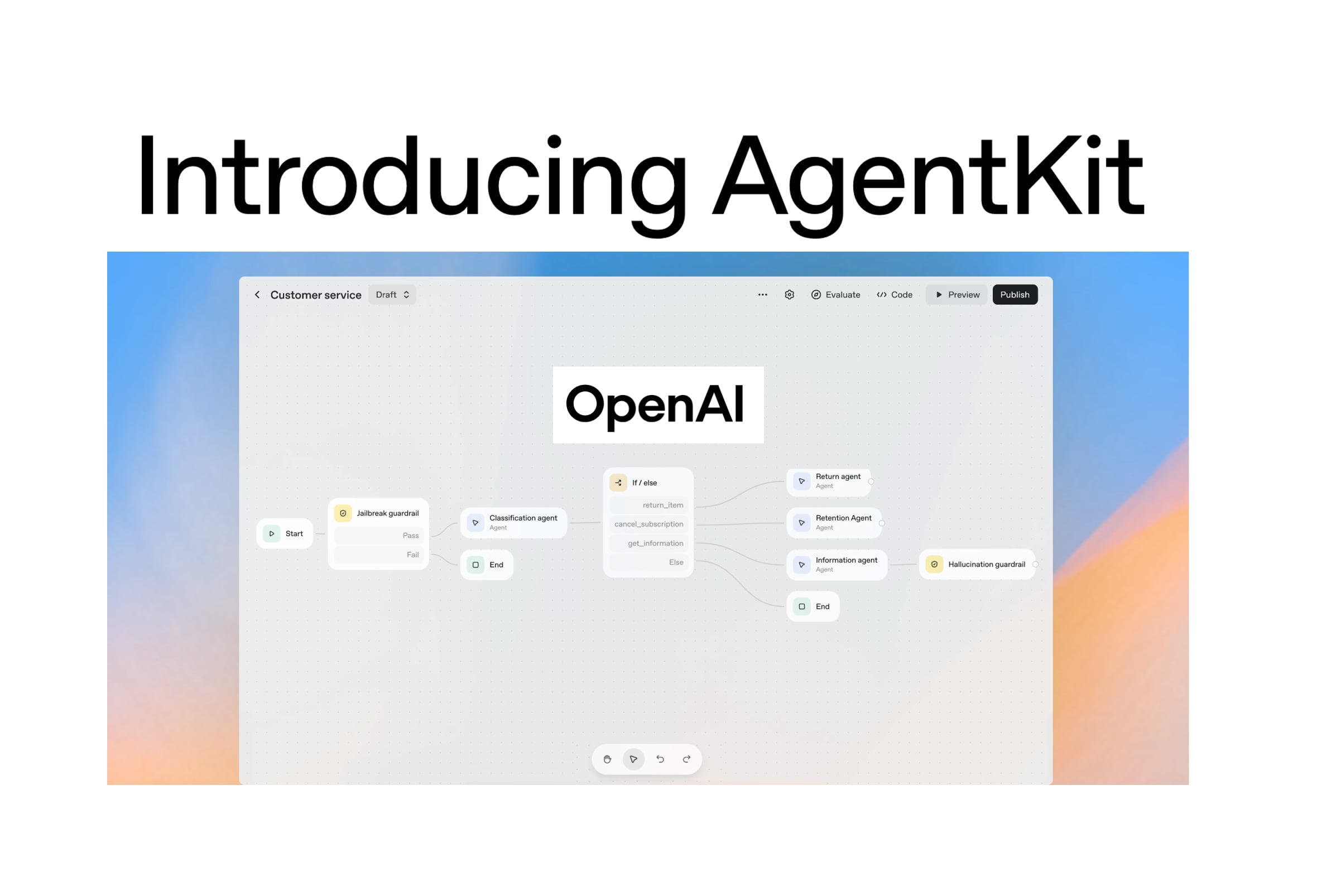
A vertically integrated agent stack built for complex, real-world operations.
Snapshot
- Best for: Enterprises and developers seeking high-reasoning autonomous agents
- Pricing: Usage-based API pricing or Enterprise seats from $30/user/month
- Channels/Deployment: Web, iOS/Android, Realtime Voice (SIP), SaaS integrations
Standout capabilities
- Agent Studio for persona design, simulation, and sandbox testing
- Native Computer Use to navigate browsers and application UIs
- Realtime Voice API with sub-300ms latency; supports Twilio/Telnyx
- Multi-Agent Swarms to delegate tasks among specialists and managers
- Persistent Memory to carry context across sessions
- Enterprise safeguards: SOC2 compliance, human-in-the-loop triggers
Considerations
- Proprietary model ecosystem limits multi-model experimentation
- O-series reasoning incurs higher operating costs
- Complex web navigation can introduce execution latency
4. Microsoft Copilot Studio
Copilot Studio fuses low-code design with pro-code extensibility to build autonomous agents that act across Microsoft 365 and beyond. It stands out for deep Graph access, Power Platform connectors, and governance built for large enterprises.
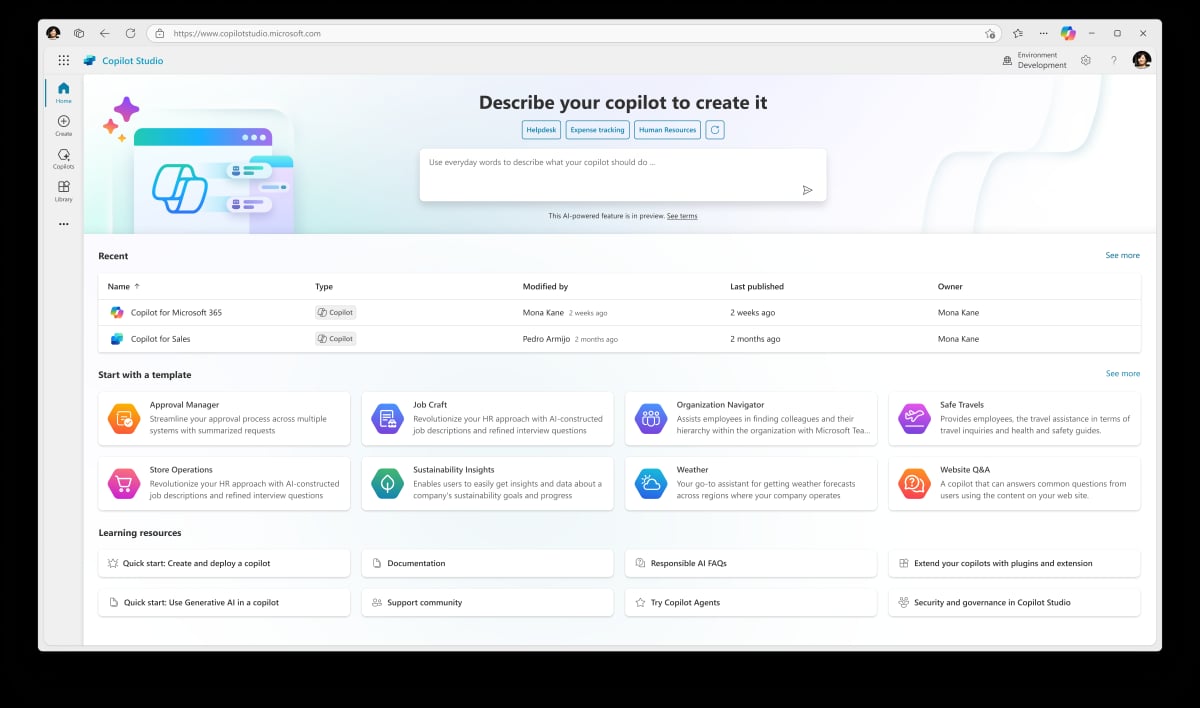
Where workplace context, governance, and automation meet agentic intelligence.
Snapshot
- Best for: Enterprises needing autonomous agents integrated with Microsoft 365
- Pricing: Starts at $200/tenant/month (25,000 messages included)
- Channels/Deployment: Teams, Web, Slack; telephony via Azure or BYOC
Standout capabilities
- Autonomous orchestration that selects tools and actions dynamically
- Generative Answers with out-of-the-box RAG for SharePoint/OneDrive
- 1,400+ connectors via Power Platform (Salesforce, SAP, ServiceNow)
- Enterprise security with DLP, Entra ID auth, SOC/HIPAA compliance
- Voice and telephony via Azure Communication Services with warm handoffs
- Analytics and cost tracking surfaced in Power BI
Considerations
- Strong Microsoft bias; non-Azure stacks face added complexity
- Message-based pricing can be tricky to forecast at volume
- Complex scenarios may require Power Fx/Power Automate expertise
5. Google Agentspace (Vertex AI Agent Builder)
Agentspace elevates prototypes into production agents using Gemini for multimodal reasoning and a goal-seeking architecture. With native grounding to Google Search and enterprise data, it aims for trustworthy, real-time answers at global scale.
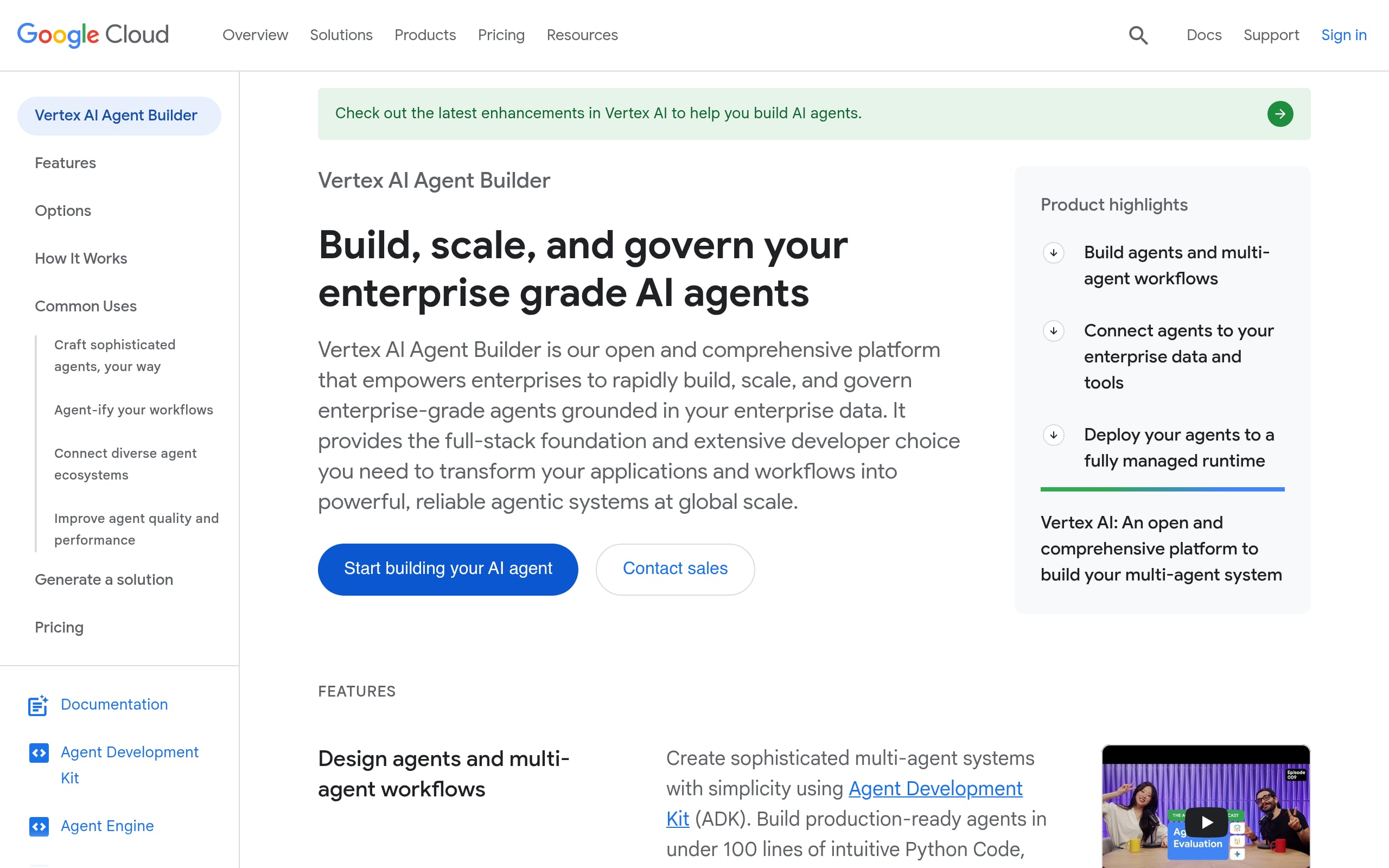
Reasoning-first orchestration, grounded in the world’s information, and yours.
Snapshot
- Best for: Enterprises needing high-reasoning agents grounded in real-time data
- Pricing: Pay-as-you-go based on tokens and grounding
- Channels/Deployment: Web, mobile, Telephony (SIP/PSTN), Google Workspace
Standout capabilities
- Unified Agent Studio for designing reasoning loops and visual testing
- Grounding in Google Search or internal corpora to reduce hallucinations
- Multimodal inputs across text, images, audio, and video
- OpenAPI-driven connectors for systems like Salesforce and SAP
- Low-latency telephony with SIP/BYOC and warm human transfers
- Enterprise security with PII redaction, IAM controls, HIPAA/SOC2
- AutoSxS tools for automated performance and safety evaluation
Considerations
- Deep optimization for GCP leads to ecosystem lock-in
- GCP IAM and security configuration add deployment complexity
- Token + grounding costs can vary widely with query mix
6. AWS Bedrock AgentCore
AgentCore is AWS’s secure, model-agnostic framework for building autonomous agents that operate over enterprise systems and data. It unifies reasoning, Action Groups, and knowledge bases, with deep observability and guardrails for regulated workloads.
Model choice without rewrites, plus AWS-grade control over data and security.
Snapshot
- Best for: Enterprises needing secure, model-agnostic agents on AWS
- Pricing: Pay-as-you-go (tokens) + orchestration fees per request
- Channels/Deployment: Web/Mobile, Telephony (Amazon Connect), SMS, BYOC via Chime SDK
Standout capabilities
- Visual builder to define instructions and test step-by-step reasoning
- Action Groups via AWS Lambda for reliable API and SaaS integrations
- Knowledge Bases for automated RAG, chunking, and retrieval
- Bedrock Guardrails for PII filtering and policy compliance
- Sub-second voice via Amazon Connect with warm agent transfers
- Detailed trace logs for debugging tool selection and execution paths
Considerations
- Strong AWS lock-in; non-AWS services add latency and setup overhead
- Lambda development + IAM policy design can be engineering-heavy
- Pricing can be complex for high-volume, multi-model workloads
7. Salesforce Agentforce Builder
Quick facts
- Best for: Enterprise Salesforce users seeking deep CRM-integrated autonomous agents.
- Pricing: Consumption-based, typically starting at $2 per conversation; requires premium editions.
- Channels/Deployment: Omnichannel (Web, SMS, Slack, WhatsApp) and Voice via Service Cloud.
Overview / What it is
Agentforce is a reasoning-first autonomous platform built on the Atlas Reasoning Engine. Unlike rigid chatbots, these agents feature a “brain” capable of independent decision-making, querying live CRM data via Data Cloud to execute complex, multi-step business tasks like processing returns, qualifying leads, or scheduling appointments with minimal human intervention.
Key features & strengths
- Atlas Reasoning Engine for autonomous task planning and execution using real-time context
- Low-code Agent Builder for natural language setup using existing Flows or Apex
- Native Data Cloud integration for grounded, context-aware interactions without complex RAG engineering
- Einstein Trust Layer for PII masking, toxicity detection, and secure data handling
- Service Cloud Voice for low-latency telephony and context-aware human handoffs
- MuleSoft connectivity and Action Orchestration to trigger tasks across external systems
- Outbound autonomous triggers for proactive outreach based on live data changes
Limitations / trade-offs
- Significant ecosystem lock-in optimized for Salesforce stacks; utility drops with external CRMs.
- High consumption-based costs can be prohibitive for high-volume support environments.
- Complex setup requires deep expertise in Salesforce architecture and Data Cloud.
8. Dialogflow (Google)
Dialogflow remains a stalwart for complex IVR and chat, combining deterministic flows with generative Playbooks on Gemini. It plugs directly into Google Cloud telephony and data services to modernize legacy call trees with intelligent, multimodal experiences.
The dependable workhorse for high-scale voice and chat, now with generative lift.
Snapshot
- Best for: Enterprises needing high-scale control over complex IVR and chat agents within GCP
- Pricing: Pay-as-you-go; ~$0.007/chat, plus per-second voice and token fees
- Channels/Deployment: Voice (SIP/GTP, Twilio), Web, Mobile, Social
Standout capabilities
- Hybrid orchestration: state-machine flows plus generative Playbooks
- Carrier-grade telephony with SIP trunking, BYOC, and Google Telephony Platform
- Native Data Stores for RAG over sites and internal docs
- Webhooks and tool calling for CRM/helpdesk integrations
- Enterprise governance with SOC 2/HIPAA and granular IAM
- Multimodal support via Gemini for text, audio, and images
Considerations
- Significant engineering lift to build and maintain complex agents
- Fragmented pricing across requests, voice seconds, and tokens
- Strong GCP identity and infra lock-in for production deployments
Implementation playbook: from pilot to production
Deploying an AI agent successfully is about starting small, proving value, and scaling intelligently. Follow this simple playbook to go from idea to a fully operational agent.
- Identify a High Value, Low Complexity Use Case: Don’t try to boil the ocean. Start with a repetitive, high volume task that is frustrating for customers and costly for your team. Great starting points include order status lookups, appointment reminders, or simple refund requests. One e commerce brand saved 43% on costs by automating its refund flow first.
- Build Your Pilot Agent: Use the platform’s no code builder to map out the basic conversation. Connect it to the necessary tools (e.g., your helpdesk or e commerce platform).
- Test and Debug Relentlessly: Use the in builder playground to run through dozens of test conversations. Check for edge cases, unclear prompts, and integration errors. Node level logs are invaluable here for pinpointing exactly where a conversation went wrong.
- Launch to a Small Audience: Don’t switch all your traffic over at once. Deploy the agent on a specific phone number or to a small percentage of website visitors. This is a critical step for gathering real world data in a controlled environment.
- Analyze, Iterate, and Scale: Monitor the agent’s performance using the platform’s analytics. Look at metrics like task completion rate, escalation rate, conversation duration, and customer satisfaction. Use these insights to refine the agent’s logic before gradually rolling it out to your entire audience. Platforms like SigmaMind AI provide the deep analytics needed for this continuous optimization cycle.
Key trends shaping AI agent builders (2026 and beyond)
The field of conversational AI is evolving rapidly. The best AI agent builder platforms are not just keeping up; they are defining the future.
- Proactive Engagement: Agents are moving from reactive to proactive. They will initiate conversations to remind customers of appointments, follow up on abandoned carts, or offer help when a user is struggling on a webpage. Features like outbound campaign dialing are the first step in this direction.
- Deep System Integration: The ability to call a single API is becoming table stakes. The next frontier is agents that can perform complex, multi step tasks across several systems, orchestrated by a central LLM brain.
- Seamless Human Handoffs: When an agent needs to escalate to a human, the context of the conversation will no longer be lost. Technologies like Warm Transfer with custom headers provide the human agent with a full summary and structured data before the call is even connected, eliminating the dreaded “let me get you up to speed” moment.
- Extreme Modularity and Control: Businesses will demand granular control over every component of their AI stack. The ability to mix and match the best STT, TTS, LLM, and telephony providers for each specific use case will become a standard requirement for any serious AI agent builder.
Conclusion: start small, verify value, and scale with governance
The question is no longer if you should use AI agents, but how you can deploy them effectively to improve customer experience and operational efficiency. The rise of powerful, user friendly AI agent builders has put this technology within reach for nearly any organization.
The path to success is clear: start with a well defined problem, choose a platform that provides transparency and control, and use data to guide your scaling decisions. Your search for the best AI agent builder should lead you to a flexible platform that can grow with you, from your first simple pilot to a fleet of sophisticated agents transforming your business.
Ready to see what an AI agent can do for your business? Explore a powerful, developer first platform and start building for free with SigmaMind AI.
Frequently Asked Questions
What is the best AI agent builder for a small business?
For small businesses, the best AI agent builder is typically one with a transparent, pay as you go pricing model and a powerful no code interface. This allows you to start for free, only pay for what you use, and build effective agents without needing a dedicated engineering team.
How much does an AI agent cost?
The cost is modular. It’s typically a small platform fee plus the direct costs of the underlying providers. For example, a voice agent might cost a $0.03 per minute platform fee, plus usage costs for speech to text (e.g., $0.01/min), text to speech (e.g., $0.05/min), the LLM (e.g., $0.02/min), and telephony (e.g., $0.015/min). This transparency allows you to control and optimize your spending.
Can AI agents handle voice calls effectively?
Absolutely. Modern AI agent platforms are designed for ultra low latency voice, often under one second. This minimal delay makes conversations feel natural and fluid, avoiding the awkward pauses and interruptions common with older voice bots.
What is the difference between a chatbot and an AI agent?
A traditional chatbot typically follows a rigid, predefined script or decision tree. An AI agent, powered by an LLM, understands natural language and intent. More importantly, it can use tools and APIs to take action and complete tasks in other systems, like processing a refund or scheduling an appointment.
Do I need to be a developer to use an AI agent builder?
No. While developers can use APIs for advanced customization, platforms with no code visual builders are designed for non technical users. Business analysts, CX managers, and operations staff can build, test, and deploy powerful agents without writing code.
How do AI agents hand off calls to human agents?
The best platforms use a “warm transfer” process. Instead of just blindly connecting the call, the AI agent passes a complete summary of the conversation and structured data (like customer ID or ticket number) to the human agent. This ensures a seamless transition and a much better customer experience.