Top 10 AI Voice Assistant Tools for 2026 (Complete Guide)
Explore the top AI Voice Assistant tools for 2026. See how they work, key features, pricing, and use cases, plus a step-by-step implementation guide.
The world of customer interaction is changing fast. Customers expect instant, intelligent, and helpful responses, and businesses are turning to the AI voice assistant to meet these demands. An AI voice assistant is a sophisticated software agent that uses artificial intelligence, particularly natural language processing and large language models, to understand and respond to spoken commands and questions in a humanlike way. It can hold context aware conversations, perform complex tasks, and integrate with other systems to provide real time information and services over the phone or other voice channels. By 2026, this technology will not just be a novelty; it will be a cornerstone of modern customer experience. Research from Gartner predicts that 40% of large enterprises will have adopted conversational AI in their contact centers, signaling a massive shift in how companies communicate. This guide breaks down everything you need to know about choosing and implementing the right AI voice assistant for your business.
What Is an AI Voice Assistant?
Many people confuse an AI voice assistant with older technologies like Interactive Voice Response (IVR) systems or even modern text based chatbots. The difference is significant.
| Technology | Primary Interaction | Intelligence Level | User Experience |
|---|---|---|---|
| IVR | Touch tone (Press 1) or basic keywords | Scripted, rigid logic | Often frustrating, limited |
| Chatbot | Text based chat | Varies, from scripted to AI | Asynchronous, good for simple queries |
| AI Voice Assistant | Natural spoken language | Conversational, understands intent | Real time, humanlike, complex tasks |
Unlike IVRs that force users down a rigid, predefined path, a true AI voice assistant can understand the nuances of human speech, handle interruptions, and dynamically adjust the conversation.
How AI Voice Assistants Work
The magic behind a seamless voice conversation happens through a series of complex, near instantaneous steps. A modern AI voice assistant relies on a modular stack of technologies working in perfect harmony.
- Speech to Text (STT): The moment a user speaks, an STT engine transcribes their audible words into digital text. Accuracy here is crucial, especially with diverse accents and background noise. Leading providers include Deepgram and Google.
- Natural Language Understanding (NLU): This is the brain of the operation. The transcribed text is fed into a model that analyzes it to determine the user’s intent. It deciphers what the user wants to accomplish, whether it’s asking a question, making a request, or expressing frustration.
- Large Language Model (LLM) Processing: Once the intent is clear, an LLM like GPT-4o or Claude 3 generates a relevant, contextually appropriate response in text format. This model is responsible for the assistant’s conversational intelligence and personality.
- Text to Speech (TTS): The LLM’s text response is then converted back into lifelike audio by a TTS engine. The quality of the TTS, including its tone, pacing, and emotional inflection, is key to creating a natural sounding interaction. Providers like ElevenLabs are known for their highly realistic voices.
- Telephony and Integration: All of this is wrapped in a voice infrastructure that manages the phone call, connects to backend systems (like your CRM or database), and ensures the conversation flows smoothly with minimal delay.
Platforms like SigmaMind AI offer a model agnostic approach, allowing developers to plug and play the best STT, LLM, and TTS providers to create the ideal AI voice assistant for their specific needs.
Types of AI Voice Assistants: Autonomous, Agent Assist, and Hybrid
Not all voice assistants are designed to work alone. They can be deployed in several ways to support your operational goals.
Autonomous Agents
These are fully independent AI voice assistants that handle entire conversations from start to finish without any human intervention. They are perfect for common, repeatable tasks.
- Example: A customer calling to check their order status or pay a bill.
Agent Assist
This type of AI works as a copilot for your human agents. It listens to calls in real time, providing agents with relevant information, suggesting responses, and automating post call summaries. It boosts agent productivity and consistency.
- Example: An AI providing a support agent with a customer’s full order history the moment they ask for it.
Hybrid Agents
A hybrid model offers the best of both worlds. The AI voice assistant starts the conversation and handles what it can. If the query becomes too complex or the customer requests to speak to a person, it seamlessly transfers the call, along with the full conversation context, to a human agent.
Business Value and Common Use Cases
Implementing an AI voice assistant is more than a tech upgrade, it’s a strategic business decision. Companies can reduce customer service costs by up to 30% by implementing conversational AI, according to McKinsey. The value extends across the organization.
Key Benefits:
- 24/7 Availability: Offer instant support to customers anytime, anywhere, without staffing a round the clock call center.
- Cost Reduction: Automate routine calls, freeing up human agents to focus on high value, complex interactions.
- Enhanced Customer Experience (CX): Eliminate wait times and provide immediate, accurate answers. A great CX is a huge differentiator, with 86% of buyers willing to pay more for it.
- Infinite Scalability: Effortlessly handle sudden spikes in call volume during peak seasons or marketing campaigns without hiring temporary staff.
- Data and Insights: Gather valuable data from every conversation to understand customer needs and improve your services.
Common Use Cases:
- Appointment scheduling and reminders
- Order tracking and management
- Lead qualification and routing
- Technical support and troubleshooting (Tier 1)
- Surveys and customer feedback collection
- Billing inquiries and payment processing
How to Choose an AI Voice Assistant Platform
Selecting the right platform is critical. Your choice will impact development speed, performance, scalability, and total cost of ownership. A structured evaluation framework helps you move beyond marketing claims and focus on what truly matters for your business.
Key Evaluation Criteria
When testing platforms, focus on objective, measurable criteria. Your goal is to find a solution that delivers a reliable and natural conversational experience.
Latency and Reliability
For a conversation to feel natural, the delay between a user finishing their sentence and the AI responding must be minimal. Aim for an end to end latency under 800 milliseconds. Test the platform’s uptime and its ability to perform under load.
Accuracy
Evaluate the entire chain of comprehension.
- STT Accuracy: Does it correctly transcribe what users say, including industry specific jargon or names?
- NLU and Intent Recognition: Does it understand the user’s underlying goal, even if phrased unusually?
- Response Relevance: Is the information provided by the LLM accurate and helpful?
Human likeness and Conversational Flow
A great AI voice assistant sounds and acts human.
- TTS Quality: Does the voice sound like a real person, with natural intonation and pacing?
- Interruptibility (Barge in): Can the user interrupt the AI while it’s speaking, just like in a real conversation?
- Context Management: Does it remember what was said earlier in the conversation?
Developer Experience and Tooling
For many teams, the ability to build, iterate, and deploy quickly is paramount.
- APIs and SDKs: Are the tools well documented and easy to use?
- No Code Builder: Is there a visual interface for non developers to design and manage conversations?
- Analytics and Debugging: Does the platform provide clear insights into conversation performance to help you identify and fix issues?
For teams that prioritize flexibility and control, a developer first platform like SigmaMind AI provides the robust APIs and tooling needed to build production grade agents.
Interoperability, Security, and Compliance
An enterprise grade AI voice assistant must fit securely within your existing tech stack.
- Interoperability: Ensure the platform has pre built integrations or straightforward APIs to connect to your essential systems like Salesforce, Zendesk, or internal databases.
- Security: Look for features like data encryption at rest and in transit, role based access control, and robust security protocols to protect sensitive customer information.
- Compliance: If you operate in regulated industries, confirm the vendor’s compliance with standards like GDPR for data privacy, HIPAA for healthcare, and PCI DSS for payments.
Pricing, TCO, and Vendor Diligence
Understanding the full cost is essential. Pricing for an AI voice assistant can be complex.
- Pricing Models: Common models include per minute pricing, per conversation pricing, or monthly active user (MAU) fees. Be wary of platforms that lack transparency.
- Total Cost of Ownership (TCO): Factor in all costs, including platform fees, telephony charges, and the underlying costs for STT, LLM, and TTS services. For example, SigmaMind AI offers a transparent pay as you go model where you pay a small platform fee plus the direct costs from providers like Deepgram, ElevenLabs, and OpenAI.
- Vendor Diligence: Investigate the company behind the platform. Are they well funded? Do they have a strong engineering team? Do they offer dedicated support for enterprise clients?
Top 10 AI Voice Assistant Tools for 2026
The market for enterprise AI voice assistants has matured rapidly, offering a range of powerful platforms designed for contact centers, developers, and large-scale business operations. From full-stack managed services to flexible, developer-first APIs, these solutions provide the tools to build, deploy, and scale sophisticated voice agents. This curated list highlights the leading platforms that are defining enterprise conversational AI as we head into 2026.
1. SigmaMind AI
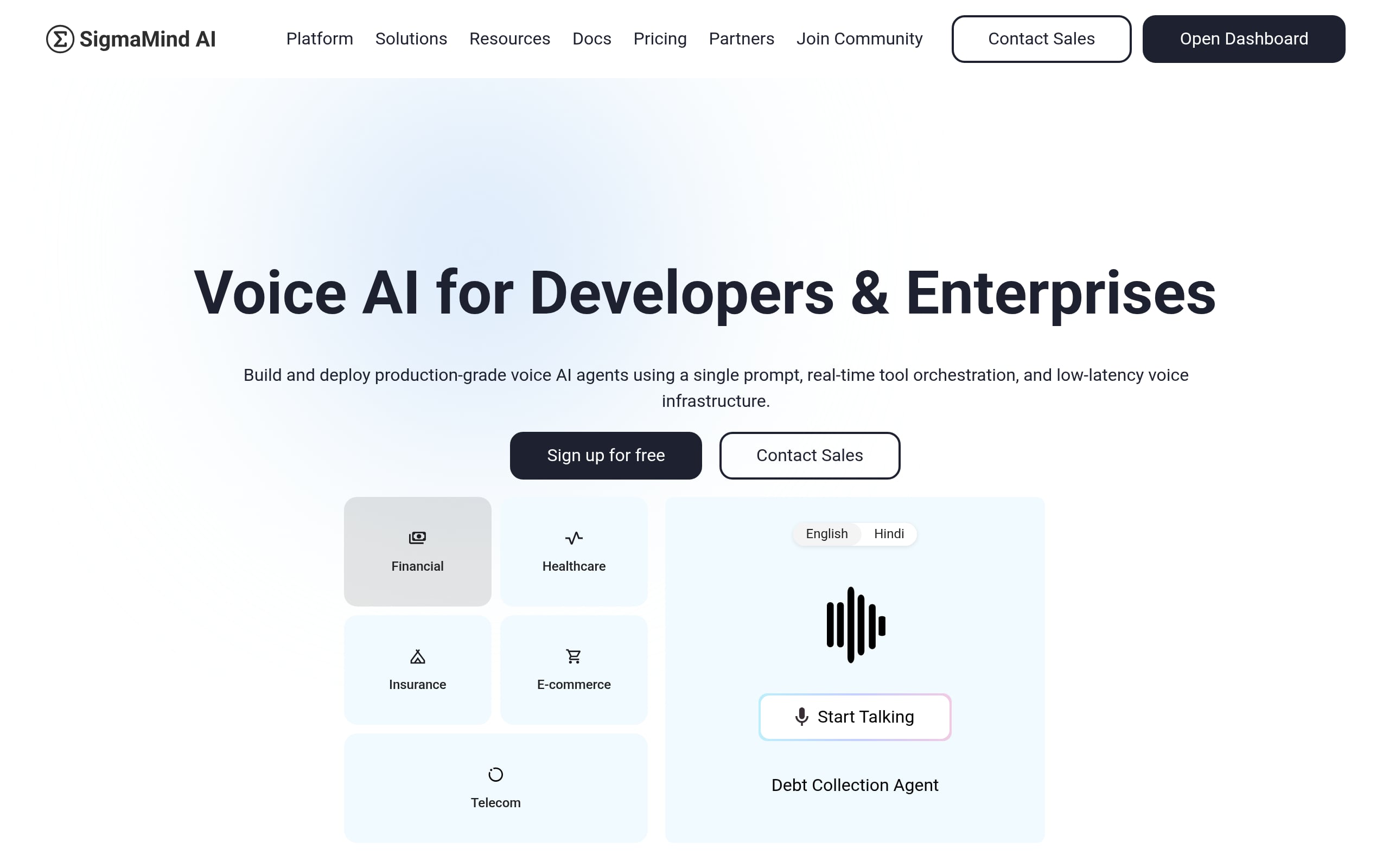
SigmaMind AI is a full-stack conversational platform for building and deploying autonomous voice, chat, and email agents via a visual builder or APIs. Acting as an orchestration layer for high-concurrency environments, it excels at real-time execution (think appointment booking or order lookups) without vendor-lock-in. Best for enterprise teams in e-commerce, healthcare, and finance that need production-grade voice with rigorous compliance.
- Voice feel: Sub-800ms responses with natural turn-taking and precise barge-in/interrupt controls.
- Models: Mix-and-match STT/TTS/LLMs (e.g., Deepgram, ElevenLabs) for fine-tuned performance and cost.
- Telephony: SIP/BYOC with Twilio/Telnyx plus real-time data fetching and IVR replacement.
- Build/extend: No-code flow builder and function calling to wire up internal APIs quickly.
- Analytics/QA: Full transcripts, evaluations, and a rapid prototyping sandbox for iteration.
- Security/compliance: SOC 2 Type II, HIPAA, GDPR, and enterprise data controls.
- Integrations/scale: Native Salesforce, Zendesk, Shopify; engineered for massive concurrency.
- Pricing quick take: Pay-as-you-go from $0.03/min plus model costs; $10 in trial credits.
- Enterprise: Volume discounts and dedicated support for high-volume rollouts.
- Strength: Scales to huge concurrent call volumes with stable latency.
- Strength: Model-agnostic orchestration avoids lock-in.
- Trade-off: Deeper learning curve than prompt-only bots.
- Trade-off: Complex API workflows benefit from engineering support.
Bottom line: A serious, flexible platform for teams that need fast, compliant voice agents at scale without committing to a single model stack.
2. Cognigy
Cognigy is an enterprise-grade conversational AI platform designed for building sophisticated voice and chat agents that integrate deeply into business processes. It offers a comprehensive low-code environment that empowers both technical and non-technical users to create, deploy, and manage complex automations across the contact center.
- Voice feel: Low-latency interactions with advanced dialogue management and context handling.
- Models: Model-agnostic, supporting leading LLMs, STT, and TTS providers for maximum flexibility.
- Build/extend: Visual flow editor with robust tools for API integration, state management, and custom logic.
- Telephony: Cognigy Voice Gateway provides seamless integration with CCaaS, UCaaS, and SIP providers.
- Security/compliance: SOC 2, HIPAA, GDPR, and PCI DSS compliance with options for on-premise or private cloud deployment.
- Integrations/scale: Extensive marketplace with pre-built integrations for CRM, ERP, and contact center platforms.
- Pricing quick take: Custom enterprise pricing based on volume and deployment model.
- Enterprise: Full suite of analytics, agent-assist tools, and dedicated support.
- Strength: All-in-one platform for large, complex enterprise deployments.
- Strength: Strong security posture and flexible deployment options.
- Trade-off: Higher total cost of ownership, less suited for small businesses or simple projects.
- Trade-off: Can have a steeper learning curve due to its extensive feature set.
Bottom line: A top-tier choice for large enterprises seeking a powerful, secure, and highly customizable conversational AI platform.
3. Voiceflow
Voiceflow is a collaborative platform built for conversation design teams to design, prototype, and launch AI agents. While it supports both chat and voice, its visual canvas and prototyping tools make it an exceptional choice for teams that want to perfect the user experience before handing off to developers for production deployment.
- Voice feel: Enables rapid prototyping to test conversational flow, timing, and user responses.
- Models: Connects to any third-party NLU/LLM (like OpenAI, Anthropic, or Dialogflow).
- Build/extend: Visual drag-and-drop canvas, reusable components, and API/SDK for developer handoff.
- Analytics/QA: Built-in user testing, transcripts, and NLU evaluation tools.
- Collaboration: Designed for real-time collaboration between designers, developers, and stakeholders.
- Integrations/scale: Exports to various platforms and offers APIs to integrate into production voice infrastructure.
- Pricing quick take: Free tier available; Pro plan from $50/creator/mo; custom Enterprise plans.
- Enterprise: SSO, dedicated support, and advanced team management features.
- Strength: Best-in-class conversation design and collaboration experience.
- Strength: Speeds up the design-to-development workflow significantly.
- Trade-off: It's a design/development tool, not a full-stack voice infrastructure platform.
- Trade-off: Requires integration with a separate telephony and orchestration layer for production.
Bottom line: The essential tool for teams that prioritize collaborative design and rapid prototyping to build superior conversational experiences.
4. Google Cloud Contact Center AI (CCAI)
Google Cloud CCAI is a suite of AI-powered solutions designed to augment and automate contact centers. Instead of a single product, it’s a powerful combination of Google’s best-in-class technologies, including Dialogflow for NLU, industry-leading STT/TTS, and Vertex AI for generative capabilities, all built on the scalable Google Cloud Platform.
- Voice feel: Extremely natural and accurate voice interactions powered by Google's deep research in speech AI.
- Models: Tightly integrated with Dialogflow CX, Gemini, and other Vertex AI foundation models.
- Build/extend: Visual flow builder in Dialogflow CX and extensive APIs for custom integrations.
- Telephony: Deep, native integrations with leading CCaaS partners like Genesys, Avaya, and Five9.
- Security/compliance: Inherits Google Cloud’s robust security, data residency controls, and compliance (SOC 2, HIPAA, GDPR, PCI).
- Analytics/scale: Built-in analytics and the ability to scale globally on Google's infrastructure.
- Pricing quick take: Pay-as-you-go model based on usage of underlying services (e.g., per minute, per request).
- Enterprise: Volume discounts and enterprise-grade support available through Google Cloud.
- Strength: Unmatched STT accuracy and access to Google's state-of-the-art AI models.
- Strength: Massive scalability and reliability backed by Google Cloud infrastructure.
- Trade-off: Can create vendor lock-in with the Google Cloud ecosystem.
- Trade-off: Pricing can be complex to calculate, involving multiple service components.
Bottom line: A formidable choice for organizations already invested in Google Cloud or those prioritizing the highest-quality speech recognition and NLU at scale.
5. OpenAI (Voice APIs)
While not a full-stack platform, OpenAI's APIs—particularly the real-time voice capabilities of models like GPT-4o—serve as the core intelligence engine for many modern AI voice assistants. Developers use OpenAI for its state-of-the-art conversational quality, speed, and human-like emotional inflection, building custom infrastructure around it.
- Voice feel: Market-leading low latency (as low as 320ms) with natural turn-taking and sentiment cues.
- Models: GPT-4o offers a fully integrated stack, handling STT, LLM reasoning, and TTS from a single model.
- Build/extend: Real-time API delivered over WebSockets; supports powerful function calling for tool integration.
- Telephony: Requires integration with a third-party telephony provider like Twilio or a platform like SigmaMind AI.
- Security: SOC 2, GDPR, HIPAA compliance with enterprise data controls and zero-retention policies.
- Integrations/scale: The foundational model for countless applications, with a massive developer ecosystem.
- Pricing quick take: Pay-as-you-go based on usage. Audio processing is typically billed per minute.
- Enterprise: Custom tiers for higher rate limits, fine-tuning, and dedicated support.
- Strength: Sets the industry benchmark for natural, human-like voice conversation quality.
- Strength: A single, powerful API endpoint simplifies the tech stack.
- Trade-off: Not a platform; you must build the telephony and agent management layers yourself.
- Trade-off: Can be more expensive at scale compared to bundled platform solutions.
Bottom line: The essential building block for development teams that want to leverage the most advanced conversational AI engine on the market.
6. PolyAI
PolyAI delivers managed, enterprise-grade voice assistants that resolve Tier-1 issues at global scale. Built for phone-first customer service in banking, hospitality, and travel, it focuses on natural dialogue, robust telephony, and measurable outcomes over DIY tinkering. For a side-by-side breakdown, see how SigmaMind AI compares to PolyAI.
- Voice feel: Sub-second latency with best-in-class barge-in/turn-taking.
- Models: Proprietary orchestration with GPT-4o and ElevenLabs for brand voice.
- Telephony: SIP/RTP with Genesys, Avaya, Twilio; warm handoffs to humans.
- Build/extend: API-first integrations to Salesforce, SAP, booking engines.
- Security: SOC 2, HIPAA, GDPR, PCI-DSS for payments.
- Scale: Tuned for volume spikes without quality dips.
- Pricing quick take: Usage-based per automated minute or resolution.
- Pilot/POC: Custom pilots typically $15k-$30k; no self-serve tier.
- Enterprise: Bespoke contracts, volume discounts, 24/7 support.
- Strength: Exceptional handling of accents and non-linear speech.
- Strength: Telephony stack minimizes dead air and drop-offs.
- Trade-off: Longer deployments (weeks/months).
- Trade-off: Pricing targets large enterprises, not SMBs.
Bottom line: When call quality and brand voice matter at massive scale, PolyAI is a proven, managed path to resolution.
7. Replicant
Replicant is a managed automation platform for contact centers that handles complex inbound/outbound interactions across voice, SMS, and chat. With its “Thinking Machine” architecture and low-code components, it’s tuned for mid-to-large enterprises that need fast time-to-value and airtight compliance.
- Voice feel: Sub-500ms latency, natural turn-taking, and responsive barge-in.
- Telephony: SIP/PSTN and native ties to Five9, Genesys for warm handoffs.
- Build/extend: Low-code Conversational Components, function calling, webhooks.
- Security: SOC 2 Type II, HIPAA, PCI DSS for sensitive PII.
- Integrations: Salesforce, Zendesk, ServiceNow for automated case ops.
- Pricing quick take: Usage-based (per-minute or per-resolution) with custom quotes; POCs available.
- Enterprise: Dedicated success, custom integrations, 24/7 monitoring.
- Strength: Top-tier interruptibility and realistic pacing.
- Strength: Rapid deployment via prebuilt blocks.
- Trade-off: Higher TCO than raw APIs.
- Trade-off: Managed layers limit deep LLM tuning.
Bottom line: A pragmatic choice when you want quick wins in the contact center without building an agent stack from scratch.
8. Retell AI
Retell AI is a developer-first platform for ultra-low-latency autonomous phone agents that sound and behave like skilled human operators. It orchestrates STT, LLM, and TTS for real-time actions, making it ideal for healthcare, logistics, and fintech teams that need reliability under heavy, concurrent call loads.
- Voice feel: Sub-800ms end-to-end with natural backchanneling and barge-in.
- Modular stack: OpenAI, Deepgram, ElevenLabs, and BYO model/provider options.
- Telephony: SIP trunking, number management, and CCaaS/PBX integration.
- Actions: Function calling for scheduling, DB queries, and secure payments.
- Analytics/QA: Post-call transcripts, sentiment, and success-reason tagging.
- Compliance/scale: SOC 2 Type II, HIPAA-ready; built for global concurrency.
- Pricing quick take: Usage-based ($0.10-$0.15/min) plus $50/mo platform fee.
- Enterprise: Volume discounts, dedicated support, private cloud options.
- Strength: Standout latency and conversational fluidity.
- Strength: Rich SDKs enable deep customization.
- Trade-off: Steeper ramp than no-code tools.
- Trade-off: Costs span multiple integrated vendors.
Bottom line: A power tool for engineers who want fine control over a fast, human-like phone agent.
9. Bland AI
Bland AI is an API-first platform for hyper-realistic phone agents, combining a visual “Pathway” builder with robust SDKs. It shines in high-volume outbound sales and inbound support where sub-second response and global concurrency are non-negotiable.
- Voice feel: Sub-500ms latency with lifelike turn-taking and interruptions.
- Models: Rich voice library; pair with GPT-4o or Claude for reasoning.
- Telephony: Local/international numbers, IVR navigation, human handoffs.
- Build/extend: API-first plus “Pathway” visual logic; real-time function calls.
- Security: SOC 2 Type II, HIPAA, GDPR with PII redaction.
- Scale/integrations: Thousands of concurrent calls; Salesforce, HubSpot, Zendesk connectors.
- Pricing quick take: Pay-as-you-go at ~$0.12-$0.15/min plus monthly platform fee.
- Enterprise: Custom tiers, dedicated infra, white-glove onboarding.
- Strength: Lightning-fast phone interactions under heavy load.
- Strength: Developer-friendly APIs speed production launches.
- Trade-off: Voice-centric and lacks native omnichannel.
- Trade-off: Visual builder has a steeper learning curve.
Bottom line: For teams that live on the phone and need speed + scale, Bland AI delivers a sharp, API-driven edge.
10. Vapi
Vapi is another strong contender in the developer-first API space, focused on making it incredibly simple to build, test, and deploy voice agents in minutes. It abstracts away the complexity of managing telephony, STT, LLMs, and TTS, offering a clean API for developers who want to move fast.
- Voice feel: Very low latency (sub-500ms) with excellent barge-in and conversational flow.
- Models: Supports a wide range of models including OpenAI, Anthropic, Deepgram, and ElevenLabs.
- Build/extend: Simple and clean REST API and Webhooks. Function calling and server URL streaming.
- Telephony: Built-in telephony with global number provisioning and SIP connectivity.
- Analytics/QA: Dashboard with call logs, transcripts, and debugging tools.
- Scale/integrations: Built to scale to thousands of concurrent calls.
- Pricing quick take: Transparent pay-as-you-go at ~$0.08/min plus provider costs. Free tier for development.
- Enterprise: Custom pricing, dedicated infrastructure, and premium support.
- Strength: Extreme developer-friendliness and speed of deployment.
- Strength: Simple, predictable pricing model.
- Trade-off: Newer platform, less extensive enterprise feature set than mature players.
- Trade-off: Primarily focused on developers; less suited for no-code users.
Bottom line: An excellent choice for developers and startups looking for the fastest path to production for high-quality voice agents.
Implementation Playbook and Scaling Best Practices
Launching a successful AI voice assistant is a journey, not a single event. Follow a structured playbook.
- Start with a Pilot: Identify a single, high impact use case for your first agent. This could be a simple task like checking order status. A successful pilot builds momentum and demonstrates value.
- Design the Conversation: Map out the ideal conversational flow. Think about the user’s goals, potential questions, and how to handle edge cases gracefully.
- Develop and Test Rigorously: Use the platform’s tools to build your agent. Test it internally with a wide range of users and scenarios to catch issues before they reach your customers.
- Launch and Monitor: Deploy your agent on a specific phone number. Use the platform’s analytics dashboard to monitor key metrics like call completion rate, average handle time, and user sentiment.
- Iterate and Improve: Use the insights from your monitoring to continuously refine and improve your agent’s performance and expand its capabilities. Platforms with strong analytics are crucial for this optimization loop.
Conclusion: Choosing and Launching the Right AI Voice Assistant
The right AI voice assistant can transform your customer service from a cost center into a powerful engine for growth and loyalty. Explore real-world outcomes in our case studies. The key is to look past the hype and conduct a thorough evaluation based on performance, developer experience, scalability, and transparent pricing. By focusing on these core pillars, you can select a partner and platform that will not only meet your needs today but also grow with you into the future.
Ready to build a production grade AI voice assistant with low latency and complete developer control? Explore the developer first platform at SigmaMind AI to get started.
FAQs
What is the difference between an AI voice assistant and a smart speaker like Alexa?
An enterprise AI voice assistant is built for specific business tasks, like customer service or sales, and integrates with company systems. Smart speakers like Alexa or Google Assistant are general purpose consumer devices designed for a wide range of personal tasks.
How much does an AI voice assistant cost?
Costs vary widely. Many modern platforms use a pay as you go model. For example, a voice agent might cost a few cents per minute, combining a small platform fee with the direct costs of telephony, STT, TTS, and LLM services.
How long does it take to build an AI voice assistant?
With a modern, developer friendly platform, you can build and deploy a simple proof of concept agent in a matter of hours or days. A more complex, enterprise grade agent with multiple integrations might take several weeks.
Can an AI voice assistant understand different accents?
Yes. Top tier STT engines are trained on vast datasets of speech from around the world, enabling them to understand a wide variety of accents, dialects, and languages with high accuracy.
What is the best AI for a voice assistant?
There is no single “best” AI. The best solution involves a combination of top performing models for each component: STT (like Deepgram), LLM (like GPT-4o), and TTS (like ElevenLabs). A model agnostic platform gives you the flexibility to choose the best combination for your needs.
Is an AI voice assistant secure for handling sensitive data?
Reputable platforms are built with enterprise security in mind. Look for vendors that are compliant with standards like SOC 2, GDPR, and HIPAA and offer features like data encryption and redaction to ensure sensitive information is protected.