
12 Best AI Voice Assistants in 2026: Real Costs & Use Cases
We rank 12 AI Voice Assistants for 2026 with real per-minute pricing, use cases, and pitfalls—so you avoid hidden costs. Compare and pick smarter.

TL;DR
AI voice assistants have moved well past novelty. Businesses now use them for live phone calls, customer support, sales qualification, and appointment booking at scale. But the “headline price per minute” you see on most vendor pages hides layered costs (LLM, speech-to-text, text-to-speech, telephony) that can triple your invoice. This guide ranks the 12 best AI voice assistants for real business use in 2026, breaks down true per-minute costs, and covers the production pitfalls that most buyer guides skip entirely.
What Counts as an AI Voice Assistant in 2026?
Forget the old IVR menus that make callers mash “0” to reach a human. A modern AI voice assistant is a real-time agent that listens (speech-to-text), reasons (large language model plus policies and tools), speaks (text-to-speech), and acts (updates CRMs, books appointments, processes refunds) over telephony or WebRTC. The difference between a good one and a bad one comes down to three things: latency, barge-in handling, and the quality of handoffs to human agents.
The market has shifted fast. Salesforce launched its Agentforce Contact Center in March 2026, bundling phone numbers, AI agents, and analytics into one product. That signals something important: voice AI isn’t experimental anymore. Enterprises expect integrated stacks, and contact centers remain voice-anchored for complex, emotional issues where voice still rules over chat.
For a deeper primer on what qualifies as a voice assistant tool, see our guide to AI voice assistant tools.
At-a-Glance Comparison Table
| Tool | Best For | Pricing Model | Telephony | Notable Strength | User Sentiment |
|---|---|---|---|---|---|
| SigmaMind AI | Production-grade, developer-first omnichannel | $0.03/min platform + provider costs (public) | Native US + BYOC (SIP/Twilio/Telnyx) | Warm transfer with structured context, per-layer analytics | 4.9 on Product Hunt (14 reviews) |
| PolyAI | High-end inbound in large contact centers | Enterprise, quote-based | Vendor-managed | Multilingual, human-like realism | G2: praised for automation and efficiency |
| Cognigy | Enterprise orchestration with governance | Enterprise, quote-based | Integrations available | Designer-oriented GUI, Gartner-recognized | Gartner Peers: ease of onboarding |
| Retell AI | Dev teams needing low-latency agents fast | $0.07–$0.31/min (public, layered) | BYOC | Latency focus, active community | G2: strong reviews; Reddit praises flow |
| Vapi | API-first “bring-your-own stack” devs | ~$0.05/min base + layered costs | BYOC | Deep custom control | Trustpilot: mixed; Reddit: power with complexity |
| Voiceflow | Cross-functional CX teams (voice + chat) | Tiered subscription (per-editor) | Not telephony-native | Intuitive visual canvas, G2 2026 award | G2: consistently praised for ease-of-use |
| Parloa | EU enterprises modernizing IVR | Enterprise, quote-based | Vendor-managed | European deployment focus | G2: sparse verified reviews |
| Replicant | Managed AI voice at scale (Tier-1 volume) | Enterprise, outcomes-based | Vendor-managed | “Human-like empathy” positioning | Gartner Peers: reduced wait times, 24/7 coverage |
| Hyro | Healthcare and public-sector automation | Enterprise, quote-based | Integrations available | Fierce 15 (2026) recognition | G2: plug-and-play value |
| Talkdesk Autopilot | CCaaS buyers wanting AI in existing stack | Varies by plan/modules | Native within Talkdesk | Barge-in documented, strong review footprint | Gartner Peers: positive on AI-assist |
| Rasa | Self-host for control and compliance | Free OSS + enterprise plans | BYO everything | Pro-code framework, sovereign deployments | Community: flexibility validated |
| Builder Toolkits (LiveKit, etc.) | Engineering teams assembling bespoke stacks | Pay-as-you-go API components | BYO everything | Maximum component control | Reddit: demo-to-production gap flagged |
How to Choose an AI Voice Assistant That Won’t Fail in Production
Most buyer guides compare features. That’s insufficient. Here are the eight criteria that actually predict whether your AI voice assistant will work on real calls with real customers.
Latency Budget
Aim for sub-second voice-to-voice response time. Human conversation has natural turn-taking windows of 100 to 400 milliseconds. Anything over one second feels broken. The delay compounds across three stages: speech-to-text transcription, LLM processing, and text-to-speech synthesis. Platforms that stream across all three stages (rather than waiting for each to finish) win on perceived quality.
Practitioners on Reddit are blunt about this: “Latency and interruptions, even small delays, break the ‘human’ feel.” Sub-second response should be a non-negotiable KPI, not a nice-to-have.
Barge-In Support
Barge-in lets a caller interrupt the AI mid-sentence and get an immediate response. Without it, callers wait through canned responses while the AI finishes speaking, which feels robotic and frustrating. Enterprise platforms like Talkdesk document barge-in explicitly in their Autopilot configuration, and any production-grade voice assistant should support it.
Warm Transfer with Structured Context
When the AI hands a call to a human agent, what happens next determines whether the caller repeats their entire story. Good platforms pass an AI-generated summary plus structured headers (intent, account details, conversation variables) to the human agent before connection. This eliminates the “please repeat yourself” problem that tanks customer satisfaction. Learn more about how to escalate calls to humans without losing context.
Observability and Analytics
You cannot improve what you cannot see. At minimum, your AI voice assistant platform should provide full transcripts, node-level logs showing where conversations branch, and cost breakdowns by layer (LLM, STT, TTS, telephony). Without this, operations teams fly blind. SigmaMind’s analytics dashboard is one example of per-layer cost tracking done right.
Telephony Strategy: Native vs. BYOC
Some platforms sell you phone numbers directly. Others require you to bring your own carrier (BYOC) through SIP trunking with providers like Twilio or Telnyx. Neither approach is inherently better, but the choice affects cost, deployment speed, and international coverage. For reference, Twilio’s US voice pricing starts at $0.0085/min for local inbound, which becomes a meaningful line item at scale.
Tool and Function Calling
An AI voice assistant that can only talk is a parlor trick. Production agents need to read and write to CRMs, scheduling systems, helpdesks, and e-commerce platforms during the call. The ability to process a refund, look up an order, or book an appointment in real time is what separates useful agents from expensive demos. Check whether the platform offers a pre-built app library for common integrations or requires custom API work for every connection.
Security and Compliance
SOC 2 is the baseline. But voice AI introduces a specific risk that most guides ignore: voice fraud is actively exploiting contact centers. Set escalation rules and knowledge-based authentication triggers. Don’t let the AI finalize high-risk actions (password resets, large transactions) without secondary verification.
Pricing Transparency
The biggest gap in how AI voice assistants are marketed is pricing. A “headline rate” of $0.05/min sounds cheap until you add the LLM cost, STT cost, TTS cost, and carrier minutes. The true cost per minute can be two to four times the advertised number. Demand a per-layer breakdown before committing. More on this in the pricing section below.
The 12 Best AI Voice Assistants in 2026
1. SigmaMind AI
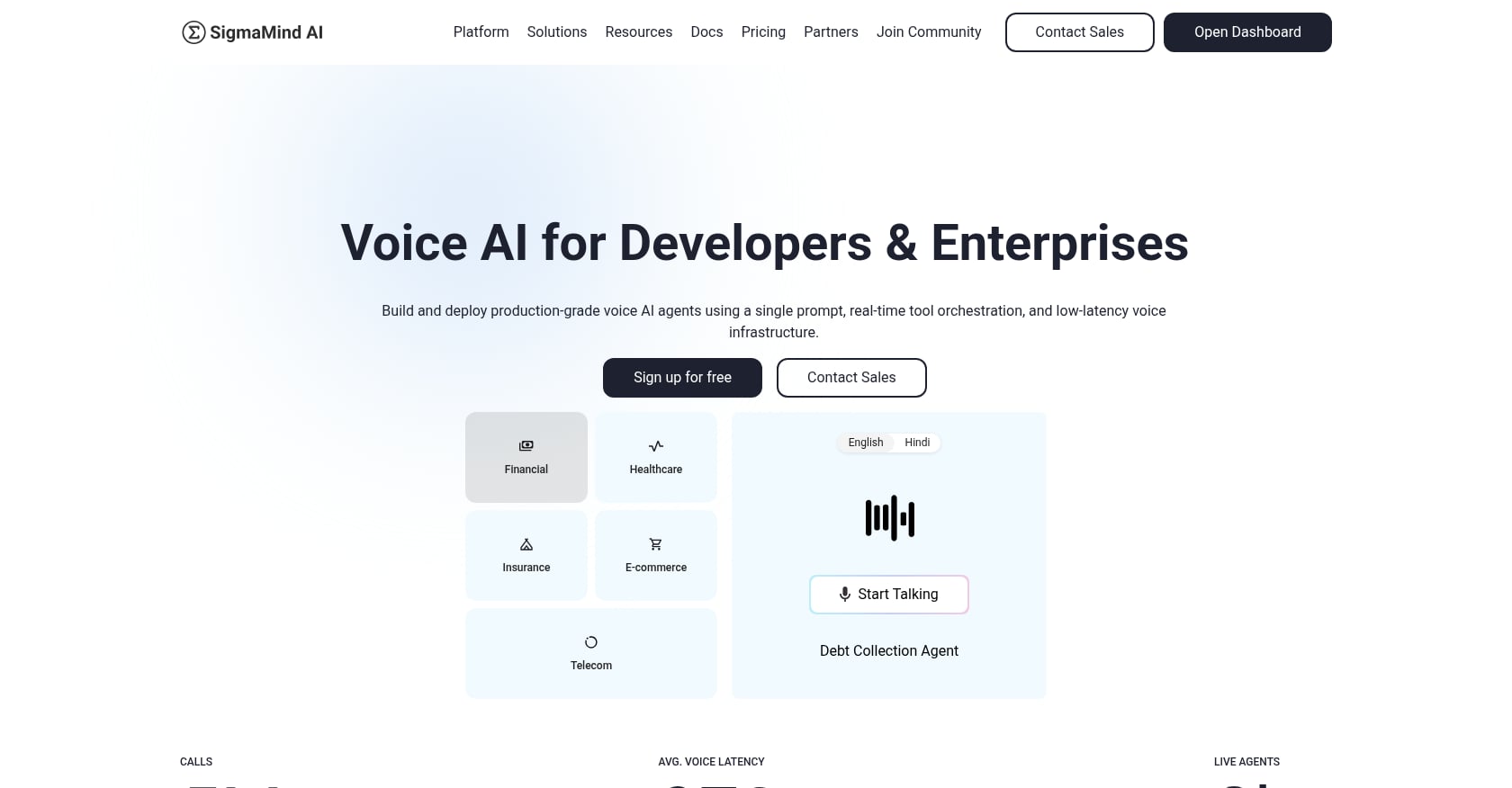
Best for: Production-grade, developer-first omnichannel voice agents with full observability.
Pricing: Pay-as-you-go. Voice agents: $0.03/min platform fee plus provider usage costs for STT, TTS, LLM, and telephony. Chat agents: $0.005 per AI message plus optional SMS. Enterprise volume pricing available. A live pricing calculator shows per-layer breakdowns so teams can model true costs before deploying.
Key features:
- No-code Agent Builder plus full APIs and MCP server for in-IDE orchestration
- Sub-second voice-to-voice latency (~970ms average) with high concurrency support
- Warm transfer with structured context headers (AI summary plus machine-readable variables passed to human agents)
- Model-agnostic stack: choose from Deepgram (STT), ElevenLabs/Rime AI/Cartesia (TTS), OpenAI/Claude/Gemini (LLM)
- Omnichannel from one canvas: voice, chat, and email with shared logic
- Native US phone numbers plus BYOC via SIP, Twilio, or Telnyx
- Pre-built app library connecting CRMs, helpdesks, e-commerce, and scheduling tools
User sentiment: 4.9 rating on Product Hunt with 14 reviews. Case studies show 4,000+ refunds/month automated with 43% cost savings and turnaround reduced from 2-3 days to under 60 seconds.
Tradeoffs:
- Direct phone number purchasing is currently US-only; international deployments require BYOC via SIP
- Modular pricing means teams need to plan provider selections and model costs up front
- Dependent on third-party AI providers for STT/TTS/LLM, which means occasional recalibration when vendors update pricing or models
Explore the full production-grade voice AI platform or start building for free.
2. PolyAI

Best for: High-end, natural inbound experiences in large contact centers with multilingual needs.
Pricing: Enterprise, quote-based. Not publicly listed. G2 reviews confirm custom contracts are standard.
Key features:
- Multilingual voice interactions with human-like realism
- Purpose-built for large-scale inbound call deflection
- Strong enterprise reference customers
- Recent financing rounds suggest growth trajectory
User sentiment: G2 reviewers highlight “automation and efficiency” and voice realism as standout qualities.
Tradeoffs:
- Pricing opacity makes budget forecasting difficult before engagement
- Setup complexity noted by reviewers; iteration speed often cited as slower compared to developer-first platforms
- Less flexibility for teams that want to swap underlying models or providers
3. Cognigy

Best for: Enterprise orchestration across channels with governance controls and cross-functional team workflows.
Pricing: Custom, enterprise-level. Public price lists are rare.
Key features:
- Designer-oriented GUI accessible to non-technical teams
- Strong governance, audit, and scale features
- Multi-channel deployment (voice plus digital)
- Recognized in Gartner Peer Insights with positive enterprise feedback
User sentiment: Gartner Peer Insights reviewers highlight ease of onboarding cross-functional teams, though some note the platform’s complexity for simpler use cases.
Tradeoffs:
- Cost and vendor-led implementations can slow time to value
- Requires dedicated team or SI partner for complex deployments
- Less suited for lean teams or agencies that need rapid iteration
4. Retell AI

Best for: Developer teams needing low-latency voice agents shipped fast.
Pricing: Public per-minute ranges from $0.07 to $0.31/min depending on voice model and settings. Final bill varies with LLM, TTS, STT, and telephony choices.
Key features:
- Optimized for voice latency
- Active developer community and content ecosystem
- Multiple voice and model options
- Quick onboarding for prototype-to-production
User sentiment: Strong G2 reviews. Reddit testers praise the human-like conversational flow. Some note a learning curve for complex multi-step flows.
Tradeoffs:
- Pricing stacks quickly with premium voices and advanced LLMs
- Telephony choices directly affect per-minute cost in ways that aren’t obvious at first
- Less emphasis on omnichannel (voice-focused)
5. Vapi

Best for: API-first developers who want to wire every component themselves and optimize each layer.
Pricing: Third-party analyses emphasize a low headline rate (~$0.05/min) but warn about layered costs from AI and telephony add-ons. True cost is stack-dependent.
Key features:
- Deep custom control over every component
- Strong for prototyping bespoke voice flows
- WebSocket-based architecture
- Large ecosystem of community-built templates
User sentiment: Polarized. Practitioners on Reddit describe Vapi as offering “power with complexity.” Trustpilot reviews flag latency and pricing concerns alongside praise for flexibility. One Reddit builder noted that “demo bots succeed; production fails without observability and human handoff tools.”
Tradeoffs:
- Engineering-heavy; not suited for teams without dedicated developers
- Observability and operational guardrails are minimal out of the box
- True cost per minute depends entirely on your specific model, voice, and carrier mix, making budgeting harder
6. Voiceflow

Best for: Cross-functional CX teams building voice and chat agents with a visual canvas.
Pricing: Tiered subscription based on number of editors, with enterprise options available.
Key features:
- Highly intuitive drag-and-drop conversation builder
- Recognized with a G2 2026 Best Software Award
- Supports both voice and chat agent design
- Growing integration ecosystem
User sentiment: G2 reviews consistently praise ease of use. Some advanced operations require custom code or third-party integration.
Tradeoffs:
- Not a telephony-native platform; you’ll need to stitch voice infrastructure and call analytics separately for contact center work
- Less granular cost tracking by AI layer
- Better for design and prototyping than for high-volume phone call operations
7. Parloa

Best for: EU enterprises modernizing legacy IVR systems with conversational voice automation.
Pricing: Enterprise, quote-based. Few public reviews available.
Key features:
- Focused on European deployment requirements (data residency, languages)
- Contact center workflow automation
- Active presence at European industry events
User sentiment: Sparse verified reviews on G2, which is a watch-out for buyers doing due diligence.
Tradeoffs:
- Limited public feedback means buyer diligence is essential on latency, analytics depth, and documentation
- Narrower geographic focus compared to global platforms
- Less community content and independent analysis available
8. Replicant

Best for: Managed AI voice at scale, resolving Tier-1 call volume with vendor-run operations.
Pricing: Enterprise, typically sold as outcomes-based contracts. Public pricing is uncommon.
Key features:
- “Human-like empathy” positioning with focus on natural interactions
- Vendor-managed operations (less internal engineering required)
- Gartner Peer Insights shows positive outcomes data
- 24/7 automated coverage for high-volume Tier-1 inquiries
User sentiment: Gartner Peer reviewers cite reduced wait times and round-the-clock coverage as primary benefits.
Tradeoffs:
- Black-box risk: confirm you have access to transcripts, tuning controls, and per-layer cost breakdowns
- Iteration velocity can be slower versus developer-first platforms
- Some G2 reviewers note limited customization flexibility
9. Hyro
Best for: Healthcare and public-sector organizations automating voice and chat interactions.
Pricing: Enterprise, quote-based.
Key features:
- Recognized as a Fierce Healthcare “Fierce 15” company in 2026
- Focus on conversational intelligence and analytics
- Plug-and-play approach for healthcare workflows
- HIPAA-aligned deployment capabilities
User sentiment: G2 reviewers cite value in the out-of-the-box approach for regulated industries.
Tradeoffs:
- Sector focus can mean a narrower integration catalog outside healthcare and public sector
- Verify specific HIPAA workflows and BAA availability
- Less suited for general-purpose contact center deployments
10. Talkdesk Autopilot

Best for: CCaaS buyers who want AI voice assistants embedded inside their existing Talkdesk stack.
Pricing: Varies by Talkdesk plan and modules. Review aggregators summarize pricing as mid-to-high range.
Key features:
- Native integration with Talkdesk routing, recording, and analytics
- Barge-in support documented for natural caller interactions
- Strong review footprint across G2 and Gartner
- Enterprise governance and compliance features
User sentiment: Gartner Peer Insights reviewers are positive on AI-assisted deflection and overall customer experience.
Tradeoffs:
- Less model and provider flexibility compared to model-agnostic builders
- Per-minute add-on costs for AI features can be unclear
- Locked into the Talkdesk ecosystem for most value
11. Rasa (Self-Host + Voice Stack)

Best for: Teams that need open-architecture control for compliance, data sovereignty, or maximum customization.
Pricing: Free developer/OSS tier plus enterprise plans. Self-hosted deployment preferred.
Key features:
- Pro-code framework with CALM dialogue engine and Rasa Studio
- Integrate any STT, TTS, and telephony provider of choice
- Full control over data (on-prem or private cloud)
- Active open-source community
User sentiment: Community threads validate the framework’s flexibility, particularly for teams with strong engineering resources.
Tradeoffs:
- You own everything: latency optimization, observability, telephony plumbing, and uptime
- Steeper path to “first working call” compared to managed platforms
- Requires ongoing engineering investment for maintenance and upgrades
12. Builder Toolkits (LiveKit-Based Toolchains and Similar)

Best for: Engineering teams assembling a fully bespoke voice AI stack and optimizing every component.
Pricing: Pay-as-you-go API components. Perceived cheap, but real cost is entirely stack-dependent.
Key features:
- Maximum control over each processing hop (STT, LLM, TTS, transport)
- Can achieve excellent cost optimization at scale with dedicated engineering
- Flexible enough for novel architectures and research-grade implementations
User sentiment: Practitioners on Reddit consistently flag that demos work fine but production fails without observability and human handoff tooling. The gap between a working prototype and a reliable production system is where most teams underestimate effort.
Tradeoffs:
- Highest integration debt and on-call burden of any approach
- No built-in analytics, warm transfer, or conversation management
- Best suited only for teams with dedicated voice infrastructure engineers
The Real Cost of Voice AI: Why Headlines Mislead
Here’s the uncomfortable truth about AI voice assistant pricing: the number on the marketing page almost never matches your invoice. Even vendor-published analyses admit this.
Every AI voice call runs through a stack with four to five cost layers:
| Cost Layer | Example Provider | Approximate Range |
|---|---|---|
| Telephony (carrier minutes) | Twilio | $0.0085–$0.022/min (US) |
| Speech-to-Text | Deepgram | $0.0043–$0.0145/min |
| LLM processing | OpenAI, Claude, Gemini | Varies by model, tokens, streaming |
| Text-to-Speech | ElevenLabs, Rime AI, Cartesia | $0.01–$0.04+/min (tier-dependent) |
| Platform fee | Varies by vendor | $0.03–$0.10+/min |
A “headline price” of $0.05/min that excludes LLM and telephony costs can easily become $0.12 to $0.18/min in practice. At 10,000 minutes per month, that gap means an extra $700 to $1,300 on your bill.
The fix is simple: demand per-layer cost breakdowns. Use a pricing calculator that lets you select your specific STT, TTS, LLM, and telephony providers, then see the true per-minute cost before you commit.
As one LinkedIn practitioner put it in a checklist for evaluating voice agents: don’t chase the lowest dollar-per-minute. Optimize for containment rate and handoff quality. That’s where ROI actually comes from.
5 Production Pitfalls to Avoid (From Practitioners Who Learned the Hard Way)
1. Latency Over One Second Tanks Customer Satisfaction
Research on real-time voice AI infrastructure shows that human turn-taking expects responses within 100 to 400 milliseconds. Anything over one second feels like talking to a broken connection. Use streaming across all three stages (STT, LLM, TTS) rather than waiting for each to complete sequentially. Prefetch knowledge via RAG or semantic caches to cut LLM processing time.
2. Voice Fraud Is a Real and Growing Threat
AI voice fraud is actively exploiting contact centers. Don’t let your voice assistant finalize password resets, large refunds, or account changes without secondary authentication. Build knowledge-based authentication triggers and automatic escalation rules for high-risk actions.
3. Barge-In Tuning Requires Real-World Testing
Setting endpointers (the silence threshold that signals a speaker has finished) too aggressively causes the AI to cut callers off mid-sentence. Too conservatively, and the AI waits awkwardly. Test with noisy backgrounds, accented speech, and varied speaking speeds. What works in a quiet demo room fails in a car or a crowded office.
4. Skipping Observability Makes Optimization Impossible
Ship with transcripts, node-level logs, and cost metrics from day one. Without them, operations teams can’t identify where conversations break down, which prompts need tuning, or where spend is concentrated. Use a platform that offers per-layer analytics and conversation tracking rather than bolting observability on later.
5. Demo Success Does Not Equal Production Success
A recurring theme in practitioner communities: “The agents that feel good aren’t the ones with the fanciest voice, they’re the ones that get you the right answer fast.” Retrieval quality and tool execution matter more than voice realism. And as multiple Reddit builders have warned, production deployments without warm transfer and human handoff tools will fail when edge cases inevitably arise. Test extensively in SigmaMind’s real-time playground or equivalent before going live.
Frequently Asked Questions
What is an AI voice assistant for business?
An AI voice assistant for business is a software agent that conducts real-time phone conversations using speech-to-text, a large language model for reasoning, and text-to-speech for responses. Unlike old IVR menus, these agents understand natural language, can take actions (booking appointments, processing refunds, updating CRM records), and hand off to human agents with full conversation context when needed.
How much does an AI voice assistant actually cost per minute?
True cost per minute typically ranges from $0.08 to $0.20+ depending on your stack. The four main cost layers are telephony (carrier minutes), speech-to-text, LLM processing, text-to-speech, plus the platform fee. Most vendors advertise only the platform fee. Always ask for a per-layer breakdown. SigmaMind’s platform fee, for example, is $0.03/min, with provider costs added transparently on top.
What latency should I target for a production voice agent?
Sub-one-second voice-to-voice response time is the minimum for natural-feeling conversations. Human turn-taking windows are 100 to 400 milliseconds, so anything approaching or exceeding one second creates noticeable, frustrating pauses. Prioritize platforms that stream across all processing stages rather than handling them sequentially.
Can AI voice assistants handle multiple languages?
Yes, many platforms support multilingual deployments. The quality varies significantly by language pair and depends on the underlying STT and TTS providers. English is universally strong; other languages should be tested with native speakers before production deployment.
What is barge-in and why does it matter?
Barge-in is the ability for a caller to interrupt the AI mid-sentence and receive an immediate response. Without it, callers must wait for the AI to finish speaking before their input is processed. This creates an unnatural, frustrating experience. Any production-grade AI voice assistant should support configurable barge-in.
Should I buy phone numbers from the AI platform or bring my own carrier?
It depends on your scale and geography. Buying numbers from the platform (if available) is faster to set up. Bringing your own carrier via SIP trunking (through Twilio, Telnyx, or similar) gives more control over costs and international coverage. At high volumes, BYOC is usually cheaper. Many businesses start with platform-provided numbers and migrate to BYOC as they scale.
How do AI voice assistants handle calls they can’t resolve?
The best platforms support warm transfer, where the AI passes the call to a human agent along with a conversation summary, detected intent, and relevant account data. This prevents the caller from repeating their story. Platforms without structured handoff context force human agents to start from scratch, which erases most of the efficiency gains.
Are AI voice assistants secure enough for sensitive industries?
SOC 2 certification is the baseline expectation. For healthcare, verify HIPAA-aligned workflows and business associate agreements. For financial services, check encryption standards and confirm that voice recordings and transcripts are stored with appropriate access controls. Regardless of industry, implement secondary authentication for high-risk actions to guard against voice fraud.
If phone-grade reliability matters for your team, prioritize platforms with explicit latency targets, warm transfer context, and per-layer analytics. These three features predict success far more than demo voice quality. Explore SigmaMind’s platform to see how production-grade voice AI works in practice, or contact the team for an enterprise walkthrough.

