
How to Add AI Voice Agents to VICIdial Without Replacing Your Infrastructure
Learn how to add AI voice agents to VICIdial without replacing your dialer, SIP trunks, or campaigns. See the 3 integration methods and how SigmaMind deploys in minutes.
IN this article

Evolve with Sigma Mind AI
Build, launch & scale AI agents
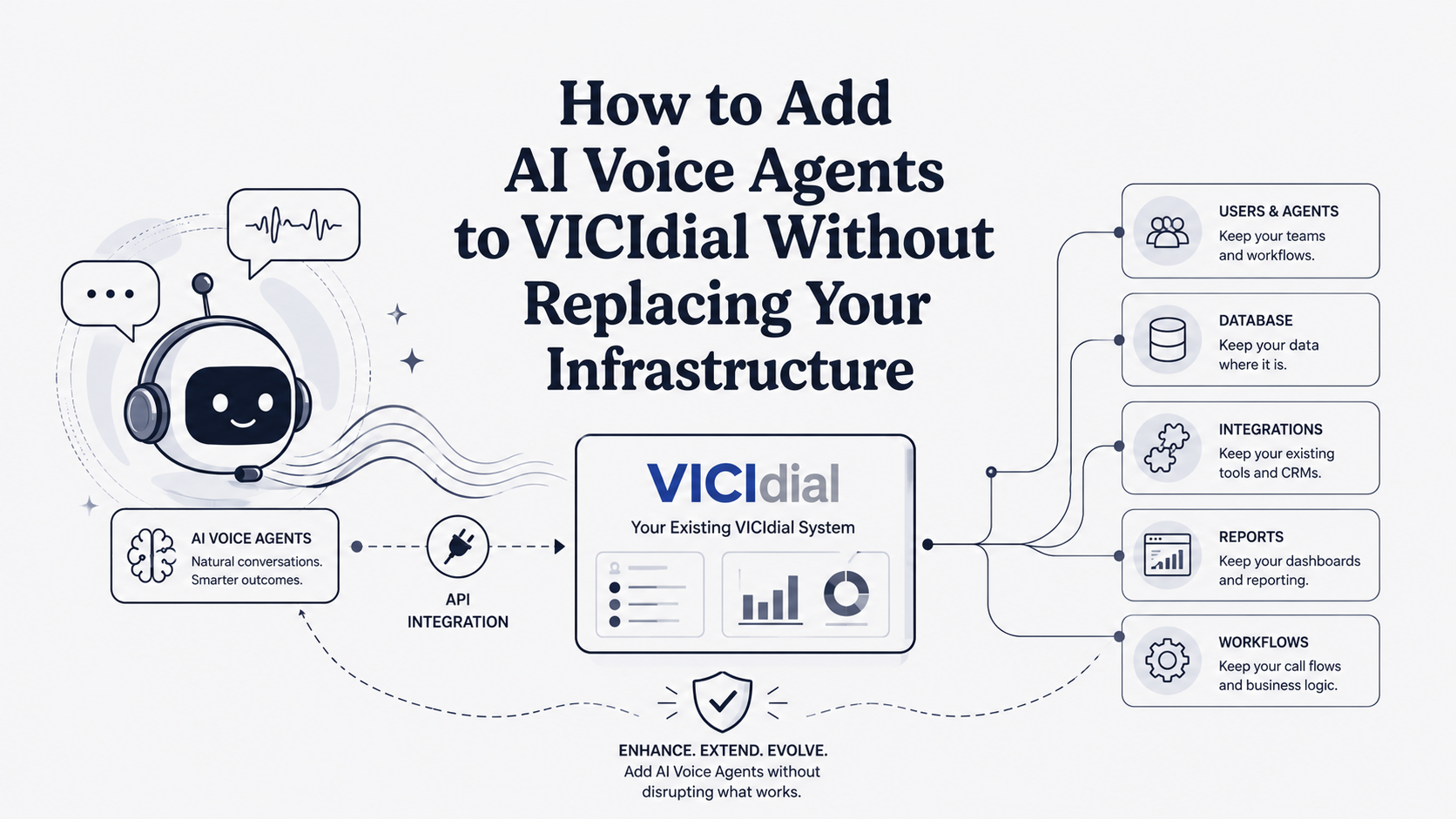
If you're running VICIdial, your infrastructure works. Your agents know it. Your campaigns are built around it. Your SIP trunks, your lead lists, your dispositions, your reporting all of it is dialled in after months or years of configuration. The last thing you want is a vendor telling you to rip it out and start over.
The good news is you don't have to. Adding Voice AI for VICIdial doesn't mean replacing your dialer. It means adding an intelligent AI layer on top of the infrastructure you already have one that handles first-touch outbound volume, qualifies leads, and hands off warm transfers to your human agents, all through your existing VICIdial setup.
SigmaMind AI has done exactly this for call centers processing over 750,000 calls per month. This guide explains how the integration works, which architecture is right for your operation, and how to add AI to VICIdial without disrupting a single campaign.
See the VICIdial Integration Live
SigmaMind AI integrates with your existing VICIdial setup in minutes no dialer replacement, no downtime, no infrastructure changes required.
Book Your Call → See SigmaMind + VICIdial in Action
Why Do Call Centers Want to Add AI to VICIdial Without Replacing It?
VICIdial powers over 100,000 call center deployments globally. It's open-source, it's proven at scale, and for outbound operations running high-volume predictive dialing, it does the job reliably. Replacing it introduces risk that most operators won't accept migration downtime, retraining costs, campaign reconfiguration, and the loss of years of custom dialplan work.
But the pressure to add AI is real. Call centers using call center voice AI on first-touch outbound are reporting 60%+ reductions in cost-per-conversion compared to human-only operations. AI handles the 80% of dials that go to voicemail, DNC-adjacent contacts, or unqualified leads freeing human agents to work exclusively on warm, pre-qualified conversations.
The operators who tried early AI integrations and failed largely did so because they used the wrong architecture adding complex middleware or SIP trunk rerouting that introduced latency and broke every time VICIdial updated. The integrations that work in 2026 are simpler, and they keep VICIdial exactly where it is.
What Are the Three Ways to Integrate AI Voice Agents with VICIdial?
There are three integration architectures for adding AI to VICIdial. Each has different tradeoffs in terms of setup time, technical complexity, and production stability.
1. SIP Extension Registration (Recommended)
The AI agent registers as a standard SIP extension directly on your VICIdial server exactly the same way a human agent's softphone would. VICIdial sees the AI as just another agent in the campaign. Calls are routed to it from your existing dialplan with zero changes to your carriers, campaigns, or lead lists.
- Setup time: 10–15 minutes
- Infrastructure changes required: None
- VICIdial sees: A standard agent extension, indistinguishable from a human agent
- Stability: High no middleware, no external routing, no failure points beyond the AI platform itself
- Best for: Most outbound call centers running standard VICIdial campaigns
2. SIP Trunk Routing
Answered calls from VICIdial route outward through a SIP trunk to the AI platform's servers. The AI qualifies the call and routes qualified leads back through a second SIP trunk to your agent queue. VICIdial's dialplan handles the routing logic.
- Setup time: 1–3 days (dialplan configuration required)
- Infrastructure changes required: SIP trunk configuration
- Best for: Operations with high concurrent call volumes that need AI processing off-premise
- Watch out for: Latency introduced by double SIP hop test carefully before production deployment
3. API Lead Injection
AI handles the outbound call externally and, upon qualifying a lead, injects the contact directly into VICIdial's lead management system via API for human agent follow-up. VICIdial is used purely for human-agent-side call management.
- Setup time: Varies by CRM and lead management configuration
- Infrastructure changes required: API access to VICIdial lead tables
- Best for: Operations where AI and human agents work in separate campaign tracks
- Watch out for: Lead data latency between AI qualification and human agent callback
For most VICIdial operators, SIP extension registration is the right starting point. It requires nothing from your existing infrastructure and can be running on a live campaign the same day.
How Does SigmaMind AI Work Inside VICIdial Once It's Connected?
Once SigmaMind registers as a SIP extension, it operates inside VICIdial's campaign structure like any other agent. Here is what the workflow looks like on a live outbound campaign:
- VICIdial predictive dialer dials outbound numbers through your existing carriers and SIP trunks no change to your current dialing setup
- Answered calls route to SigmaMind AI as the next available agent in the campaign queue AMD (Answering Machine Detection) filters voicemails before the AI connects
- SigmaMind handles the conversation introducing the call, running the qualification script, handling objections, and collecting the information your campaign requires
- Qualified leads get warm-transferred to a human agent in your VICIdial queue with a live call summary delivered to the agent before the call connects
- Unqualified contacts are dispositioned automatically in VICIdial using your existing disposition codes no manual logging required
- All call data transcript, qualification outcome, disposition, duration flows back into VICIdial's reporting system alongside your human agent data
Your supervisors see everything through the same VICIdial interface they use today. AI agent activity appears in real-time monitoring alongside human agents. Your existing QA and reporting workflows continue without modification.
What Happens to Your Existing VICIdial Campaigns, SIP Trunks, and Settings?
Nothing changes. This is the core principle of the SigmaMind integration approach and the reason it has been stable in production at high volume. Your AI Voice agent with VICIdial deployment preserves the following without modification:
- Existing campaigns AI agents are added to campaigns as additional extensions. Existing campaign configuration, dial ratios, and schedules remain unchanged
- SIP trunks and carriers Outbound dialing continues through your existing SIP trunk providers. SigmaMind does not require a new carrier relationship
- Lead lists and CRM data VICIdial's lead management system continues to manage all contact data. SigmaMind reads and writes disposition data through standard VICIdial integration points
- Disposition codes AI uses your existing VICIdial disposition codes so all outcome data lands in the same reporting structure your team already works from
- Call recordings AI-handled calls record through VICIdial's existing recording infrastructure same storage location, same QA access, same compliance coverage
- Supervisors and monitoring Real-time monitoring shows AI agent activity in the standard VICIdial agent board. No new dashboards required to see what's happening
What Call Types Should You Start With When Adding AI to VICIdial?
The fastest path to measurable ROI is starting AI on a single, structured campaign before expanding. These are the call types that work best as a first deployment on VICIdial:
- Lead qualification campaigns AI works through discovery questions, scores responses, and warm-transfers qualified prospects to closers. Structured scripts with clear pass/fail qualification criteria are where AI performs most reliably
- Payment reminder outreach Initial contact, balance confirmation, and soft payment arrangement prompts on compliant collections workflows. Consistent script delivery and automatic disposition logging make AI the right fit here
- Appointment confirmation and scheduling Confirming, rescheduling, and booking appointments with live calendar integration. High call volume, low conversation complexity ideal for AI handling
- Re-engagement campaigns Reaching dormant leads or lapsed contacts at scale without burning human agent time on cold lists. AI handles the volume; humans handle the reconnects that show genuine intent
- After-hours inbound routing Capturing and qualifying inbound calls outside business hours without staffing an overnight shift
For a deeper look at how AI performs across these use cases on VICIdial, the Voice AI solution with VICIdial architecture guide covers integration methods, latency benchmarks, and production deployment considerations in detail.
What Are the Most Common VICIdial AI Integration Questions from Call Center Operators?
These are the questions that come up consistently when VICIdial operators are evaluating an AI integration for the first time:
Does adding AI require downtime on my VICIdial server?
No. SIP extension registration adds the AI as a new agent endpoint. Your server, campaigns, and active calls continue without interruption during setup.
What happens if the AI goes offline mid-campaign?
VICIdial treats a disconnected AI extension exactly like a human agent going offline calls route to the next available agent in the queue. If you have human agents as backup, they absorb the overflow automatically. No campaign downtime occurs.
Will the AI work with my current VICIdial version?
SigmaMind's integration has been tested across VICIdial versions 2.11 through 2.14 in production environments. If you're running a significantly older version, a quick configuration check before deployment confirms compatibility.
Can I run AI on one campaign while keeping others human-only?
Yes. You assign the AI extension to specific campaigns only. Other campaigns continue running entirely with human agents. This is the standard approach for a controlled pilot before broader rollout.
Does TCPA compliance change when I add AI to VICIdial?
AI actually strengthens TCPA compliance on outbound campaigns. SigmaMind enforces call attempt limits, respects DNC lists, manages call pacing, and produces structured call logs automatically removing the compliance variables that human agents introduce through inconsistent execution.
Is Adding AI to VICIdial the Right Next Step for Your Call Center?
If you're processing meaningful outbound call volume on VICIdial and your human agents are spending time on unqualified contacts, voicemails, and repetitive first-touch scripts the answer is almost certainly yes. The integration doesn't ask you to change anything that's working. It adds AI capacity on top of the infrastructure you've already built, on the campaigns where AI delivers the most reliable return.
SigmaMind AI is purpose-built for exactly this deployment model. Your VICIdial setup stays intact. Your team works the same way. Your reporting stays in the same place. What changes is how much of your outbound volume gets handled before a human agent ever picks up the phone and what that does to your cost-per-conversion on every campaign you run.
Ready to Add AI to Your VICIdial Setup?
Book a call with the SigmaMind team and see the integration running on a live VICIdial environment no infrastructure changes, no dialer replacement, no commitment required.
Sign Up Free → Book Your VICIdial Integration Call
Evolve with Sigma Mind AI
Build, launch & scale AI agents
Related Blogs
Ready to transform your call center?

More Conversations.
Less Manual Work.

Building from San Francisco, CA