
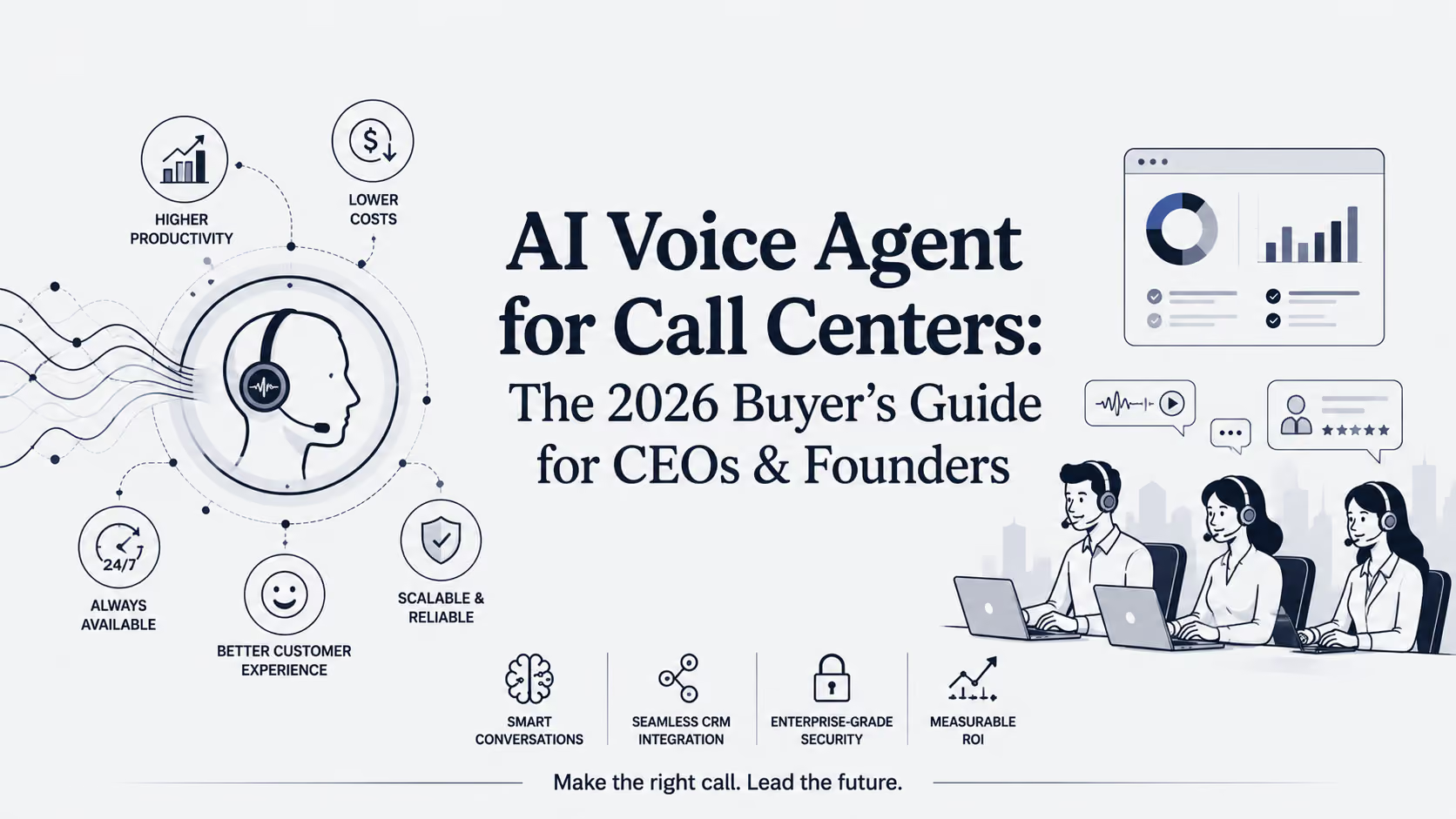
AI Voice Agent for Call Centers: The 2026 Buyer's Guide for CEOs & Founders
The 2026 buyer's guide for call center CEOs and founders covering AI voice agent evaluation criteria, 10 demo questions to ask every vendor, deployment timelines, and VICIdial compatibility.
IN this article

Evolve with Sigma Mind AI
Build, launch & scale AI agents
The AI voice agent market in 2026 is not what it was eighteen months ago. Platforms have moved from scripted demos to production deployments handling millions of calls per month. Autonomous resolution rates have climbed to 60–80% on structured call types. Cost-per-contact for AI-handled calls sits at a fraction of fully loaded human agent cost. And the conversation has shifted from 'should we evaluate this?' to 'which platform is right for our operation and how do we deploy without disrupting what's already working?'
This guide is written for call center CEOs and founders who are at that evaluation stage. Not engineers deciding which API to integrate. Not IT teams benchmarking latency. Decision-makers who need to understand what an AI call center solution actually delivers, what to look for when platforms all sound the same, and how to make a buying decision that holds up six months after go-live.
See SigmaMind AI Running on Live Call Center Traffic
Book a call and watch SigmaMind handle a real outbound campaign lead qualification, warm transfer, and automatic CRM logging on a live session.
Book Your Call → See SigmaMind in Action
What Is an AI Voice Agent and How Is It Different from What You've Used Before?
An AI voice agent is a software system that holds real spoken conversations with callers understanding natural language, accessing your CRM and business data in real time, taking actions like booking appointments or updating lead records, and transferring calls to human agents with full context when needed.
That last part is what separates a 2026 AI voice agent from what most call center leaders tried and wrote off three years ago. Early implementations were scripted audio players with basic branching logic. They failed because they couldn't handle anything outside a narrow decision tree. A caller said something unexpected and the system either looped, disconnected, or said 'I didn't understand that' until the caller hung up.
Modern Voice AI solution platforms run on large language models that understand intent, handle interruptions, manage multi-turn conversations, and adapt dynamically to what a caller actually says, not just what you predicted they would say. The result is an agent that holds up under real call conditions, not just in a controlled demo environment.
What Call Types Are AI Voice Agents Best Suited For in 2026?
The fastest path to measurable ROI is deploying AI on call types where the conversation is structured, the qualification criteria are clear, and the volume is high enough that human agent time on these calls represents a meaningful cost. The strongest use cases in 2026 are:
- Outbound lead qualification AI works through discovery questions, scores prospects, and warm-transfers qualified leads to human closers. Every lead gets the same rigorous qualification call with zero drift from the approved script
- Appointment scheduling and confirmation Booking, rescheduling, and confirming appointments with live calendar integration. High call volume, low conversation complexity, and zero tolerance for missed bookings
- Payment reminders and first-touch collections Initial outbound contact, balance confirmation, and soft payment arrangement prompts on compliant debt workflows. Built-in TCPA compliance controls remove the human agent compliance variable
- Inbound call routing and triage Answering inbound calls, identifying caller intent, collecting initial information, and routing to the right queue with full context eliminating the dead time between ring and first useful conversation
- After-hours coverage Running 24/7 at the same cost per minute, AI captures and qualifies calls outside business hours that would otherwise go to voicemail and never convert
- Re-engagement campaigns Reaching dormant leads or lapsed customers at scale without burning human agent time on lists that will convert at 2–5%
What Should CEOs and Founders Actually Evaluate When Buying an AI Voice Agent Platform?
Every vendor in this market will show you a clean demo with a pleasant voice and a smooth transfer. The demo is not the product. What matters is how the platform performs in production, at your call volume, on your call types, with your existing infrastructure. Here is what to evaluate:
Production latency, not demo latency.
Sub-second response time is the threshold for natural conversation. Anything above 1,500ms of end-to-end latency will feel robotic and damage caller experience. Ask vendors for p50 and p95 latency figures at 100+ concurrent calls, not the number they use for a single-call demo.
Autonomous resolution rate on your specific call type.
Platform-level resolution rates mean nothing. A platform that resolves 80% of software support calls may resolve 40% of collections outreach because the conversation dynamics are completely different. Ask for production data from call centers with similar use cases and volumes.
Infrastructure compatibility.
If your call center runs on VICIdial, Five9, or a custom SIP stack, your AI platform needs to integrate with what you have not required you to replace it. Voice AI for VICIdial integrations specifically should be treated as a core requirement, not a future roadmap item, if VICIdial is part of your current setup.
Warm transfer quality.
The handoff from AI to human agent is where many deployments fail. A caller who has to repeat everything they just told the AI has a worse experience than if they had reached a human directly. Evaluate what the human agent sees before the call connects, not just what gets logged after.
Compliance controls.
For outbound call centers in the USA, TCPA compliance is non-negotiable. Your AI platform must enforce attempt limits, honor DNC lists, manage call pacing by time zone, and produce structured call logs automatically. Ask vendors to walk through their compliance configuration specifically not their general certification documents.
Post-go-live support model.
Who maintains conversation flows when your scripts change? Who updates qualification criteria when your campaign pivots? Platforms that require engineering work every time your business logic changes generate ongoing costs that were never in the original purchase evaluation.
What Are the 10 Questions to Ask in Every AI Voice Agent Demo?
These questions separate platforms that are production-ready from platforms that are polished for demos. Ask all ten and pay attention to how quickly you get a specific answer:
- What is your end-to-end latency at 100+ concurrent calls p50 and p95?
- Can you show me a production deployment from a call center with similar volume and use case to ours not a controlled demo environment?
- How does your platform handle barge-in when a caller interrupts the AI mid-sentence?
- What CRM and telephony integrations are pre-built versus requiring custom API development?
- How does your platform handle AI Voice agent with VICIdial specifically which integration architecture do you use and what does setup actually involve?
- What does the human agent see before a warm transfer connects and how is that context delivered?
- How are TCPA compliance rules configured, attempt limits, DNC lists, call pacing and who maintains them when rules change?
- What happens when the AI doesn't understand a caller, what does the caller experience and where does the call go?
- When our scripts or business logic change, what is the process and who owns the update, your team or ours?
- Can you share references from two call centers currently running your platform at production volume in our specific use case?
How Does Voice AI for Telecom and High-Volume Operations Differ from General Use Cases?
General-purpose AI voice agents are built for moderate call volumes across diverse use cases. Telecom and high-volume call center operations have requirements that most general platforms simply aren't built to meet:
- Concurrent call capacity A platform that handles 10 concurrent calls without latency issues may fall apart at 500. Voice AI solution for telecom deployments need infrastructure that maintains sub-second response times across hundreds of simultaneous active calls without quality degradation
- SIP infrastructure compatibility High-volume call centers run on SIP trunks, on-premise dialers, and custom carrier relationships. Native SIP integration not just a web-based API is a hard requirement at this scale
- Campaign-level compliance configuration Running multiple simultaneous campaigns requires separate TCPA configurations, DNC lists, and attempt rules per campaign not a single platform-level setting applied across everything
- Carrier-agnostic deployment Enterprise call centers have existing carrier relationships and SIP trunk agreements. Any platform that requires changing carriers to deploy AI is a non-starter for most operations
- Automatic failover When AI goes offline, calls must route to human agents automatically with zero campaign downtime. This requires proper failover configuration at the dialer level, not just a vendor SLA document
What Does a Realistic AI Voice Agent Deployment Look Like Over the First 90 Days?
Expectations about deployment timelines are where many buyer-vendor relationships go wrong. Here is a realistic 90-day framework for a first AI voice agent deployment on a single outbound campaign:
Days 1–14: Setup and configuration.
SIP integration with your existing dialer, CRM connection, script configuration, qualification criteria definition, and compliance rule setup. For platforms with clean integration documentation, this phase takes 1–2 weeks. For platforms with complex middleware dependencies, expect 4–6 weeks to factor that into your evaluation timeline.
Days 15–30: Controlled pilot.
Run AI on 10–20% of one campaign's call volume alongside your existing human agents. Monitor autonomous resolution rate, call quality, transfer completion rate, and CRM data accuracy. Do not expand volume until you have baseline data from at least 1,000 AI-handled calls.
Days 31–60: Optimization.
Adjust conversation flows based on real call data. Common optimizations in this phase include refining qualification thresholds, improving objection handling responses, and tuning transfer triggers based on actual caller behaviour patterns.
Days 61–90: Scale.
Expand AI to full campaign volume and add additional campaigns where pilot performance meets your targets. By day 90, you should have a clear picture of cost-per-conversion change, human agent time recovered, and the ROI case for further expansion.
For a real-world view of this timeline in action, the SigmaMind AI case studies cover production deployments including a 750,000-call-per-month VICIdial operation that reached stable production performance within 30 days of integration.
What Should You Do Before Signing Any AI Voice Agent Contract in 2026?
Three things, in this order:
- Run a pilot on real call volume, not a demo on simulated traffic. Any serious platform will support a paid or trial pilot on a live campaign before a long-term contract. If a vendor won't let you test on real calls, that is your answer.
- Get references from production deployments in your specific use case. Ask for two call centers currently running the platform at your volume and your call type. Speak to their operations leads, not their vendor success managers.
- Evaluate the integration as rigorously as you evaluate the AI. The best voice AI in the world doesn't help if it takes four months to integrate with your dialer and breaks when you update VICIdial. Technical integration quality is a first-class buying criterion, not an afterthought.
SigmaMind AI is built specifically for call center operators at production scale native VICIdial compatibility, sub-800ms end-to-end latency, built-in TCPA compliance, automatic CRM logging, and a deployment model that adds AI on top of your existing infrastructure without replacing anything that's working. The pilots speak for themselves.
Ready to Evaluate SigmaMind for Your Call Center?
Sign up or book a call and we'll run a live session on your actual call type not a scripted demo. See production performance before you make any commitment.
Sign Up Free → Book Your SigmaMind Evaluation
Evolve with Sigma Mind AI
Build, launch & scale AI agents
Related Blogs
Ready to transform your call center?

More Conversations.
Less Manual Work.

Building from San Francisco, CA