
VICIdial AI in 2026: 7 Practical Ways and When to Switch
Learn 7 proven ways to add VICIdial AI in 2026: voice bots, agent assist, QA, real costs, and when to switch. Get practical patterns and pricing now.
IN this article

Evolve with Sigma Mind AI
Build, launch & scale AI agents
TL;DR
VICIdial remains the most widely deployed open-source call center platform, but it ships with zero native AI. You have three realistic paths: bolt on a voice AI layer for automated calls with warm transfer, add real-time agent assist to help humans on live calls, or batch-process recordings for QA and compliance. SigmaMind AI is the fastest production-ready option for voice and chat agents that hand off cleanly into VICIdial queues. If you lack Linux and Asterisk expertise, switching to an AI-first CCaaS may save you more than it costs.
VICIdial + AI in 2026: What Changed and What Didn’t
VICIdial still powers thousands of contact centers worldwide and remains the most widely used open-source option in its category. The codebase is stable, the community is active, and for teams comfortable with Asterisk and Linux, the raw flexibility is unmatched.
What changed is everything around it. Large language models got fast enough for real-time conversation. Speech-to-text dropped below $0.02/min. Text-to-speech voices sound human. And orchestration platforms now handle the messy glue between those components and your existing telephony.
The result: adding VICIdial AI capabilities is no longer a science project. But the “how” matters enormously. A bad integration adds latency, confuses callers, and costs more than the agents it was supposed to replace.
This guide covers seven concrete ways to wire AI into VICIdial today, with real pricing math, integration patterns, practitioner feedback, and honest tradeoffs. It also covers when you should stop trying to bolt things on and switch to a platform built around AI from the start.
At-a-Glance Comparison
ApproachConnects viaExample Cost/Min (Apr 2026)Build EffortLatency ControlBest ForKey LimitationSigmaMind voice agent + warm transferSIP/Twilio/Telnyx~$0.12Low-MedStrong24/7 automation with clean handoffsInternational DIDs require BYOCDIY Jambonz + PipecatSIP bridge/AGIVaries (can be cheaper on paper)HighVariableTeams with Asterisk expertiseHigh maintenance burdenReal-time agent assistMirror RTP to STT + LLM~$0.04-0.07 (text-only)MediumGood (no TTS)Quality and handle-time gainsCustom UI development neededPost-call AI QARecording export/APISTT + LLM batch pricingLowN/ACompliance and coaching at scaleInsights arrive after callsCepstral TTS (AI-lite)Built-in utilitiesPer-license, not per-minuteLowN/ADeterministic IVR/surveysDated voice quality, no understandingMultichannel AI triageDigital channels + SIP$0.005/msg (chat) + voice on transferLow-MedGoodDeflecting repeat ticketsChannel orchestration design requiredOutbound AI campaignsSIP/Twilio/Telnyx~$0.12 (same voice stack)Low-MedStrongSales, reminders, appointment settingTCPA/consent compliance
How AI Actually Plugs into VICIdial
Before picking a tool, understand the three integration surfaces. VICIdial is built on Asterisk, which gives you more connection options than most proprietary dialers, but also more ways to get it wrong.
SIP trunking is the cleanest path. You route calls between VICIdial and an external AI platform over SIP. The AI handles the conversation, then transfers (warm or cold) back to a VICIdial queue. This is how SigmaMind’s SIP integration works, and it is also the pattern practitioners on the VICIdial forum describe using with Jambonz middleware.
AGI (Asterisk Gateway Interface) lets your dialplan hand off call control to an external script. One forum contributor shared working dialplan snippets that route calls to an AI middleware layer and return them to VICIdial on escalation. This gives fine-grained control but requires someone who can debug Asterisk dialplan logic under pressure.
API-based integration covers everything that doesn’t touch the call path directly: pulling recordings for QA, pushing lead data to an AI agent before a call, or feeding real-time transcripts to an assist tool. VICIdial exposes agent and non-agent APIs, plus a well-documented database structure that makes it possible to build custom workflows on top.
The SigmaMind platform overview shows how its model-agnostic orchestration layer sits between these connection points and your choice of STT, TTS, and LLM providers.
The 7 Best VICIdial AI Options This Year
1. SigmaMind AI
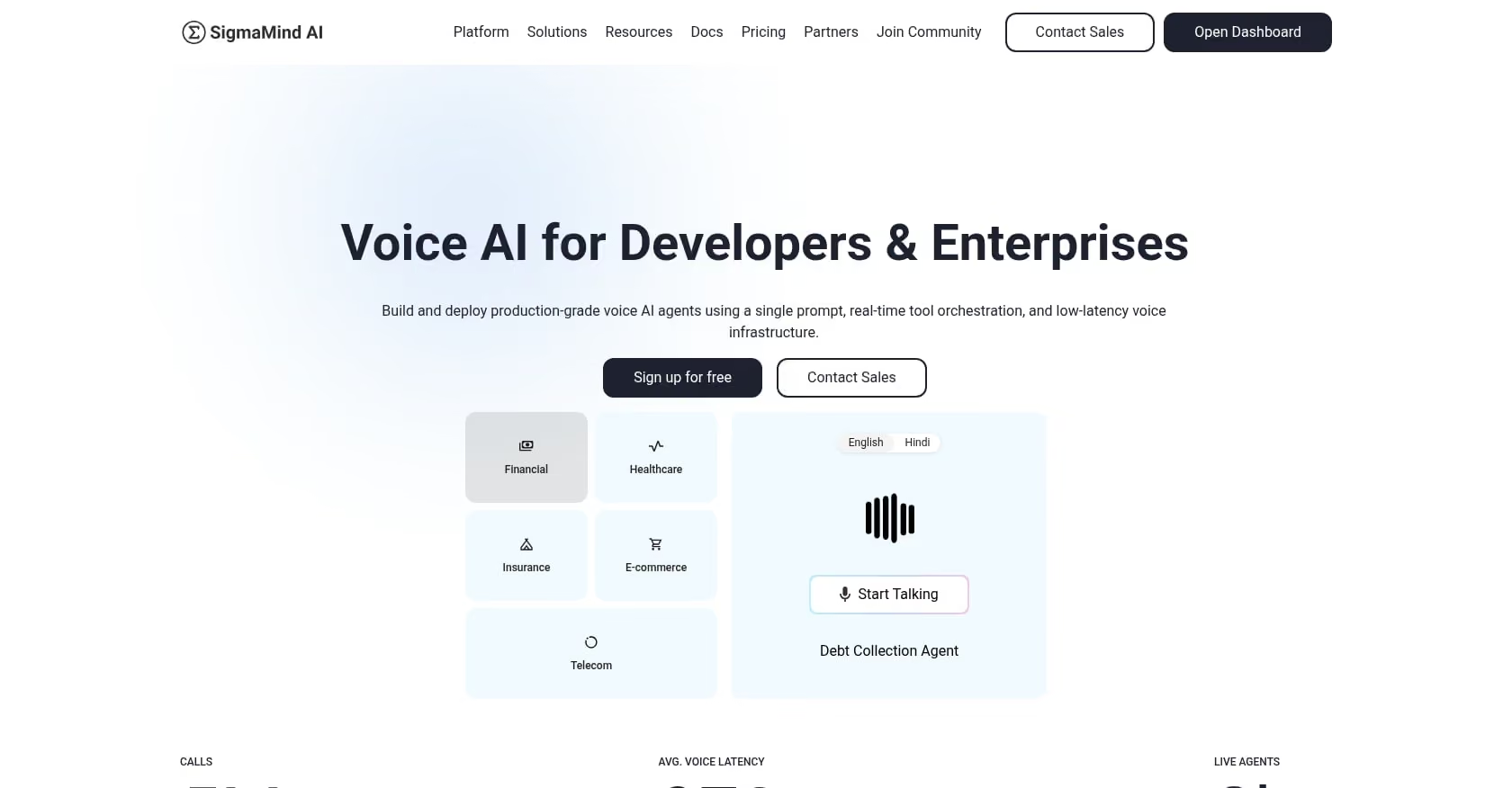
Best for: Production-grade AI voice agents that warm-transfer into VICIdial with full context.
SigmaMind is a developer-first orchestration platform for voice, chat, and email agents. It combines a no-code agent builder with deep APIs and a model-agnostic stack, meaning you pick your STT, TTS, and LLM providers based on your latency and cost requirements.
Pricing (as of April 2026):
- Platform fee: $0.03/min for voice, $0.005 per AI message for chat
- Total voice cost = platform + STT + TTS + LLM + telephony
- Example stack: Deepgram STT ($0.01/min) + ElevenLabs TTS ($0.05/min) + GPT-4o LLM ($0.02/min) + Twilio US outbound (~$0.014/min) = roughly $0.124/min all-in before taxes
- Use the SigmaMind pricing calculator to model your actual stack
Key features:
- No-code agent builder with branching logic, tool calls, and conditional flows
- Warm transfer that passes AI-generated summaries and structured context to human agents, so callers never repeat themselves (detailed in the warm transfer guide)
- App Library integrations for Zendesk, Gorgias, Shopify, Calendly, and more
- Outbound campaign support with concurrency controls
- Built-in US phone numbers or BYOC via SIP/Twilio/Telnyx
- Analytics with per-layer cost breakdowns
User sentiment: Product Hunt reviewers emphasize low latency, easy setup, and smooth integrations, with a 4.9 rating across 14 reviews as of launch. Practitioners in leadgen communities stress that SigmaMind’s transparent, layer-by-layer pricing avoids the “hidden fees” problem common with headline “$0.10/min” claims.
Tradeoffs:
- US phone numbers available natively; international numbers require BYOC SIP configuration
- True per-minute cost is a blend of multiple providers; you need to plan your mix deliberately
- Dependent on third-party AI providers for STT/TTS/LLM, meaning vendor pricing changes can shift your costs
SigmaMind is the right starting point for teams that want a VICIdial AI layer up and running fast, with observable costs and reliable human handoffs. If your primary use case is customer support automation or appointment scheduling, the pre-built flows cut setup time significantly.
2. Self-Hosted Voice AI with Jambonz + Open Frameworks
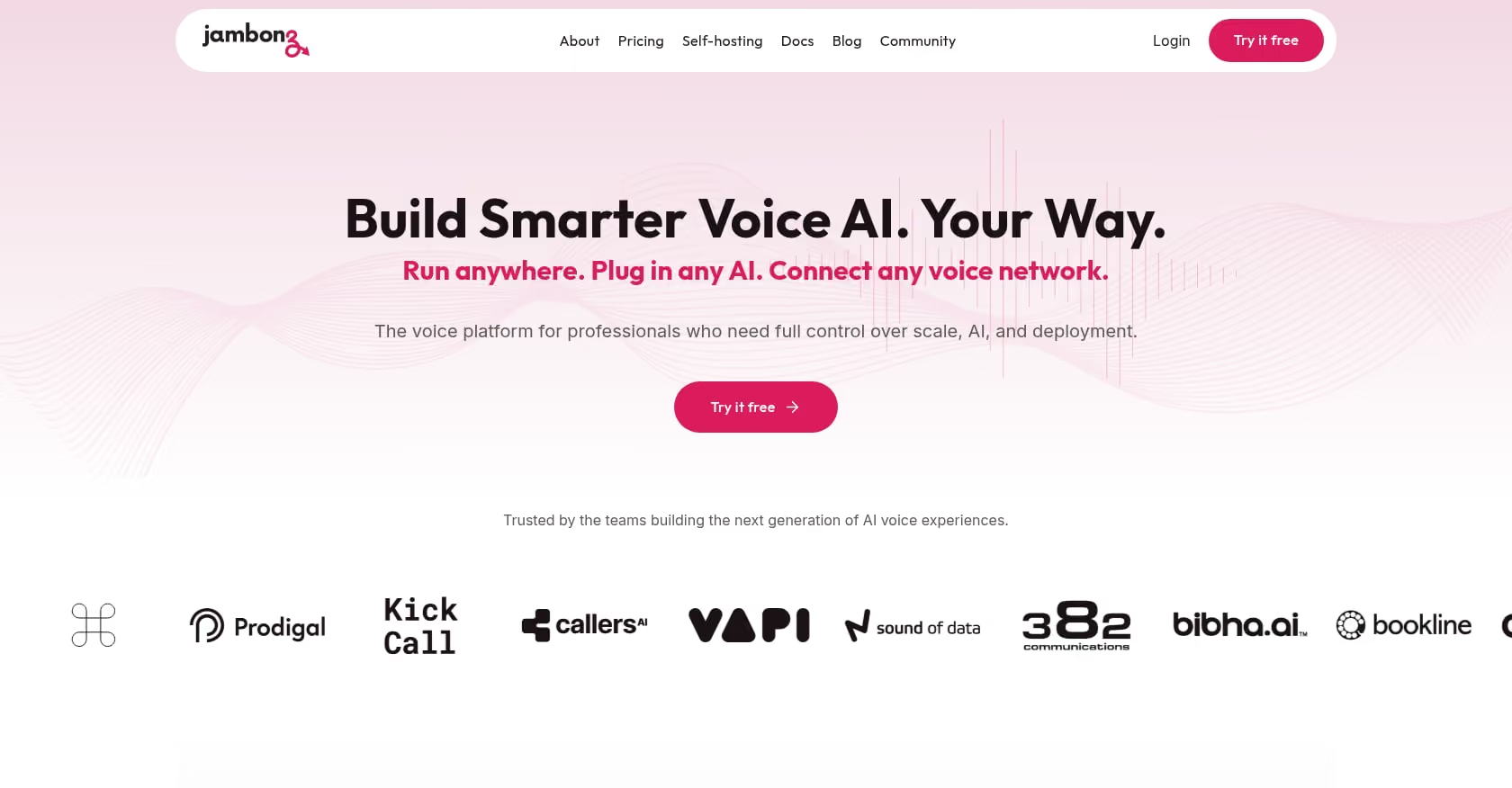
Best for: Teams with in-house Asterisk and SIP expertise who want full ownership and the lowest possible unit cost.
This is the DIY path. VICIdial dials or receives calls, you bridge media and signaling to a real-time voice agent stack (STT + LLM + TTS) through middleware like Jambonz, and you handle escalations by transferring back to a VICIdial queue.
Pricing (as of April 2026):
- You pay each component directly: STT, TTS, LLM, telephony, plus middleware
- Forum practitioners report $8/channel/month for cloud-hosted Jambonz
- STT costs cited as low as $0.001/min for some models (treat with caution, confirm with vendors)
- No platform fee, but engineering time is your real cost center
Key features:
- Total control over every component in the stack
- Working dialplan examples and lead routing patterns shared in the VICIdial community
- Choice of any STT/TTS/LLM without platform restrictions
- One practitioner on the VICIdial forum reports sub-second performance paths with this architecture
User sentiment: Admins on the VICIdial forum value the control and lower headline cost per minute. But they also call out the maintenance burden. One contributor noted that even small misconfigurations can introduce latency or talk-over problems that are difficult to diagnose in production.
Tradeoffs:
- Highest build and maintenance burden of any option here
- Outages are entirely on you; no vendor support escalation path
- Costs can drift as individual provider prices change
- No built-in warm transfer context passing; you build that yourself
3. Real-Time Agent Assist on VICIdial Calls
Best for: Centers that want quality and handle-time improvements without putting a bot in front of customers.
Keep humans on the phone. Add speech-to-text and an LLM to transcribe calls in real time, surface knowledge base articles, suggest replies, and auto-summarize after hangup. Practitioners on Reddit report that agent assist can deliver more immediate impact than voice bots because it lowers cognitive load without changing the caller experience.
Pricing (as of April 2026):
- STT: ~$0.013-0.017/min (Deepgram published rates)
- LLM tokens for text-only assist: roughly $0.04-0.07/min uplift including telco (varies with token usage and caching)
- No TTS cost since the human speaks
- Telephony stays the same as your current VICIdial setup
Key features:
- Mirror RTP streams to a real-time STT engine like Deepgram
- Stream transcripts to your assist application, push suggestions to the agent screen
- Auto-generate call summaries and disposition notes
- VICIdial’s APIs allow custom agent interfaces and data sync
User sentiment: Workers on r/CallCenterWorkers describe agent assist as “mostly accurate” and more useful than standalone chatbots. Admins note that the ROI really shows up when transcripts and suggestions tie directly into CRM records.
Tradeoffs:
- Building a reliable assist UI inside VICIdial’s interface requires custom development
- Transcript privacy and compliance (PCI, HIPAA) must be addressed before deployment
- Benefits are incremental, not transformative; you still need the same number of agents
For teams interested in measuring AI call interaction quality, agent assist generates the transcript data that makes scoring possible.
4. Post-Call AI QA and Compliance from VICIdial Recordings
Best for: Regulated teams or those new to AI who want the biggest wins with the lowest customer-facing risk.
VICIdial already records calls. The infrastructure for AI-powered quality assurance is sitting in your recording_log table right now. Batch-transcribe your recordings, auto-score for compliance and quality, and generate coaching reports without ever putting AI in front of a live caller.
Pricing (as of April 2026):
- Storage: MP3 encoding reduces file size 8-10x compared to WAV
- STT for batch transcription: rates vary by provider, generally cheaper than real-time
- LLM scoring: token costs scale with minutes scored
- Budget for storage growth and network I/O if centralizing archives to S3 or FTP
Key features:
- Pull recordings from VICIdial’s recording_log and location fields
- VICIhost supports mono and stereo recording, plus FTP/S3 archival
- Feed transcripts to any LLM for compliance keyword detection, sentiment analysis, and scorecard generation
- Stereo recording separates agent and caller channels for more accurate analysis
User sentiment: Practitioners warn that recording storage sneaks up on you. Running out of disk during production hours is catastrophic, causing calls to fail silently or lose recordings right when you need them most.
Tradeoffs:
- QA benefits arrive after the call; no real-time saves on at-risk conversations
- Stereo recording doubles storage and is rarely sustained long-term
- Requires a pipeline to move recordings, transcribe, score, and surface results to supervisors
5. VICIdial Native Cepstral TTS (AI-Lite)
Best for: Cost-controlled, deterministic IVR and survey prompts where “AI” means dynamic voice playback, not free-form conversation.
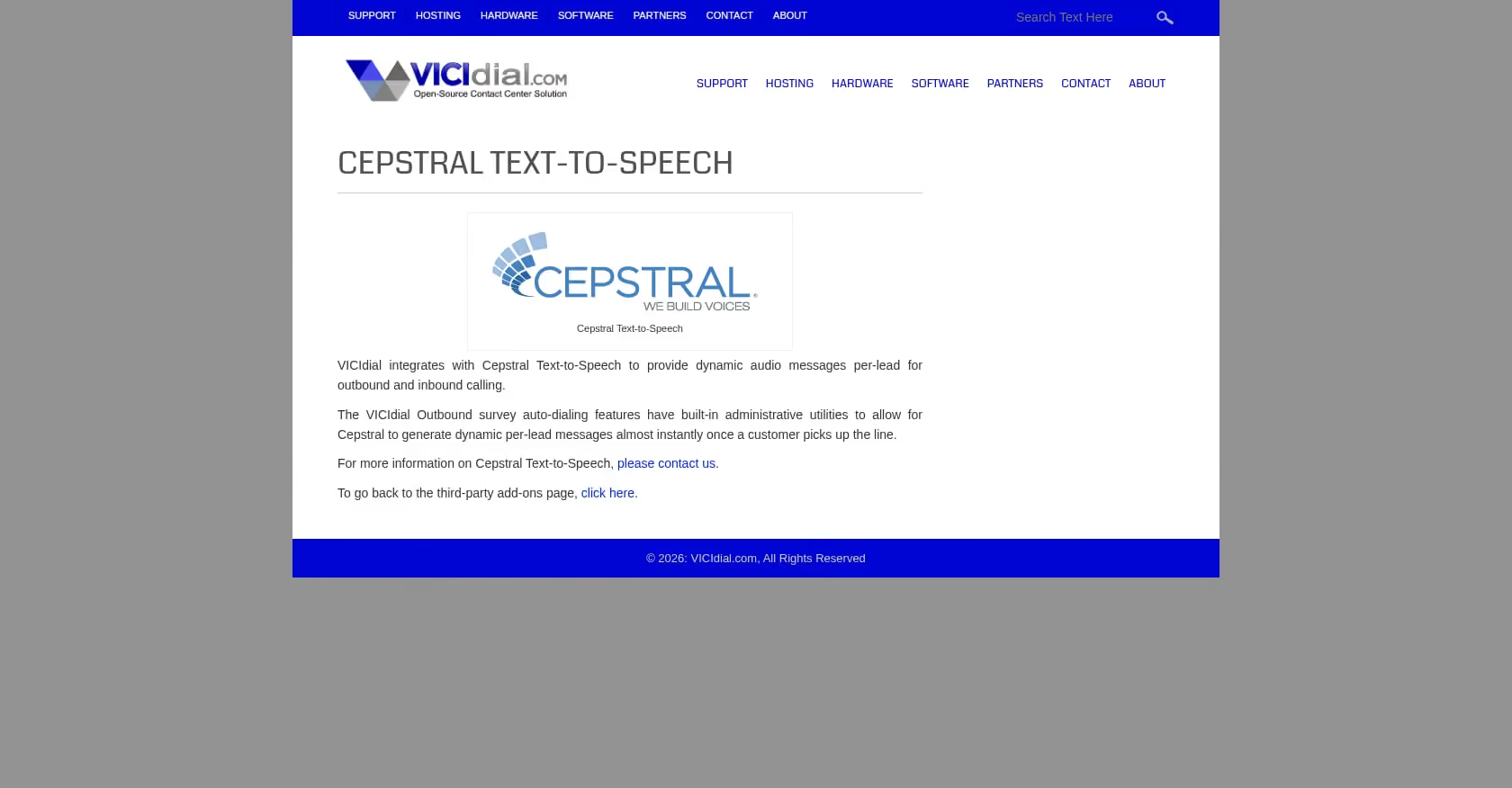
This is VICIdial’s longest-standing “AI-adjacent” feature. Cepstral TTS integration generates context-specific audio per lead: personalized confirmations, dynamic survey questions, appointment reminders with caller-specific details.
Pricing (as of April 2026):
- Cepstral uses per-voice and per-port licensing, not per-minute billing
- Exact 2026 pricing varies; purchase via Cepstral’s store
- No ongoing AI model costs since there is no LLM involved
Key features:
- Built into VICIdial’s existing utilities for batch and offline TTS generation
- Dynamic variable insertion (caller name, appointment date, balance amount)
- Reliable and deterministic, meaning the same input always produces the same output
User sentiment: Mature and stable, but the voices sound dated compared to modern neural TTS from providers like ElevenLabs or Cartesia. VICIdial community members reference the setup as straightforward but note it requires Cepstral licensing for voice, port, and save-to-file.
Tradeoffs:
- Does not understand callers; purely one-directional output
- Synthetic voice quality is noticeably worse than current neural models
- No conversational capability whatsoever
- Limited to scripted, predictable use cases
6. Multichannel AI Triage with Handoff to VICIdial
Best for: Support organizations drowning in repeat tickets that want to preserve phone capacity for complex exceptions.
Use an AI agent to handle chat, SMS, and WhatsApp conversations. Resolve simple issues automatically (order tracking, password resets, FAQ answers). When a caller needs a human or the issue requires a phone conversation, warm-escalate to a VICIdial queue with the full conversation context already attached.
Pricing (as of April 2026):
- Chat AI is significantly cheaper than voice: SigmaMind’s chat platform fee is $0.005 per AI message plus LLM costs
- Voice minutes only accrue when a call actually starts after escalation
- Digital deflection reduces your total voice minute consumption
Key features:
- Digital agent collects context, triggers actions (ticket updates, order lookups via the SigmaMind App Library), and resolves what it can
- On escalation, passes a structured summary to the human agent: customer info, issue type, what was already attempted
- One AI “brain” serves all channels, keeping responses consistent
User sentiment: Teams that implement this pattern consistently report that starting live calls with context already on screen eliminates the “please repeat your issue” failure mode. Warm transfer documentation emphasizes the “no repeats” principle as the single biggest driver of customer satisfaction during handoffs.
Tradeoffs:
- Channel orchestration design is non-trivial; routing logic between digital and voice requires planning
- Consent and opt-in for SMS and WhatsApp messaging must be handled properly
- Requires integration between your messaging platform and VICIdial’s inbound queue routing
7. AI-Driven Outbound Campaigns with Transfer to VICIdial
Best for: Sales and field-service organizations that want higher show rates and less manual prospecting.
Run outbound voice campaigns with an AI agent handling the initial conversation: qualify leads, confirm appointments, screen interest. When someone is qualified or asks a complex question, warm-transfer them to a VICIdial agent queue with a summary of what was discussed.
Pricing (as of April 2026):
- Same blended cost structure as item 1: platform + STT + TTS + LLM + telephony
- Twilio US outbound voice: ~$0.014/min with volume discounts available
- Model selection drives the biggest cost variance; cheaper LLMs work fine for simple qualification scripts
Key features:
- CSV upload, scheduling, concurrency caps, and personalization variables via SigmaMind’s campaign tools
- AI agent handles the conversation flow (branching, objection handling, booking)
- Warm transfer delivers qualified prospects to VICIdial agents with full context
- SIP integration bridges SigmaMind’s dialing to your existing VICIdial infrastructure
User sentiment: Builders in leadgen communities on Reddit emphasize that transparent cost modeling (LLM + STT + TTS + telco) beats headline “$0.10/min” claims every time. They also warn that callers hang up quickly if latency or voice quality is poor.
Tradeoffs:
- TCPA compliance and local consent rules are your responsibility
- Calendar and API hygiene matters; a booking confirmation that fails silently destroys trust
- Voice quality and latency are critical for outbound, where you have even less goodwill than inbound
For lead qualification specifically, AI outbound campaigns can screen hundreds of contacts per hour, passing only warm leads to your human team.
Real Pricing Math: One 3-Minute Call, Three Stacks
Headline per-minute pricing is misleading. Practitioners on Reddit consistently warn that “$0.10/min AI calling” usually excludes LLM, TTS, STT, or telephony. Model the full stack or you will be surprised.
Here is the math for a 3-minute qualified call across three VICIdial AI architectures, using April 2026 published rates:
Front-of-house voice bot via SigmaMind:
LayerRate/Min3-Min CostSigmaMind platform$0.030$0.090Deepgram STT$0.010$0.030ElevenLabs TTS$0.050$0.150GPT-4o LLM$0.020$0.060Twilio US outbound$0.014$0.042Total~$0.124~$0.372
Sources: SigmaMind pricing, Deepgram pricing, Twilio US voice
These are tunable. Swap ElevenLabs for a cheaper TTS provider and the total drops significantly. Use a smaller LLM for simple scripts and you save another $0.01-0.02/min. The SigmaMind analytics dashboard breaks down cost per layer so you can optimize after your first hundred calls.
Agent assist (text-only, no TTS):
LayerRate/Min3-Min CostDeepgram STT$0.015$0.045LLM (text assist, cached)~$0.030$0.090Telephony (unchanged)$0.014$0.042Total uplift~$0.059~$0.177
Agent assist adds roughly $0.04-0.07/min on top of your existing telephony costs. No TTS needed because your human agents do the talking.
DIY Jambonz + open-source stack:
LayerRate/Min3-Min CostNo platform fee$0.000$0.000STT (varies by model)~$0.005$0.015TTS (varies)~$0.030$0.090LLM~$0.020$0.060Telephony$0.014$0.042Jambonz (~$8/ch/mo, amortized)~$0.005$0.015Total~$0.074~$0.222
Looks cheaper on paper. But one VICIdial forum contributor notes that the engineering time to build, debug, and maintain this stack is substantial. If your engineer spends 20 hours a month keeping it running at $75/hour, that is $1,500 in hidden cost that does not show up in the per-minute math.
Latency, Talk-Over, and Warm Transfer: The Quality Levers
For VICIdial AI voice bots, latency is the single most important technical metric. Every hop in the call path (SIP to middleware to STT to LLM to TTS back to SIP) adds milliseconds. Stack enough hops and you get talk-over, where the bot starts speaking while the caller is still finishing their sentence.
Three rules that practitioners consistently reinforce:
Keep the media path short. Avoid double-transcoding (converting audio formats multiple times). Choose STT and TTS providers with real-time streaming endpoints. Deepgram markets sub-second latency for its real-time STT. SigmaMind targets sub-second voice-to-voice response times.
Choose TTS carefully. TTS is often the biggest latency contributor because it has to generate audio before the bot can “speak.” Streaming TTS (where audio starts playing before the full response is generated) makes a noticeable difference.
Warm transfer with context prevents the repeat problem. When an AI bot transfers a call to a human agent, passing a structured summary (customer name, issue, what was already discussed, intent classification) means the agent does not have to ask the caller to start over. This is where most VICIdial AI integrations fail. The bot qualifies the caller, transfers to a queue, and the human agent says “How can I help you?” as if nothing happened.
SigmaMind’s warm transfer passes context summaries and custom headers to the receiving agent. The difference between a good and bad handoff is often the difference between a closed sale and a hangup.
Compliance and Recordings: Use What VICIdial Already Gives You
VICIdial’s recording infrastructure is underappreciated for AI purposes. Before you build anything new, understand what you already have.
Mono vs. stereo: Mono recording captures both sides on one channel. Stereo separates agent and caller, which is better for transcription accuracy and speaker diarization but doubles your storage requirements. Most teams use mono for cost reasons and accept slightly lower transcription quality.
MP3 vs. WAV: MP3 encoding reduces file size 8-10x compared to WAV with minimal quality loss for speech. If you are archiving recordings for AI processing, MP3 is almost always the right choice.
Storage management: This is where teams get burned. Practitioners warn repeatedly that recording storage sneaks up, and running out of disk during production causes call failures. Archive aggressively to FTP or S3. Set up monitoring alerts at 70% disk capacity, not 90%.
Building your QA pipeline: Pull recording paths from VICIdial’s recording_log table. Batch-transcribe with a cost-effective STT provider. Run transcripts through an LLM with your scorecard criteria (compliance phrases, required disclosures, sentiment flags). Surface results in a dashboard your supervisors actually check.
This is the lowest-risk way to start with VICIdial AI. You are processing historical data, not changing the live caller experience.
When to Switch Instead of Integrate
Not every VICIdial deployment should get an AI layer bolted on. Sometimes the right answer is switching to an AI-first CCaaS platform. Here is a checklist:
Switch if you lack Linux/Asterisk skills. VICIdial is famously described by admins as “free but looks like 1995 and needs a Linux PhD.” If your team cannot confidently troubleshoot Asterisk dialplan issues, SIP routing problems, or server capacity under load, adding AI on top of that foundation is risky.
Switch if uptime SLAs matter more than customization. Self-hosted VICIdial means you own the uptime. If a 99.99% SLA from a vendor is worth more to your business than the ability to customize every database field, a managed platform is the better bet. Capterra and G2 list Genesys Cloud CX, Five9, Talkdesk, and others as leading alternatives.
Switch if your total cost of ownership exceeds seat-based pricing. “Free software” still requires servers, bandwidth, engineers, and time. VICIdial TCO analyses show that self-hosting costs are real, even if the license is $0.
Stay if you value data access and custom reporting. One founder on Reddit shared that they miss VICIdial’s raw data access after switching to a hosted dialer. The custom reporting flexibility of direct database access is genuinely hard to replicate on managed platforms.
Stay if you have the team to support it. With competent Asterisk and Linux admins, VICIdial plus an AI layer like SigmaMind gives you more control at lower cost than any seat-based CCaaS.
How to Try This with the Least Risk
Starting with VICIdial AI does not require a full rip-and-replace. Here is a phased approach:
Week 1-2: Post-call QA. Pick your worst-performing campaign. Export recordings, batch-transcribe, run compliance scoring. This costs almost nothing, changes nothing in production, and gives you baseline data.
Week 3-4: Agent assist pilot. Mirror RTP from a small team’s calls to a real-time STT stream. Surface suggestions in a side panel. Measure handle time and quality score changes against your QA baseline.
Week 5-8: Warm-transfer voice bot for one use case. Pick a narrow, high-volume scenario: appointment confirmations, order status checks, or basic qualification. Build the AI agent, wire warm transfer into your VICIdial queue, and run it alongside human agents. Compare cost per completed interaction.
SigmaMind’s playground environment lets you test agent flows with node-level logs before routing live calls. Start there, validate your conversation design, then scale concurrency gradually using campaign controls.
If you are ready to start building, sign up for free and pay only for what you use. For complex deployments involving BYOC SIP routing or enterprise-scale concurrency, contact the SigmaMind team directly for architecture guidance.
Frequently Asked Questions
Can VICIdial do AI natively without third-party tools?
No. VICIdial has no built-in LLM, speech-to-text, or conversational AI capabilities. The closest native feature is Cepstral TTS for dynamic audio generation, which is a scripted playback tool, not conversational AI. Any meaningful VICIdial AI integration requires external platforms connected via SIP, AGI, or API.
What is the cheapest way to add AI to VICIdial?
Post-call QA using batch transcription of existing recordings is the cheapest starting point, requiring only STT and LLM scoring costs with no changes to live call flows. For live AI, agent assist (text-only, no TTS) typically adds $0.04-0.07/min on top of existing telephony, making it the most affordable real-time option.
How does warm transfer work between an AI voice agent and VICIdial?
The AI agent handles the initial conversation over SIP. When escalation is needed, it transfers the call to a VICIdial DID or queue, passing along a structured summary (customer name, intent, issue details, what was already discussed). The human agent sees this context before picking up, so the caller does not have to repeat anything.
What latency should I target for a VICIdial AI voice bot?
Sub-second voice-to-voice response time is table stakes for a natural conversation. Anything above 1.5 seconds causes noticeable talk-over and caller frustration. Choose streaming STT/TTS providers, minimize SIP hops, and avoid audio format transcoding in the media path.
Is the “$0.10 per minute” AI calling pricing I see advertised accurate?
Usually not. Practitioners on Reddit consistently warn that headline pricing often excludes one or more layers: LLM inference, TTS, STT, or telephony. Always model the blended cost per minute across all five layers (platform + STT + TTS + LLM + telephony) and calculate cost per completed conversation, not just cost per minute.
Should I switch from VICIdial to a managed CCaaS instead of adding AI?
It depends on your team. If you have Asterisk and Linux expertise, adding an AI layer to VICIdial gives you more control and often lower cost. If you lack that expertise, or if uptime SLAs and vendor-managed AI are top priorities, switching to an AI-first CCaaS like Genesys, Five9, or Talkdesk may be the better investment.
Can SigmaMind handle both inbound and outbound calls with VICIdial?
Yes. For inbound, SigmaMind AI agents answer calls and warm-transfer to VICIdial queues on escalation. For outbound, SigmaMind’s campaign tools handle dialing, conversation, and qualification, then transfer interested or complex calls to VICIdial agents with full context. Both patterns connect via SIP, Twilio, or Telnyx.
How do I handle call recording compliance when adding AI to VICIdial?
VICIdial’s existing recording infrastructure (mono/stereo, MP3/WAV, FTP/S3 archival) continues to work. When adding an AI layer, ensure your AI platform also stores or passes through recordings in compliance with your regulatory requirements. For the AI-processed portion of the call, verify where transcripts and audio are stored, who has access, and whether your data retention policies cover the additional processing layer.
Evolve with Sigma Mind AI
Build, launch & scale AI agents
Related Blogs
Ready to transform your call center?

More Conversations.
Less Manual Work.

Building from San Francisco, CA