Top 10 AI Voice Agent Platforms 2025 (2026 Update)
Compare AI Voice Agent Platforms 2025 by sub‑second latency, tool calling, pricing/TCO, telephony, and security. See our top 10—start building today—now.
April 13, 2026
The world of customer interaction is undergoing a massive shift. Clunky, frustrating phone menus are being replaced by intelligent, conversational AI that can understand, reason, and act. In this new landscape, choosing the right foundation for your voice automation is critical. This guide breaks down the essential criteria for selecting from the top AI voice agent platforms 2025, helping you move from concept to production with confidence. We’ll explore the technology, the costs, and the strategy needed to deploy voice agents that don’t just talk, but actually get work done.
What is an AI Voice Agent Platform?
An AI voice agent platform is a specialized software solution for building, deploying, and managing automated voice agents that can handle complex, human like conversations over the phone.
It’s important to distinguish these platforms from other voice technologies:
- Traditional IVR (Interactive Voice Response): These are the rigid “press 1 for sales” systems. They rely on predefined, linear scripts and cannot handle natural language.
- Voice Assistants (Siri, Alexa): These are consumer focused and are not designed to execute specific, multi step business workflows within a contact center environment.
- Basic Telephony APIs: These provide the raw building blocks for making and receiving calls but require you to assemble and manage the entire AI stack (Speech to Text, Large Language Models, Text to Speech) yourself, which is a significant engineering challenge.
A true voice agent platform orchestrates all these components. It provides a unified environment where you can design conversational logic, connect to telephony, integrate with business tools like your CRM, and manage high concurrency calls with low latency. Platforms like SigmaMind AI act as the central brain, combining everything needed to turn a conversation into a completed task.
Evaluation Criteria That Matter in 2025
When evaluating AI voice agent platforms 2025, look beyond the simple demos. Production readiness depends on a few key factors.
Conversational Quality and Latency
The delay between a caller finishing a sentence and the AI responding is the single biggest factor in how “human” a conversation feels. High latency leads to awkward pauses and people talking over the agent. In 2025, the standard for a natural conversation is sub second latency. For example, SigmaMind AI has engineered its stack for ultra low latency, with an average response time of around 970 milliseconds.
Integration and Tool Calling Capabilities
A voice agent’s real value comes from its ability to complete tasks. This requires deep integrations with your existing business systems. Look for platforms with robust function calling or “tool calling” capabilities and pre built app libraries. The ability to read from a database, write to a CRM, or trigger an action in a helpdesk like Zendesk or Shopify is what separates a chatbot from a work completing agent. One documented SigmaMind case study shows an e-commerce brand automating over 4,000 refunds per month, a 43% cost saving, by integrating directly with their backend systems.
Model and Provider Flexibility
The AI landscape moves fast. The best LLM, Speech to Text (STT), or Text to Speech (TTS) provider today might not be the best tomorrow. Avoid platforms that lock you into a single proprietary model. The leading AI voice agent platforms are model agnostic, allowing you to mix and match providers like Deepgram for STT, ElevenLabs for TTS, and OpenAI, Claude, or Gemini for language models. This flexibility lets you fine tune for performance, cost, and voice quality on a per use case basis.
Developer Experience and Control
Your engineering team needs tools that fit their workflow. A powerful platform offers both a no code builder for rapid prototyping and deep APIs for custom logic and control. Features to look for include:
- An in builder playground for real time testing and debugging.
- Detailed, node level logs to understand exactly how an agent makes decisions.
- APIs and an MCP server that allow developers to trigger and manage calls directly from their coding environment.
Security and Enterprise Readiness
For many industries, especially healthcare and finance, security is non negotiable. Look for platforms that have a strong security posture, such as SOC 2 compliance. While full HIPAA compliance involves more than just a platform, using a solution that supports HIPAA friendly workflows is a critical starting point for healthcare use cases like automated appointment scheduling.
Pricing Models and Total Cost of Ownership (TCO)
Understanding the cost of AI voice agent platforms 2025 is crucial. The most common model is pay as you go, which provides transparency and scalability.
However, the headline price per minute is only part of the story. Your Total Cost of Ownership (TCO) is a combination of several layers:
- Platform Fee: The core fee charged by the orchestration platform. For example, SigmaMind AI charges a $0.03 per minute platform fee.
- STT Provider Cost: The cost to transcribe the caller’s speech to text.
- LLM Provider Cost: The cost of the language model processing the text and generating a response.
- TTS Provider Cost: The cost to synthesize the AI’s text response back into natural sounding speech.
- Telephony Cost: The cost of the phone number and the per minute carrier fees.
The best platforms provide a detailed pricing calculator to help you estimate your TCO based on your chosen providers and expected call volume. You can see an example of this transparent approach on the SigmaMind AI pricing page.
Decision Framework: Match Platforms to Your Use Cases and Team
Not all AI voice agent platforms are created equal. The right choice depends on your specific needs.
For Startups and Developer Teams
If you’re a developer focused team, prioritize API quality, documentation, and a flexible, usage based pricing model. You need a platform that lets you build, test, and iterate quickly without being locked into long term contracts.
For Enterprise Contact Centers
Enterprises should focus on scalability, reliability, and advanced features. The ability to handle hundreds of concurrent calls is essential. A critical feature is Warm Transfer, which allows the AI to pass a live summary and structured data to a human agent, eliminating the frustrating experience of a customer having to repeat themselves.
For Agencies and BPOs
Agencies building voice solutions for multiple clients have unique needs. Look for platforms with multi client workspaces for easy account management. A powerful feature for agencies is the ability to clone entire agents, including all their logic and settings, to rapidly onboard new clients. This is a key feature offered by SigmaMind AI to serve its agency partners.
Top 10 AI Voice Agent Platforms 2025
As businesses prioritize seamless automated communication, this selection represents the most advanced platforms currently dominating the conversational AI landscape. These industry leaders are grouped together for their exceptional ability to provide low-latency, human-like voice interactions that integrate directly into existing enterprise workflows. Exploring these top-tier options will help you identify the specific features and scalability required to transform your customer service experience.
1. SigmaMind AI
A YC-backed orchestration platform, SigmaMind AI builds production voice agents with a model-agnostic stack (Deepgram, ElevenLabs, OpenAI, Claude) and telephony that spans native US numbers plus BYOC via SIP. Designed for sub-second turns and high concurrency, it unifies voice, chat, and email so one “brain” can power every channel.
-
Build-and-scale highlights:
- Real-time call control with barge-in and stateful, multi-node flows for complex tasks.
- Streaming STT/TTS with multilingual coverage (including English and Hindi).
- Function calling for CRM/helpdesk: prebuilt paths into Shopify, Zendesk, Salesforce.
- Warm transfers that pass live AI summaries and structured context via custom headers.
- Developer velocity: REST APIs, webhooks, and an MCP server for IDE-first builds.
- Deep analytics: per-layer cost breakdowns, full transcripts, and quality metrics.
-
Pricing & scale:
- Usage-based at $0.03/min platform fee plus provider costs; BYOC SIP keeps carrier choice flexible. Scales to hundreds of concurrent calls with campaign-level controls.
-
Best fit:
- Agencies/BPOs managing multi-client workspaces with rapid agent cloning.
- Enterprises automating refunds, bookings, and CRM updates.
- Developers wanting IDE-native orchestration via MCP and low-latency performance.
-
Caveats:
- Native number purchase is US-only; international requires SIP/BYOC.
- Modular pricing means cost tuning across STT/TTS/LLM/telephony is essential.
2. Cognigy
Cognigy is an enterprise conversational AI platform with a carrier-grade Voice Gateway and a bring-your-own-carrier approach across SIP, Twilio, and RingCentral. It’s model-pluggable for STT/TTS/LLMs and proven at scale, supporting 25,000+ concurrent conversations for global programs.
-
Build-and-scale highlights:
- Barge-in, DTMF, and Answering Machine Detection tuned for production flows.
- Streaming STT/TTS with regional hosting to minimize latency and meet compliance.
- Powerful tool calling via HTTP nodes and MCP Server for CRM and core systems.
- Seamless human handoff with transcripts, summaries, and live context transfer.
- Analytics via Insights plus OData export for custom BI.
- Security & governance: SOC 2, granular roles/audit, PCI/GDPR/CCPA redaction.
- DevOps-ready: CLI, APIs/SDKs, CI/CD snapshots for versioned releases.
-
Pricing & scale:
- Quote-based, often per concurrent session. Total cost is driven by chosen speech/LLM providers and telephony. Documented support for 25K+ concurrent conversations.
-
Best fit:
- Global contact centers needing BYOC and CCaaS integrations.
- Regulated industries prioritizing data residency and security controls.
- Teams standardizing on a best-of-breed, pluggable model stack.
-
Caveats:
- Pricing lacks public transparency and varies by configuration.
- SIP/AMD tuning benefits from telecom expertise.
- Roadmap may skew toward broader CCaaS ecosystem integrations.
3. PolyAI
PolyAI delivers enterprise phone assistants over native telephony and BYOC/SIP into CCaaS platforms like Genesys and Twilio. With proprietary Owl ASR and Raven LLM, it targets sub-300ms model latency, plus regional deployments and interchangeable TTS (e.g., ElevenLabs, Azure) for brand voice.
-
Build-and-scale highlights:
- Full-duplex barge-in, DTMF, and precise real-time call control.
- In-house Owl ASR + Raven LLM tuned for lightning-fast turn-taking.
- Prebuilt connectors for Salesforce, Zendesk, Stripe to speed production.
- Warm handoffs with context preserved into platforms like Amazon Connect.
- Advanced observability: NLQ analytics, SLO/SLA breach alerts.
- Omnichannel orchestration for voice, chat, and SMS in one design.
-
Pricing & scale:
- Per-minute usage with 99.9% uptime SLAs. Final TCO reflects ASR/LLM/TTS selection plus any BYOC or regional number fees.
-
Best fit:
- Enterprises embedding voice into established CCaaS stacks.
- Hospitality and QSR brands automating reservations and ordering.
- Regulated utilities needing SOC 2/HIPAA controls.
-
Caveats:
- Enterprise pricing and BYOC fees can add up.
- CLI/ADK tooling is in early access.
- PCI/PHI-heavy flows may need extra configuration.
4. Kore.ai
Kore.ai is a full-stack conversational AI platform with a native Voice Gateway (BYOC SIP, Microsoft Teams) and adapters for Twilio/AudioCodes. It supports diverse STT/TTS (e.g., Deepgram, ElevenLabs) and LLMs (OpenAI, Anthropic) to deliver low-latency streaming at enterprise scale.
-
Build-and-scale highlights:
- Real-time call control with configurable barge-in and DTMF.
- Low-latency STT/TTS via Deepgram Flux, ElevenLabs, and others.
- Rich tool calling and 100+ pre-built connectors.
- Warm transfers and handoff via SIP REFER with metadata.
- Analytics for quality, transcripts, and conversation mining.
- Enterprise posture: SOC 2, ISO 27001, HIPAA-aligned controls.
- Dev experience: APIs/SDKs and MCP support for modern workflows.
-
Pricing & scale:
- Quote-based; often per 15-minute activity session plus Voice Gateway add-ons. Costs scale with STT/TTS/LLM usage, concurrency, and BYOC carrier minutes.
-
Best fit:
- Regulated industries needing governance and optional on-prem.
- Global contact centers standardizing on BYOC SIP and agent assist.
- Retailers unifying voice and messaging automation.
-
Caveats:
- Steeper learning curve for complex IVR/Gateway designs.
- Pricing requires careful modeling of blended per-minute + session costs.
5. Genesys Cloud CX
Genesys Cloud CX is a leading CCaaS platform with native global telephony and BYOC. Voice agents run via Architect flows or third-party bots (e.g., Dialogflow), typically using Amazon Transcribe/Polly. Expect 99.99% uptime with ~sub-5s transcript latency inside enterprise-scale routing.
-
Build-and-scale highlights:
- Per-flow barge-in/interrupt logic and precise call control.
- Secure audio streaming with AudioHook Monitor and Audio Connector.
- REST Data Actions plus CRM integrations (Salesforce, Zendesk).
- Warm transfers and digital handoffs carrying full interaction context.
- Speech analytics: sentiment, empathy, event streaming for BI.
- Compliance-ready: HIPAA/BAA, PCI DSS, FedRAMP Moderate.
- Developer toolset: public REST APIs, SDKs, Terraform “CX as Code”.
-
Pricing & scale:
- Tiered per-user licenses with AI Experience tokens; STT (~$0.01/min), TTS, and telephony drive variable costs across AWS regions.
-
Best fit:
- Healthcare/government programs requiring HIPAA/FedRAMP.
- Enterprises needing first-party telephony with BYOC options.
- Teams embracing infrastructure-as-code for large rollouts.
-
Caveats:
- Third-party bot PCI/HIPAA scope may be constrained.
- BYOC Premises is deprecating in favor of cloud-native media.
6. Vapi
Vapi is a developer-first platform for real-time phone agents over native telephony or BYOC (Twilio/SIP). It orchestrates STT/TTS/LLM providers to achieve sub-second turn-taking and barge-in, and extends to WebRTC for browser calls as teams scale from pilots to enterprise.
-
Build-and-scale highlights:
- Fine-grained barge-in and smart endpointing controls.
- Multi-provider STT/TTS (Deepgram, ElevenLabs) with typically around 800 milliseconds for end-to-end voice processing.
- Built-in function calling and CRM/GoHighLevel integration.
- Context-rich warm transfers and operator handoffs.
- Post-call analytics, structured extraction, and Langfuse tracing.
- Security: HIPAA/SOC 2 with BAA.
- Developer toolkit: CLI, MCP server, Web/Server SDKs.
-
Pricing & scale:
- $0.05/min platform fee plus pass-through model/telephony costs. Default concurrency is 10; enterprise tiers unlock reserved capacity, SLAs, and effectively unlimited scale.
-
Best fit:
- Builders optimizing for granular model choice and TCO.
- Call centers integrating by SIP/BYOC.
- Healthcare apps needing HIPAA/BAA.
-
Caveats:
- Costs vary with provider selections and usage.
- Concurrency caps require reserved capacity for scale.
- Native number availability is primarily US.
7. Retell AI
Retell AI ships production-ready phone agents via native numbers or BYOC SIP (Twilio/Telnyx), pairing GPT-4/Claude with streaming STT/TTS for sub-600ms conversations. Its proprietary turn-taking and failover logic target natural, resilient interactions under real-world load.
-
Build-and-scale highlights:
- Real-time call control with configurable barge-in and DTMF.
- Streaming STT/TTS with auto-failover and high-fidelity voices (e.g., ElevenLabs).
- Advanced tool calling for scheduling, CRM sync, and custom webhooks.
- Warm transfers with summary context for smooth human handoff.
- Analytics with latency breakdowns and automated AI QA.
- Security: SOC 2 and HIPAA with BAA options.
- Developer features: SDKs and custom LLM WebSocket integration.
-
Pricing & scale:
- $0.07–$0.31/min depending on LLM/TTS. Standard plans include 20 concurrent calls; paid expansions and burst capacity support spikes.
-
Best fit:
- HIPAA-aligned reception and scheduling in healthcare.
- Dev teams needing BYOC carriers and deep observability.
- Brands prioritizing natural prosody and voice quality.
-
Caveats:
- Limited native international numbers; use BYOC for global reach.
- SMS support excludes certain carriers (e.g., Telnyx).
- Costs shift with premium model/voice choices.
8. Bland AI
Bland AI is a full-stack platform for inbound/outbound agents, offering native telephony and BYOT/SIP. Its in-house Babel ASR and BTTS v2 target sub-second latency, while SMS and web chat round out an omnichannel play built for production scale, supporting up to 1M concurrent calls.
-
Build-and-scale highlights:
- Granular call control: barge-in thresholds, DTMF/IVR tuning.
- High-performance stack: proprietary ASR and voice cloning options.
- Integrations: Salesforce, Calendly, plus custom REST tools.
- Enterprise handoffs: warm transfers with agent pre-briefing prompts.
- Observability: rich call logs, structured outcomes, regression testbeds.
- Security: SOC 2, HIPAA, SIP over TLS.
-
Pricing & scale:
- Tiered per-minute starting at $0.14 (down to ~$0.11). Costs hinge on connected minutes and transfers; concurrency governed by daily caps.
-
Best fit:
- Regulated healthcare/banking seeking HIPAA/BAA support.
- High-volume contact centers needing massive concurrency.
- Outbound campaigns, appointment setting, and collections.
-
Caveats:
- Recent pricing changes to tiered model.
- Warm transfers/SMS often sit in enterprise tiers.
- SIP requires TLS/SRTP configuration.
9. Google Dialogflow CX
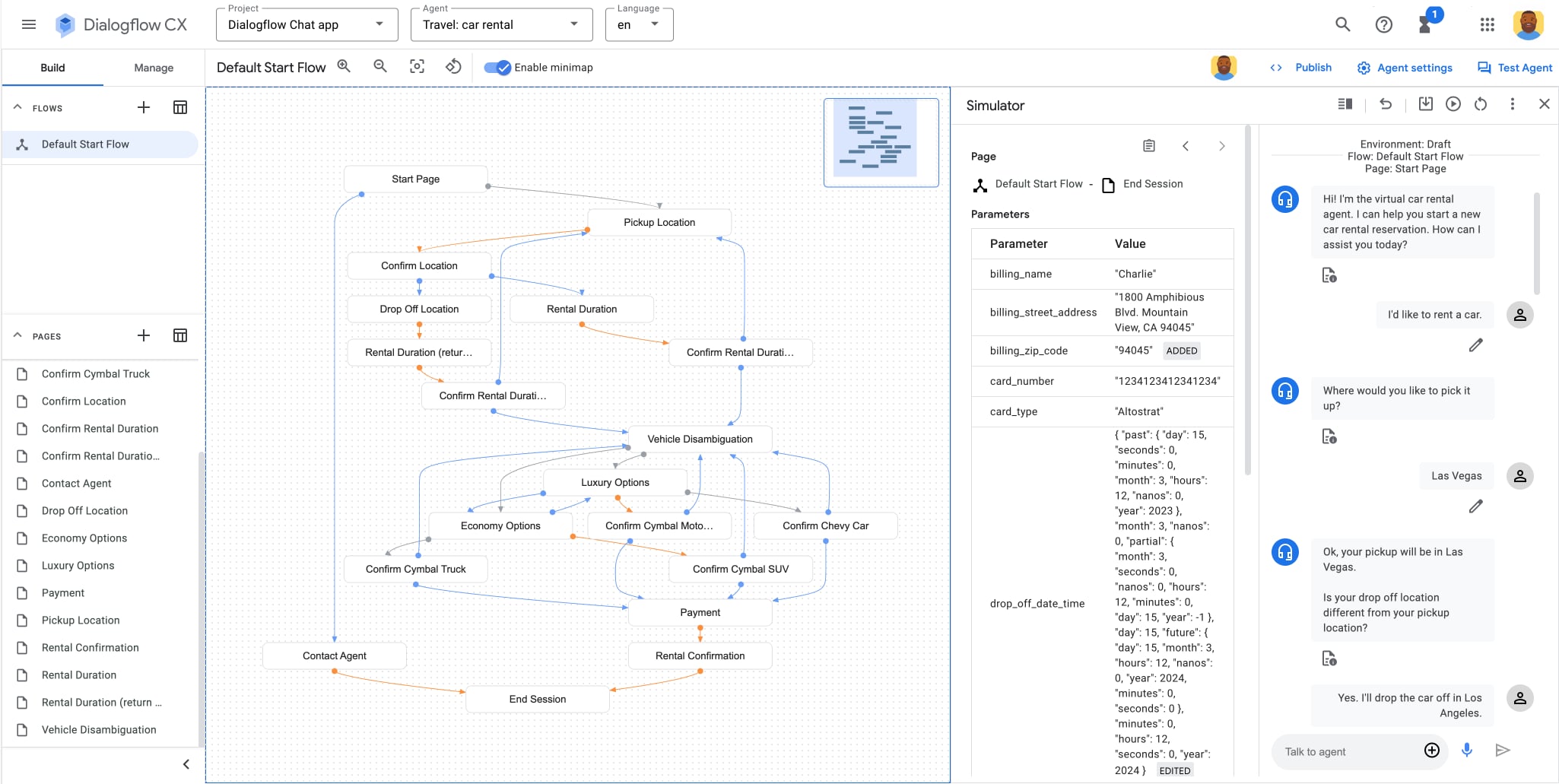
Dialogflow CX is Google Cloud’s modern platform for deterministic and generative agents, combining native STT/TTS with Vertex AI/Gemini. Voice is delivered via Google Telephony Platform (SIP) or BYOC (Twilio, Telnyx), enabling global reach on top of GCP infrastructure.
-
Build-and-scale highlights:
- Barge-in, smart endpointing, and partial playback cancellation.
- Low-latency streaming STT/TTS, including Neural and Chirp HD voices.
- Webhook fulfillments for real-time tools, CRM, and commerce.
- Warm handoffs with preserved context into partners like Twilio Flex.
- Analytics with one-click export to BigQuery for advanced reporting.
- Compliance: HIPAA, SOC 2, FedRAMP High eligible services.
- Developer experience: REST/gRPC, multi-language SDKs, Git/versioning.
-
Pricing & scale:
- Usage-based at ~$0.001–$0.002 per voice-second (input and output billed). Scale controlled via RPM and phone-minute quotas; no native latency SLA.
-
Best fit:
- Complex IVR containment and omnichannel deflection on GCP.
- Regulated programs needing HIPAA/FedRAMP High-aligned controls.
- Teams leveraging BigQuery/Cloud Logging for analytics at scale.
-
Caveats:
- Sub-second performance often requires meticulous tuning.
- Interrupted TTS is billed, raising cost in barge-heavy flows.
10. Google Contact Center AI (CCAI)
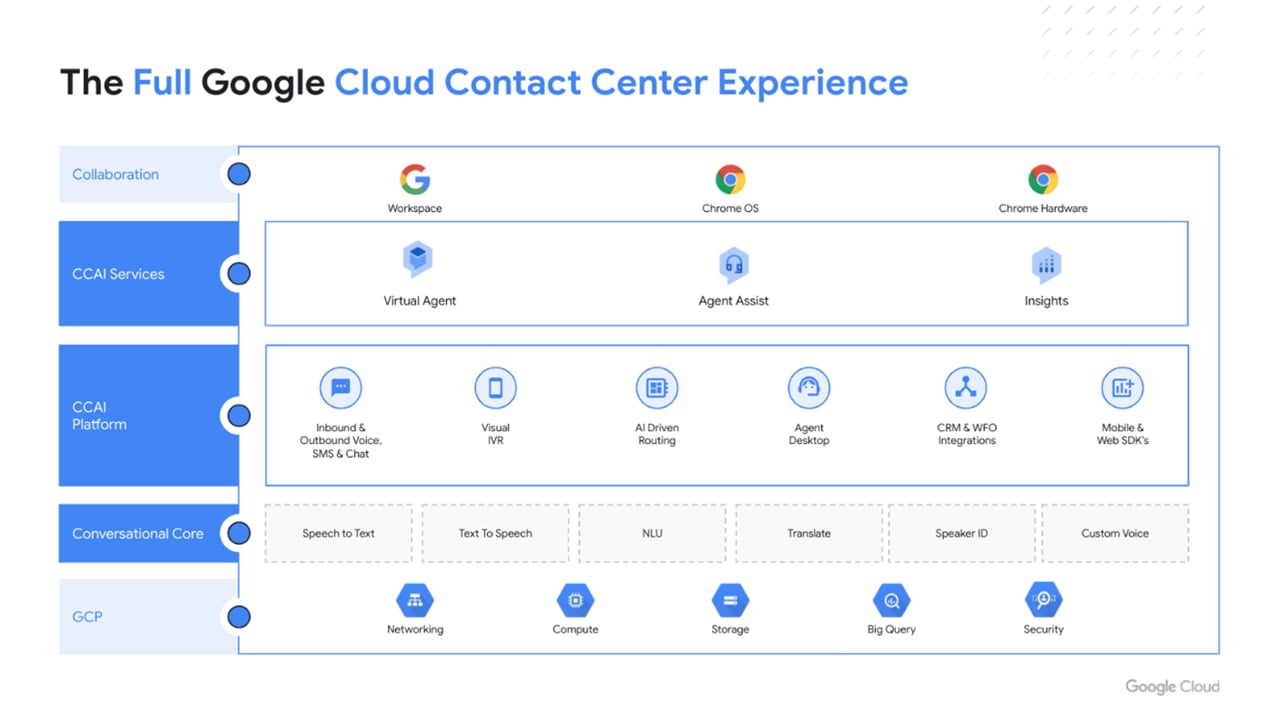
Google CCAI packages Dialogflow CX Flows with generative Playbooks and carrier-grade telephony (native or BYOC via Twilio/Telnyx). It pairs streaming STT with Cloud TTS (WaveNet) and plugs into global contact center operations with Google Cloud reliability.
-
Build-and-scale highlights:
- Real-time call control with interruptible responses and barge-in.
- Phone-optimized STT and high-fidelity WaveNet TTS.
- Integrations via webhooks for Salesforce, ServiceNow, Jira.
- Context-aware warm transfers using LiveAgentHandoff.
- Analytics via CCAI Insights for sentiment and quality.
- Security: HIPAA eligibility, VPC Service Controls, SOC 2.
- Developer tooling: REST/SDKs and CLI-friendly DevOps.
-
Pricing & scale:
- Per voice-second (Flows ~$0.001/s, Playbooks ~$0.002/s). Costs scale with generative use and telephony; concurrency governed by GCP quotas per region.
-
Best fit:
- Enterprises needing HIPAA-aligned controls and data residency.
- Programs integrated with Cisco, Genesys, or Twilio CCaaS.
- Teams standardizing on Vertex AI for generative design.
-
Caveats:
- Orchestration across Flows/Playbooks has a learning curve.
- Regional telephony quotas vary; many global builds rely on BYOC carriers.
Implementation Playbook: Pilot to Production
Deploying a voice agent successfully is a journey, not a single event. Follow this playbook for a smooth rollout.
- Start with a Narrow Pilot: Don’t try to boil the ocean. Pick a single, high volume, and repetitive use case, like order status inquiries or appointment reminders.
- Build and Test Rigorously: Use a no code builder to create your conversational flow. Test exhaustively in a playground environment to catch edge cases before a single customer call.
- Launch a Controlled Rollout: Begin by routing a small percentage of live calls (e.g., 5-15% of live inbound call traffic) to your new AI agent.
- Analyze Performance Metrics: Closely monitor key metrics like task completion rate, call duration, and escalation rate. Use this data to identify areas for improvement.
- Iterate and Scale: Refine your agent’s logic based on real world data. As performance and reliability improve, gradually increase the percentage of traffic handled by the AI.
Metrics That Matter for AI Voice Agents
To measure the ROI of your voice AI, you need to track the right metrics.
- Task Completion Rate: The percentage of calls where the agent successfully achieved its goal without needing a human.
- Containment Rate: The percentage of calls fully handled by the AI.
- Cost Per Call: The total TCO divided by the number of calls, giving you a clear picture of your operational savings.
- Customer Satisfaction (CSAT): Post call surveys are essential to gauge customer perception. A well designed agent can significantly improve CSAT, as one SigmaMind customer, Gardencup, saw a 20% lift in satisfaction.
- First Response Time (FRT): AI agents can answer on the first ring, dramatically cutting response times compared to human queues.
Risks and Limitations (and How to Mitigate)
While powerful, AI voice agents have limitations.
- Cost Overruns: Without proper monitoring, a runaway agent can be expensive. Mitigation: Choose a platform with granular, real time analytics that break down costs by each layer (STT, LLM, etc.).
- Bad Customer Experience: A poorly designed agent is often worse than no agent at all. Mitigation: Always provide a clear and easy way for a caller to escalate to a human agent at any point in the conversation.
- Vendor Lock In: Committing to a single provider’s entire technology stack is risky. Mitigation: Opt for a model agnostic platform that allows you to swap out individual components as better technology becomes available.
Trends to Watch in 2025 and Beyond
The evolution of AI voice agent platforms is accelerating. Key trends include:
- Proactive Engagement: Agents will move beyond just answering calls to proactively initiating them based on business events, such as for abandoned cart recovery or appointment follow ups.
- Emotional Awareness: The integration of sentiment analysis will allow agents to detect a caller’s emotional state (e.g., frustration) and adapt their tone and conversational strategy accordingly.
- Deeper Personalization: Agents will leverage real time data from CRM and other sources to provide highly personalized and contextual conversations.
Conclusion: Selecting, Launching, and Scaling the Right Platform
Choosing from the many AI voice agent platforms 2025 requires a clear understanding of your use case, your team’s capabilities, and your long term goals. The market has matured beyond simple chatbots to powerful orchestration platforms that can execute complex tasks and deliver significant business value. By focusing on conversational quality, integration capabilities, and transparent pricing, you can select a partner that will enable you to deploy truly effective voice agents.
Ready to see how a production grade voice AI platform can transform your customer interactions? Start building for free with SigmaMind AI.
FAQ
What is the main difference between voice AI platforms and IVR?
The main difference is intelligence and flexibility. IVR systems follow rigid, predefined menus (“press 1, press 2”), while voice AI platforms use natural language understanding to have dynamic, two way conversations and complete complex tasks.
How much does an AI voice agent cost per minute?
The total cost per minute is a sum of multiple parts: the platform fee, Speech to Text (STT), Text to Speech (TTS), Large Language Model (LLM), and telephony costs. While this varies based on the providers you choose, a typical all in cost can range from $0.10 to $0.40 per minute.
Can AI voice agents handle complex customer support issues?
Yes, but with a strategy. They excel at handling “Tier 1” issues like order tracking, refunds, and FAQs. For highly complex or emotional issues, the best practice is for the agent to gather initial context and then perform a warm transfer to a human agent, providing the human with a full summary.
What is the best AI voice agent platform for a small business?
For a small business, the best platforms are those with a pay as you go model, a no code builder for easy setup, and pre built integrations with common tools like Shopify or calendar systems. This minimizes upfront investment and allows you to scale as you grow.
How long does it take to build a production ready voice agent?
With modern AI voice agent platforms, you can build and test a simple agent for a specific task (like appointment reminders) in a matter of hours or days, not weeks or months.
Are AI voice agent platforms secure for industries like healthcare?
Leading platforms are taking security very seriously. Look for vendors with SOC 2 certification who explicitly state they can support HIPAA friendly workflows. This ensures they have the necessary controls in place for handling sensitive data, though you will still need to sign a Business Associate Agreement (BAA).