
SigmaMind AI vs. ElevenLabs, Convoso, Trillet, Klariqo, Retell AI & Vapi: The 2026 Comparison
Compare SigmaMind AI vs ElevenLabs, Convoso, Trillet, Klariqo, Retell AI, and Vapi. See which voice AI platform best fits call centers, BPOs, developers, and agencies in 2026.
IN this article

Evolve with Sigma Mind AI
Build, launch & scale AI agents
SigmaMind AI differs from ElevenLabs, Convoso, Trillet, Klariqo, Retell AI, and Vapi because it's built voice-first specifically for call centers and BPOs, designed to layer onto the dialer and CRM you already run. Each competitor here is genuinely useful, just for a different buyer.
The voice AI category isn't one market. It's several adjacent ones: audio infrastructure, developer platforms, white-label reseller tools, and call-center-native platforms, competing on the same "best voice AI" lists even though they're built for different jobs.
How does SigmaMind AI compare to ElevenLabs?
ElevenLabs is fundamentally an audio and voice-model company first, with a conversational agent platform built on top of that strength. Its text-to-speech quality is genuinely excellent, and its agent platform has real enterprise traction, with strong multilingual coverage and fast-improving latency. What it's not is a purpose-built call center product: teams still need to assemble telephony, CRM integration, and call center workflows around it, since that's not what the platform was originally built to do. SigmaMind AI starts from the opposite direction: a call center product first, with voice quality built to match rather than lead, and telephony, CRM sync, and per-client workflows built in rather than left for the buyer to assemble.
How does SigmaMind AI compare to Convoso?
Convoso is a predictive dialer with AI features layered on top of a telephony product, not a voice-first conversational platform. It's a strong fit for teams that need aggressive outbound dialing pace and are looking to add AI capability to an already-familiar dialer interface, particularly in high-volume outbound verticals like collections and insurance where Convoso already has deep adoption. The architecture behind adding AI to VICIdial is a useful comparison point here, since SigmaMind AI takes the layering approach without requiring a dialer switch, while a Convoso evaluation usually means adopting Convoso's dialer as the core system rather than adding AI to infrastructure you already run.
How does SigmaMind AI compare to Trillet?
Trillet is built specifically for agencies that want to white-label and resell voice AI to their own clients, with sub-account management and reseller-focused pricing as the core product design. That's a genuinely different buyer than a BPO or in-house call center running its own operation directly. A BPO buying for its own floor doesn't need white-label branding or sub-account reselling; it needs a platform that performs reliably across many client telephony environments, which is a different product shape entirely.
How does SigmaMind AI compare to Klariqo?
Klariqo is built for speed and simplicity, a no-code assistant that can be live in minutes for straightforward use cases, with a direct VICIdial plug-in aimed at outbound-heavy agencies and small BPO floors. That makes it a reasonable option for a small operation running simple, structured calls. It's less built for complex, multi-step conversations, deep per-client customization, or the kind of warm transfer logic a larger call center needs when a call has to move cleanly from AI to a specific human with full context attached.
How does SigmaMind AI compare to Retell AI and Vapi?
Retell AI and Vapi are both developer-first infrastructure platforms, and they're genuinely strong choices for engineering teams that want to assemble their own stack of speech-to-text, language model, and text-to-speech providers with full control over each piece. That flexibility comes with a real cost: real engineering time to configure, maintain, and monitor, plus ongoing work every time an underlying provider changes its API or pricing.
A call center or BPO without dedicated engineering bandwidth for that work tends to be better served by a platform where the call center logic, escalation, per-client customization, and compliance handling is already built in rather than something the team has to construct and maintain indefinitely.
Grand View Research projects the AI voice agents market growing steadily through 2033, driven largely by customer support automation and a fast-growing outbound segment, which is part of why so many differently-shaped platforms are competing for the same buyer's attention right now.
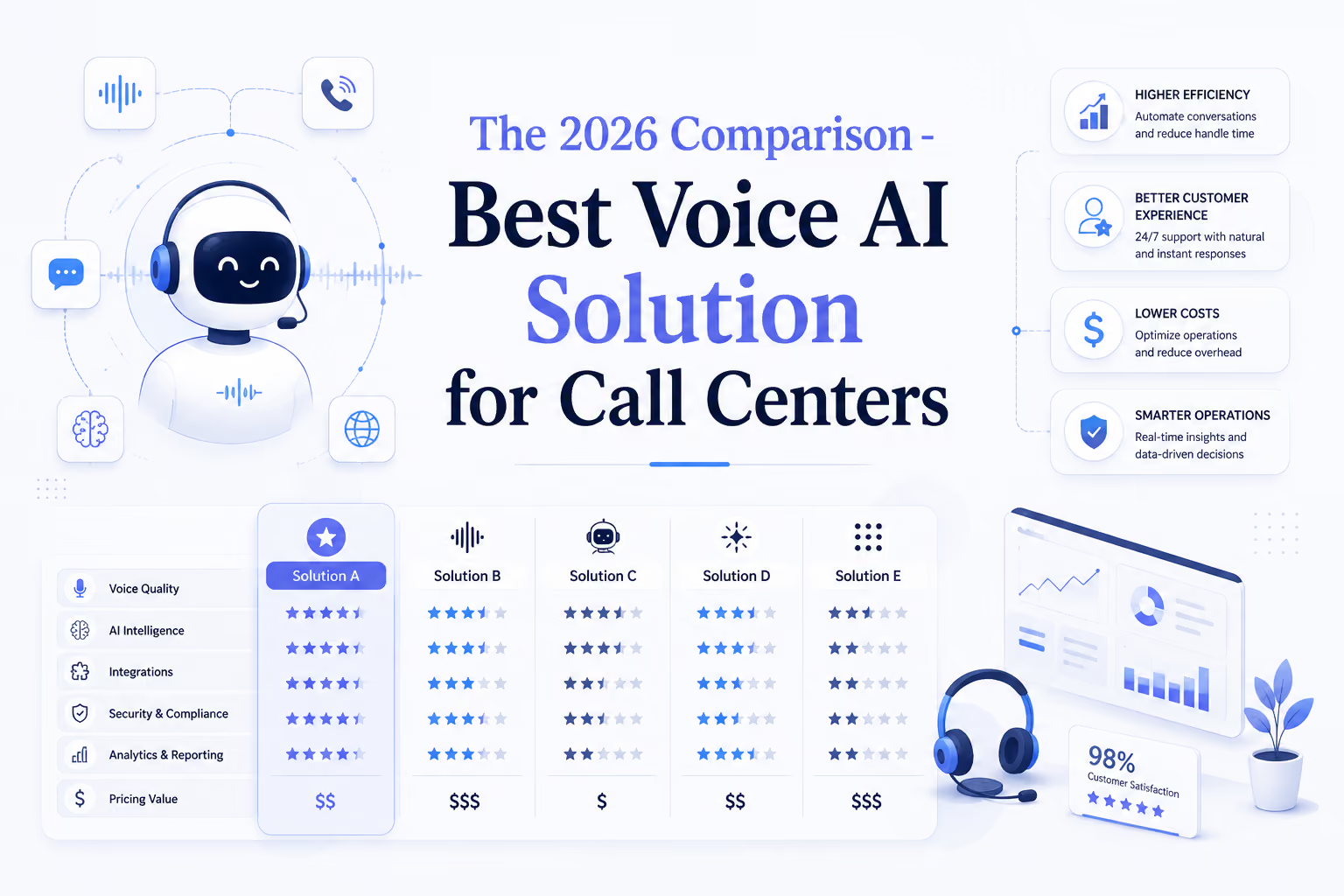
Here's how the seven platforms break down by category, since that matters more for picking the right one than any individual feature does:
Which platform should you actually pick?
Pick based on what you're actually building, not which platform has the most name recognition. If you're an agency reselling voice AI under your own brand, Trillet fits that model directly, since sub-account management and reseller economics are core to how it's priced and built. If you have engineering resources and want full control over the stack, Retell AI or Vapi make sense, provided the team has the bandwidth to own that infrastructure long-term.
If you need something live in minutes for simple use cases, Klariqo is a reasonable starting point, especially for a small operation with limited call complexity. If you're already running Convoso and just want to layer AI on top without switching dialers, that's worth evaluating directly against a layer-on approach rather than assuming the dialer and the AI layer have to come from the same vendor.
If you're a call center or BPO that needs inbound and outbound handled natively, layered onto infrastructure you already run, with per-client customization and clean human handoffs built in rather than assembled, that's the specific gap SigmaMind AI is built to fill. The approach to reducing average handle time without firing your team is worth reading alongside this comparison, since coverage strategy matters as much as which vendor you pick.
Bottom line: there's no single "best" voice AI platform across all six of these, because they're not all solving the same problem. SigmaMind AI is built for call centers and BPOs that want voice-first automation layered onto infrastructure they already run, not assembled from developer parts or reseller tooling built for a different buyer entirely.
Ready to see how SigmaMind AI stacks up on your own calls? Talk to the team or start building for free to test it yourself.
Evolve with Sigma Mind AI
Build, launch & scale AI agents
Related Blogs
Ready to transform your call center?

More Conversations.
Less Manual Work.

Building from San Francisco, CA