
How to Send Context From Bot to Human Agent — 2026 Guide
Learn how to send context from bot to human agent with warm transfers, SIP headers, webhooks, and routing. Get schemas, transcript tips, and 2026 best practices.
IN this article

Evolve with Sigma Mind AI
Build, launch & scale AI agents
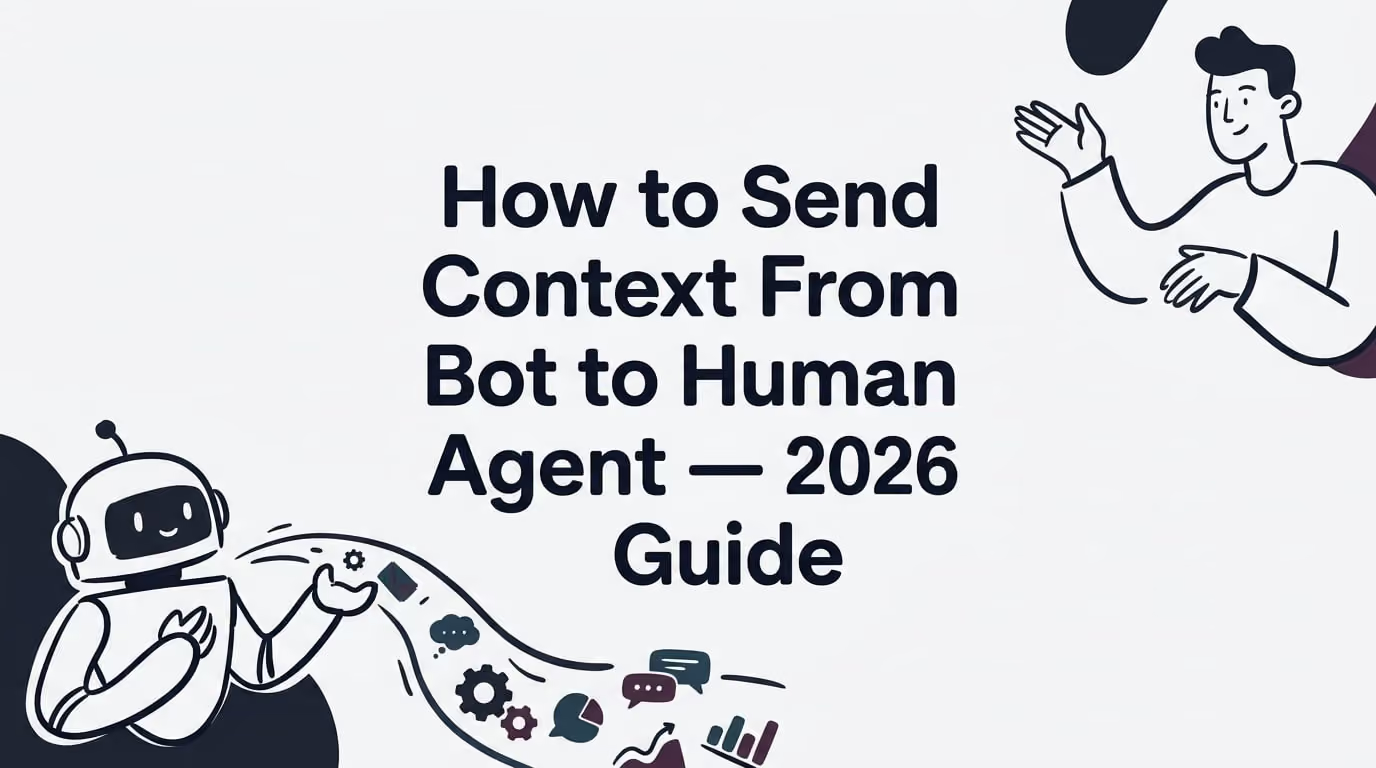
A common failure point in CX automation is the “cold transfer,” where a bot escalates a user to a human agent without any context. This forces the user to repeat themselves—a frustrating experience that harms CSAT and increases handle times. The solution is a “warm transfer,” a handoff that preserves the entire conversational history.
This technical guide details the patterns and protocols for how to send context from bot to human agent. We’ll cover building and transmitting context payloads, leveraging transfer protocols like SIP with custom headers, and implementing skills-based routing logic to connect the user to the right agent, every time.
What is an Agent Transfer with Bot Context?
A warm transfer is the process of escalating a user from an AI agent to a human while passing along a structured payload of data gathered during the bot interaction. Instead of the human agent starting from scratch, their CTI (Computer Telephony Integration) client or helpdesk dashboard is prepopulated with a complete picture of the user’s issue.
This is achieved by sending a context payload over a predefined channel. For voice transfers, this is often done by embedding data in SIP (Session Initiation Protocol) headers, such as a custom X-Context header containing a Base64-encoded JSON object. For chat or web-based handoffs, the payload is typically sent via a webhook to an intermediary service or directly to the agent desktop API.
The goal is to provide immediate, actionable intelligence so the agent can bypass repetitive discovery questions and begin problem-solving. This is a core function of modern, developer-first platforms like SigmaMind AI, which use structured context headers to enrich live transfers.
Initiating the Handoff with a Context Payload
A successful transfer begins with a well-defined trigger and a comprehensive data payload. The handoff logic must determine the precise moment to escalate and what information to bundle for the agent.
Handoff Triggers
Handoffs are event-driven. Common triggers in a production environment include:
- Explicit Intent Detection: The NLU model identifies a direct request, such as
intent:request_human_agent. - Consecutive Fallbacks: The agent fails to understand the user’s request multiple times (e.g., 3 consecutive
intent:nlu_fallbackevents), indicating it’s out of its depth. - Sentiment Analysis Threshold: The system detects a significant drop in the user’s sentiment score, signaling frustration and triggering a proactive escalation.
- Tool/API Failure: A required backend API call (e.g., looking up an order) fails, preventing the agent from completing its task.
The Context Payload Schema
Once a trigger is fired, the agent platform assembles a context payload. This is typically a JSON object containing everything the human agent needs. A well-designed payload is the foundation for knowing how to send context from bot to human agent.
Here is an example JSON payload schema:
{
  "handoffId": "hnd_1a2b3c4d5e",
  "conversationId": "conv_6f7g8h9i0j",
  "timestamp": "2026-04-13T10:30:00Z",
  "source": "VoiceBot_OrderInquiry",
  "trigger": {
    "type": "SENTIMENT_THRESHOLD",
    "details": "Negative sentiment detected for 3 consecutive turns."
  },
  "customer": {
    "customerId": "cust_12345",
    "name": "Jane Doe",
    "phone": "+15551234567",
    "authenticated": true
  },
  "context": {
    "intent": "return_damaged_item",
    "entities": {
      "orderNumber": "ORD-98765",
      "itemSku": "SKU-ABC-123"
    },
    "sessionVariables": {
      "returnEligibility": "true",
      "photos_uploaded": "true"
    },
    "summary": "Customer Jane Doe is requesting to return a damaged item from order ORD-98765. Bot confirmed eligibility and that photos have been uploaded. Customer is frustrated. Next step: Initiate return label generation.",
    "sentiment": {
      "score": -0.8,
      "trend": "decreasing"
    }
  },
  "transcriptUrl": "https://api.sigmamind.ai/v1/transcripts/conv_6f7g8h9i0j",
  "lastUserUtterance": "This is taking too long, I just want my return label."
}
Attaching the Conversation Transcript
The full conversation transcript is a critical part of the context. While it can be embedded directly into the payload, this can bloat its size, especially for long conversations. A more scalable approach is to store the transcript securely and include a signed URL to access it, as shown in the transcriptUrl field in the example above.
This gives the agent on-demand access to the complete history without overloading the initial handoff mechanism. Modern agent platforms provide centralized transcripts and analytics so agents don’t have to hunt for past context. For maximum utility, transcripts should be structured with speaker labels, timestamps, and confidence scores for each utterance.
Sharing a Concise Case Summary with the Agent
While the full transcript is essential for deep dives, agents under pressure need an at-a-glance summary. This summary can be generated by an LLM right before handoff and included in the payload’s context.summary field.
When the transfer occurs, this summary can populate a “screen pop” in the agent’s CRM or helpdesk, providing an instant briefing: “Customer needs to replace a damaged item (Order #18422). Photos uploaded. Bot confirmed eligibility. Next step: provide a return label.”
This immediate context allows agents to resolve issues faster. Real-world teams have cut refund delays by 80% using this approach, as it eliminates the initial discovery phase of the call.
Using the Bot as a Proxy to Retain Context
An alternative to passing a static payload is architecting a system with a shared state manager. In this model, both the bot and the human agent’s client read from and write to a centralized data store (like Redis or a database) keyed by the conversationId.
This “shared memory” architecture is powerful. When an agent joins, their client simply subscribes to the existing conversation state. There is no data transfer to manage or risk of dropped packets. This is particularly effective in platforms that use a node-based agent builder, where state is persisted at each step of the flow. The human agent effectively picks up the session exactly where the bot left off, creating a truly unified conversational experience.
The Power of a Conversational Warm Transfer
A warm transfer ensures the context arrives with the user. In voice telephony, this is often implemented using a SIP REFER request that includes the context payload in a custom header.
For example, the platform might initiate a transfer to the contact center’s SIP URI with an X-SigmaMind-Context header containing the Base64-encoded JSON payload. The contact center’s Session Border Controller (SBC) or softswitch then parses this header and passes the data to the agent’s desktop client via its CTI integration.
A more advanced technique is the “agent whisper,” where the bot plays a private audio message to the human agent just before connecting the customer. This can be a text-to-speech rendering of the context summary: “Transferring a customer about order #18422. They need a return label for a damaged item.” Platforms like SigmaMind AI use this method to escalate calls to humans without losing context, fully briefing the agent before they say “hello.”
Passing the Most Recent User Message
A common race condition occurs when a user says something critical right as the handoff is triggered, causing that final utterance to be lost. To prevent this, the payload schema should include a lastUserUtterance field, ensuring the agent sees the absolute latest input and can respond to it directly.
Routing to the Right Agent with Context
Sending context isn’t just about briefing the agent; it’s about getting the user to the right agent. The data in the context payload can be used to drive intelligent routing decisions in an Automatic Call Distributor (ACD) system. This is a core capability in platforms designed for enterprise customer support.
The routing engine can apply rules to the payload to determine the best queue or agent skill group.
Here is a simplified pseudo-code example of routing logic:
// Pseudocode for skills-based routing logic
function routeHandoff(payload) {
  let targetQueue = 'General_Support'; // Default queue

  if (payload.context.intent === 'return_damaged_item' && payload.customer.tier === 'VIP') {
    targetQueue = 'VIP_Returns_Specialists';
  } else if (payload.context.language === 'es') {
    targetQueue = 'Spanish_Support';
  } else if (payload.context.sentiment.score < -0.7) {
    targetQueue = 'Retention_Team';
  } else if (payload.context.intent.startsWith('tech_support_')) {
    targetQueue = 'Technical_Tier_2';
  }

  // Pass the payload to the ACD for delivery to the selected queue
  return acd.routeTo(targetQueue, payload);
}
This ensures the first human the user speaks to is equipped with both the context and the skills to solve their problem, drastically improving First Contact Resolution (FCR). By implementing these technical strategies, you can build a robust system that truly knows how to send context from bot to human agent. To see these patterns in a live environment, you can explore SigmaMind AI’s developer-first tools and build a production-grade agent.
Frequently Asked Questions (FAQ)
1. What is the most important information to send from a bot to a human agent?
A structured context payload containing a unique conversation ID, the customer’s authenticated identity, the detected intent, a machine-generated summary, a link to the full transcript, and any extracted entities (like order or ticket numbers) is most critical.
2. How does a warm transfer improve customer satisfaction?
Technically, it reduces Average Handle Time (AHT) by eliminating redundant discovery questions. For the customer, this translates to a faster, more efficient resolution without the frustration of repeating information, which directly boosts CSAT and Net Promoter Score (NPS).
3. What is a context payload in a bot to human handoff?
A context payload is a structured data object, typically JSON, that is programmatically passed from the bot to the agent desktop or CTI system during a handoff. It contains the complete state of the conversation, including user data, intent, entities, a summary, and a transcript link. Knowing how to send context from bot to human agent via a payload is fundamental to a smooth handoff.
4. Can AI help route a customer to the correct agent?
Yes. The context payload generated by the AI bot can be fed into an ACD’s routing engine. The engine can then use the data within the payload (e.g., intent, language, sentiment score, product SKU) to execute complex, skills-based routing rules, ensuring the call is directed to the most qualified agent queue.
5. Why is it so bad for a customer to have to repeat their issue?
From a systems perspective, it indicates a state management failure between two tiers of support (bot and human). It creates operational inefficiency, inflates handle times, and degrades the customer experience, which can lead to churn and negative brand perception.
6. Is there a way to see how to send context from bot to human agent in action?
Yes, developer-focused platforms like SigmaMind AI are architected around this principle. They provide APIs and tools for configuring warm transfers, custom SIP headers, and context-aware routing. You can sign up for a free account to build and test these handoff mechanisms yourself.
Evolve with Sigma Mind AI
Build, launch & scale AI agents
Related Blogs
Ready to transform your call center?

More Conversations.
Less Manual Work.

Building from San Francisco, CA