
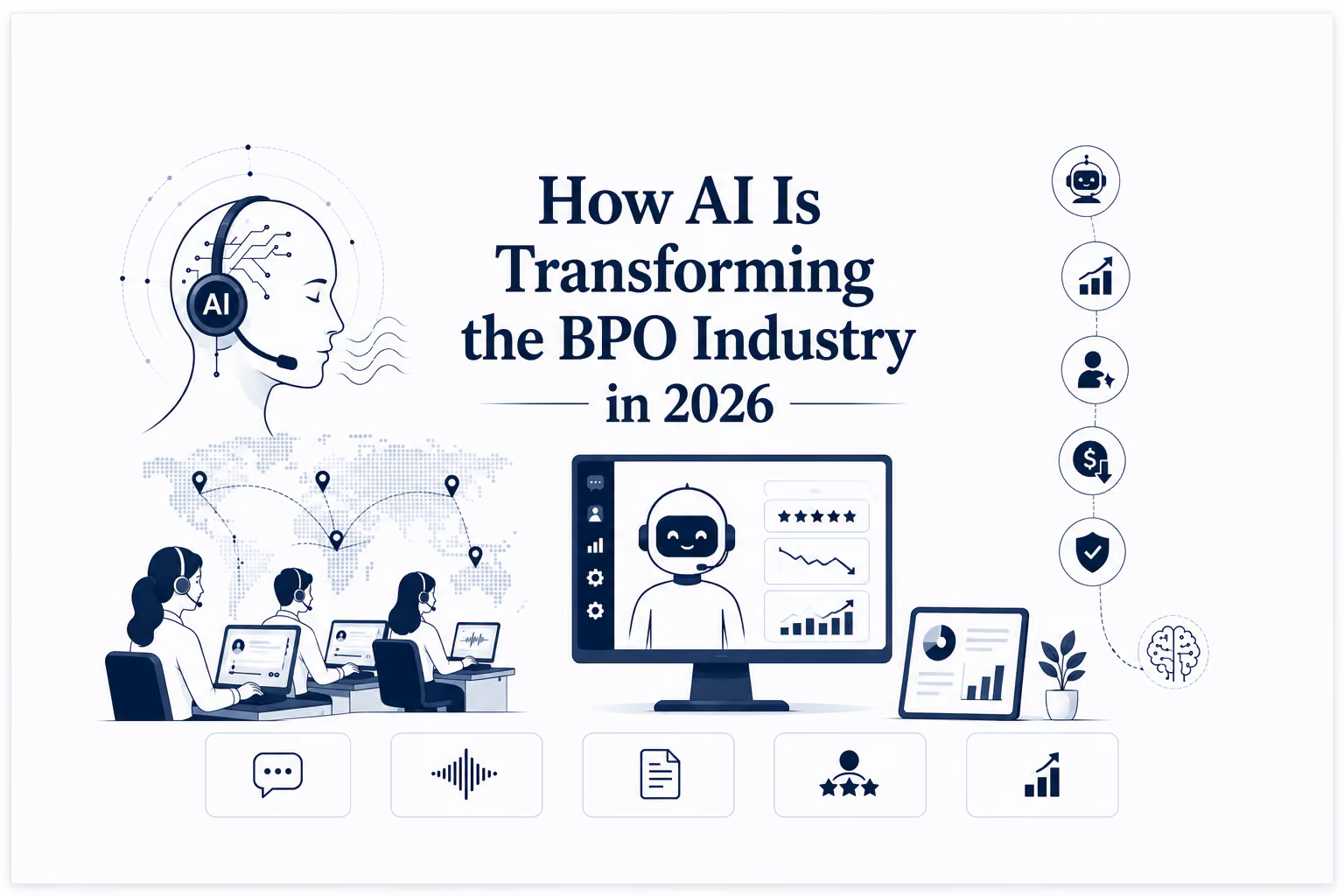
How AI Is Transforming the BPO Industry in 2026
How AI is transforming the BPO industry in 2026, covering AI chatbot implementation, voice agents in call centers, and what's driving adoption.
IN this article

Evolve with Sigma Mind AI
Build, launch & scale AI agents
AI is transforming the BPO industry in 2026 by shifting call center work to an 80/20 hybrid model, where AI voice agents and chatbots handle routine, high-volume work while human agents focus on the calls that need judgment. That shift is showing up in cost structure, staffing models, and how BPOs pitch clients on service level agreements, not just in the tools on an agent's desktop.
Business process outsourcing has always competed on cost and consistency. AI voice agent deployment is changing what both of those actually mean, and the BPOs moving fastest on it are pulling ahead of ones still running pilots.
See AI Transform a Real BPO Call Flow
Watch SigmaMind AI handle inbound support, outbound sales, and escalation in the same platform your BPO already runs.
What does AI chatbot implementation actually look like in a BPO today?
AI chatbot implementation in a BPO today means one agent handling a conversation across chat, voice, and email, not three separate bots built and maintained independently. Most BPOs still run legacy setups with a chatbot for web, an IVR for phone, and a separate email triage tool, none of which share context.
Consolidating those into one conversational layer changes the economics directly. A single agent built once and deployed across channels costs less to maintain than three, and it gives a client's end customer a consistent experience regardless of which channel they picked. It also solves a problem specific to BPOs: a client asking why their chatbot doesn't know about the call a customer made an hour earlier is a support failure a unified system doesn't create in the first place. The architecture behind adding AI to VICIdial covers how this consolidation works when a BPO is layering AI onto a dialer it already runs rather than replacing its stack outright.
How are AI voice agents changing call centers inside BPOs?
AI voice agents are changing BPO call centers by absorbing the routine volume that used to require the most headcount to staff. Order status, account verification, appointment confirmations, and basic troubleshooting now run through an AI voice agent in call centers without a human touching the call, freeing floor staff for calls that need real judgment.
This changes staffing math for BPOs specifically, since headcount is the core cost driver in their pricing model. A BPO that can hold service levels with fewer floor agents on routine volume has a real pricing advantage over one still staffing purely to call volume. That advantage compounds at contract renewal too, since a BPO that can point to measurable AI-driven cost reduction has a much easier renewal conversation than one asking a client to trust that headcount alone will keep improving.
Why are BPOs in the USA adopting conversational AI for call centers fastest?
BPOs in the USA are adopting conversational AI for call centers fastest because US clients combine high compliance requirements with high expectations for response speed, and AI is well suited to both at once.
- Compliance: TCPA, HIPAA, and industry-specific rules make consistent, auditable call handling valuable, and AI voice agents apply the same script and disclosure logic on every call without drift
- Speed: US clients expect faster lead response and shorter hold times than BPOs serving other markets, and AI closes that gap by answering the moment a call comes in rather than after a queue clears
That combination, strict compliance plus high speed expectations, is a harder standard to hit with headcount alone, which is part of why US-facing BPO accounts are often where AI gets piloted first even inside a global operation. The comparison of the top AI voice service platforms for business calls is worth reviewing for BPOs evaluating which platform actually fits a compliance-heavy US client base versus a general-purpose one.
What does a voice AI agent deployment actually require inside a BPO?
A voice AI agent deployment inside a BPO requires layering onto the dialer and CRM the BPO already runs for its clients, not replacing that infrastructure client by client. BPOs run multiple client accounts on shared or client-specific telephony stacks, and a platform that forces a full migration for each client relationship is rarely worth the disruption.
The deployment also needs to support per-client customization without duplicating the underlying build:
- Different scripts and compliance rules per client, running on the same core agent architecture.
- Different escalation paths depending on each client's own human team structure.
- Per-client reporting and QA, without maintaining a separate codebase for each account.
A platform built to layer onto existing infrastructure handles this far more cleanly than one built assuming a single, unified telephony environment, since a BPO managing ten client accounts is really managing ten different telephony setups at once, not one.
What's driving AI adoption in BPOs, and what's holding it back?
Client contract pressure is driving adoption faster than internal BPO initiative. New IT and BPO contracts increasingly require AI-enabled productivity gains built into pricing from day one, which means BPOs without a working AI deployment are losing deals on price before the relationship even starts.
Execution is what's holding adoption back, not appetite. Everest Group's 2026 research found a real gap between ambition and delivery:
- 80% of organizations expect positive ROI from AI.
- Only 15% believe their service providers are actually leveraging it extensively.
- 67% cite legacy infrastructure as a key barrier.
- 55% cite change management as a key barrier.
Source: Everest Group
That gap between ambition and execution is exactly where BPOs that move first, rather than the ones with the most capital, are pulling ahead.
Getting started with AI in your BPO operation
Start with the client account generating the most routine call volume, not the whole floor at once. Layer voice AI onto that account's existing dialer, prove it holds service levels on routine calls, then use that result as the case for expanding to the next account using the same core build. A single proven account is worth more in a client renewal conversation than a roadmap slide promising future automation.
Platform choice matters more in a BPO context than most, since the same platform has to perform consistently across many different client environments, compliance requirements, and telephony setups at once. The detailed comparison against Parloa is worth a look here too, since latency and setup time compound differently when you're deploying across ten client accounts instead of one.
Bottom line: AI is transforming the BPO industry by making the 80/20 hybrid model, AI on routine volume, humans on judgment calls, the new baseline clients expect. The BPOs winning new contracts in 2026 are the ones that can prove that model works, not just describe it.
Ready to see how AI can transform your BPO's call operations? Talk to us to see AI voice agent deployment on your own client call flows.
Evolve with Sigma Mind AI
Build, launch & scale AI agents
Related Blogs
Ready to transform your call center?

More Conversations.
Less Manual Work.

Building from San Francisco, CA