
Best AI Voice Platforms for Customer Service (2026): 11 Platforms Ranked
Discover the 11 best AI voice platforms for customer service. A detailed comparison of Voice AI tools ranked on workflow depth, pricing, integrations, and handoff quality.
IN this article

Evolve with Sigma Mind AI
Build, launch & scale AI agents
TL;DR
The best AI voice customer service platform is not the one with the most impressive demo. It is the one that resolves real customer problems, connects to your systems, and transfers cleanly to a human when it cannot.
SigmaMind AI tops this list for teams that need voice agents capable of completing actual work (refunds, bookings, order lookups, CRM updates) with both no-code building and developer-level control. Retell AI is the strongest alternative with high public review volume, Vapi suits developer teams wanting maximum stack control, and enterprise buyers should evaluate PolyAI, Cognigy, or their existing CCaaS suite.
Voice Support Is being rebuilt with AI, not replaced
Phone support is not dying. According to McKinsey, live phone conversations remain among the most preferred support methods across age groups, and 57% of customer care leaders expected call volumes to increase by as much as one-fifth over the next one to two years. More than 80% of those leaders were already investing in generative AI or planning to do so soon.
At the same time, Gartner predicted that by 2029, agentic AI will autonomously resolve 80% of common customer service issues without human intervention and reduce operational costs by 30% source. Today the technology is no longer theoretical. The question is which platform to trust with real customers.
That is harder than it sounds. Practitioners from Intercom/Fin and Cartesia have publicly stated that production voice AI is “10x harder than demos,” requiring evaluation frameworks, background noise handling, real business integrations, and answer quality that actually solves problems, not just sounds good. Meanwhile, practitioners on Reddit report that headline per-minute pricing hides the true cost of voice AI, and buyers should model fully blended costs including STT, TTS, LLM, telephony, and transfer fees before committing.
This guide compares the 11 best AI voice customer service platforms by what actually matters for customer service automation: pricing transparency, workflow depth, voice quality, integration capability, human handoff quality, observability, and real user sentiment.
The ranking of the best AI Voice Customer Service Software explained
Every platform was evaluated across ten criteria:
Best AI Voice Customer Service Platforms at a Glance
RankPlatformBest ForPricing SnapshotKey DifferentiatorUser SentimentMain Tradeoff1SigmaMind AIWork-completing voice agents with no-code + API control$0.03/min platform fee + provider costsModel-agnostic orchestration, node-based workflows, warm transfer with context4.9/5 Product Hunt (14 reviews); 1M+ calls handledUS numbers only in-product; international via SIP/BYOC2Retell AIProduction-ready agents with strong public reviews$0.07/min; Enterprise from $8,000High G2 review volume, post-call analyticsG2 4.8/5 (1,802 reviews)Cost and tuning increase in production3VapiDeveloper teams building custom voice products$0.05/min platform; all-in often $0.15-$0.40/minMaximum stack control via APIProduct Hunt 4.9/5; Trustpilot 2.4/5Requires technical ownership; mixed support sentiment4PolyAILarge enterprise managed voice assistantsCustom enterprise pricingLifelike enterprise voice assistantsG2 5.0/5 (12 reviews)Not self-serve; limited public pricing5CognigyEnterprise omnichannel contact center AICustom enterprise pricingVoice + chat + IVR + agent assistG2 4.6/5 (13 reviews)Enterprise complexity; modest review volume6ParloaEnterprise AI agent managementSubscription/custom tiersAgent lifecycle managementG2 4.0/5 (1 review)Very limited public review data7TalkdeskCCaaS teams wanting AI inside a suite$85-$105/user/monthContact center suite + AI automationG2 4.4/5 (2,501 reviews)Not a pure voice-agent platform8Five9Established contact centers and outbound operations~$119-$300/agent/monthMature CCaaS + outbound/dialer strengthsG2 4.1/5 (597 reviews)Add-ons and suite cost9NICE CXone MpowerEnterprise contact centers needing WFM/QM/AI$71-$249/agent/monthBroad enterprise CX suiteG2 4.3/5 (1,728 reviews)Complexity and higher-tier costs10SynthflowNo-code SMB/agency voice agentsLegacy tiers from $29/mo; newer ~$0.13-$0.24/minFast no-code deploymentG2 4.5/5 (1,007 reviews)Scaling cost and customization limits11Bland AIProgrammable high-volume calling experiments$0.11-$0.14/min + monthly plansOutbound automationSparse Trustpilot; Reddit latency concernsProduction support needs careful testing
Want to see what a production AI voice support workflow looks like? Explore SigmaMind’s customer support voice agent use cases.
Comparison of the best AI Voice Customer Service Platforms
1. SigmaMind AI
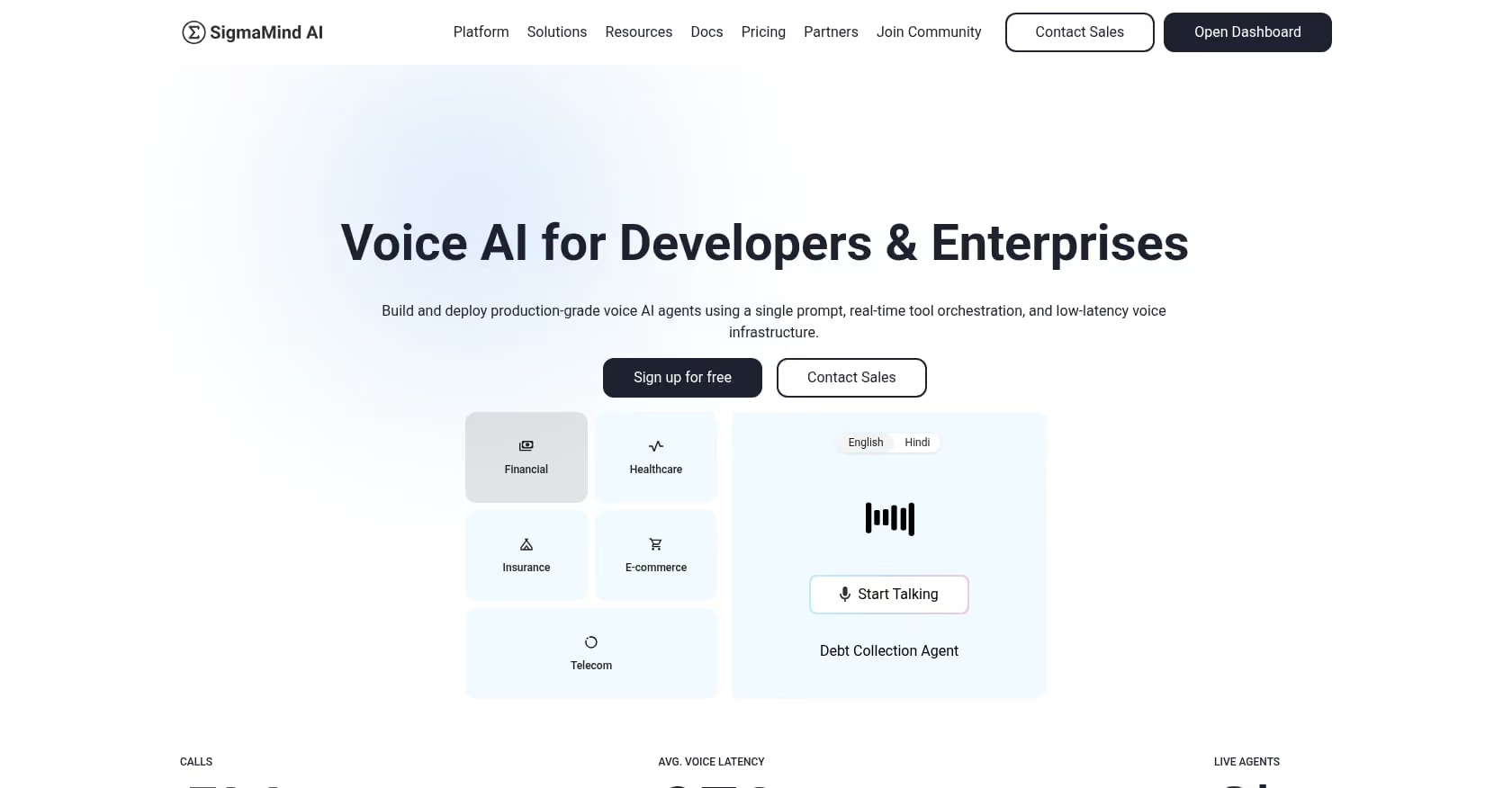
Best for: Enterprises, agencies, BPOs, customer service automation and developer teams that need AI voice customer service agents capable of completing multi-step work, not just answering questions.
SigmaMind AI is a Y Combinator-backed voice AI orchestration platform built around a central premise: voice agents should complete tasks, not just hold conversations. Where many platforms stop at FAQ handling, SigmaMind’s node-based workflow builder lets teams design agents that process refunds, update CRM records, book appointments, look up orders, trigger escalations, and send confirmation messages, all within a single call.
Key features:
Pricing:
Pay-as-you-go voice agents cost $0.03 per minute platform fee plus provider costs for STT, TTS, LLMs, and telephony. Chat agents cost $0.005 per AI message platform fee plus LLM and optional SMS add-ons. Enterprise plans offer custom volume-based pricing. Check the pricing calculator to model your actual cost.
User sentiment and proof:
Homepage telemetry shows 1M+ calls handled, 1,500+ live agents, and approximately 970 ms average voice latency. In a published case study, one ecommerce brand automated 4,000+ refunds per month with 43% cost savings, dropping turnaround from 2 to 3 days to under 60 seconds with zero processing errors reported. Gardencup achieved an 80% reduction in refund processing time and a 20% CSAT lift. CleanBoss saw 50% first response time reduction and 15% CSAT improvement in three months. On Product Hunt, SigmaMind launched with a 4.9 rating from 14 reviews and 283 followers.
Tradeoffs:
Verdict: Choose SigmaMind AI if you need AI voice customer service agents that actually complete work, refunds, bookings, lookups, CRM updates, and escalations with context, while giving your team both no-code speed and developer-level control over models, telephony, and cost.
2. Retell AI
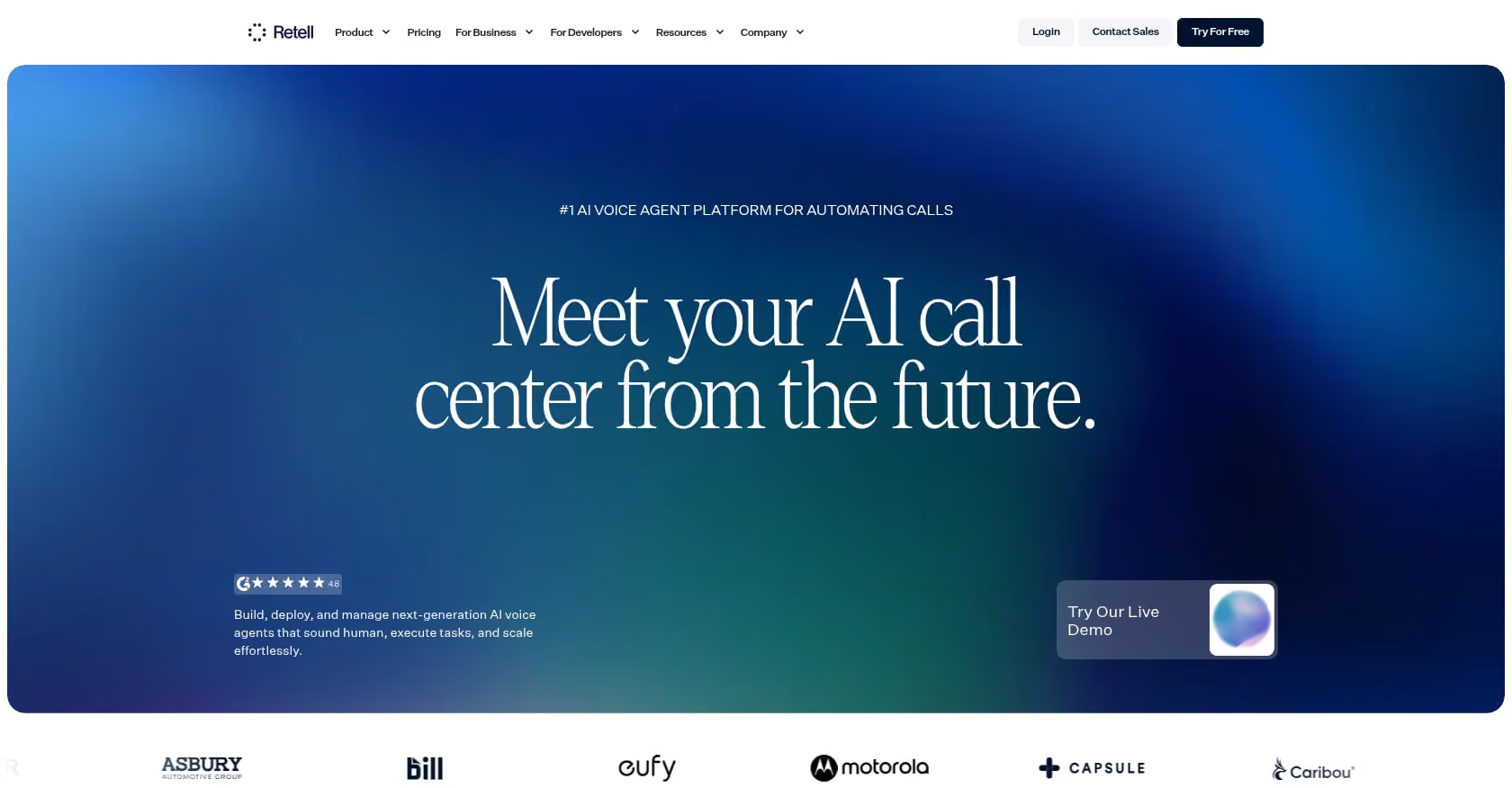
Best for: Teams wanting production-ready AI voice agents backed by the strongest public review volume in the category.
Retell AI has built serious momentum as an AI-native voice platform. Its drag-and-drop builder, LLM-native agents, and post-call analytics make it accessible for both support teams and agencies.
Key features:
Pricing:
G2 lists pay-as-you-go pricing at $0.07 per minute with Enterprise starting at $8,000. Third-party analyses note that actual all-in costs can be higher once model, voice, and telephony choices are included.
User sentiment:
G2 shows 4.8 out of 5 from 1,802 reviews, with users praising ease of use, integration options, and interface quality. Summarized cons include missing features, cost-per-call concerns, and prompt/understanding issues.
Tradeoffs:
Verdict: Retell is a strong alternative for teams that want a widely reviewed AI voice customer service platform with quick setup. It is not the cheapest once production costs are included, but it has broad use-case coverage and strong review momentum.
3. Vapi
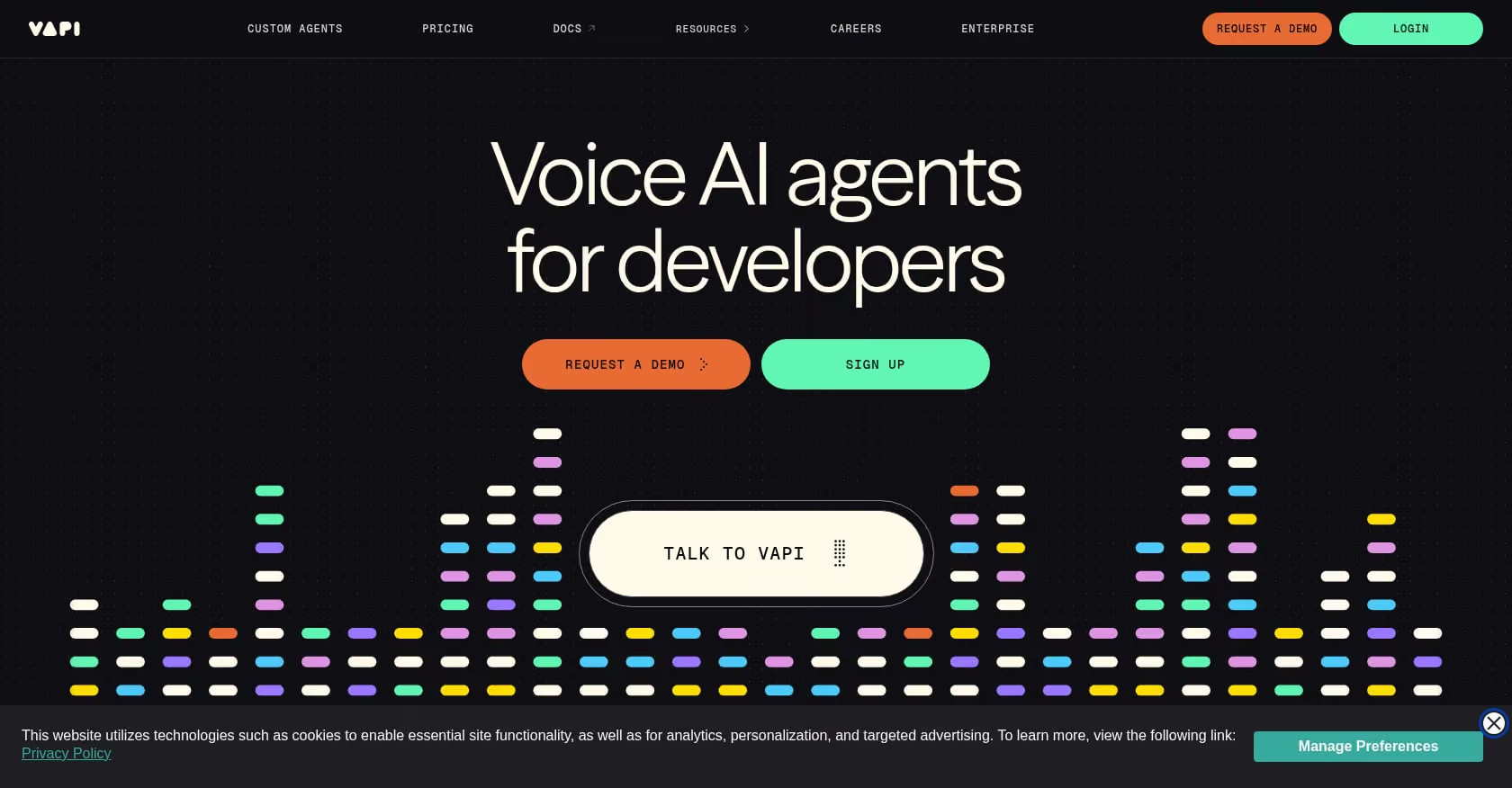
Best for: Developer teams that want maximum control over the entire voice AI stack.
Vapi takes an API-first approach, letting developers choose their own LLM, STT, TTS, and telephony providers. This makes it powerful for custom voice AI products but demanding for teams without engineering resources.
Key features:
Pricing:
Third-party breakdowns describe a $0.05 per minute platform fee, with real all-in costs commonly landing between $0.15 and $0.40 per minute after LLM, STT, TTS, and telephony.
User sentiment:
Product Hunt shows 4.9 out of 5 from 23 reviews, with praise for documentation, flexibility, and natural voices. Trustpilot tells a different story: 2.4 out of 5 from 15 reviews, with complaints about support, hidden charges, reliability, and latency. This split suggests Vapi works well for builders who can manage the stack but frustrates buyers expecting turnkey support.
Tradeoffs:
Verdict: Choose Vapi if your team wants to build the voice AI product from scratch. Avoid it if you need a turnkey AI customer service agent with predictable total cost.
4. PolyAI
Best for: Large enterprises that want managed, lifelike voice assistants for high-volume call environments.
PolyAI focuses on enterprise deployments in hospitality, banking, insurance, retail, and telecom. Rather than offering a self-serve builder, PolyAI provides a managed service where the vendor handles implementation and optimization.
Key features:
Pricing:
Custom enterprise pricing. Expect a sales process and implementation engagement.
User sentiment:
G2 shows a perfect 5.0 out of 5, but from only 12 reviews. One enterprise hospitality reviewer reported PolyAI helped their VIP Services team answer 30% more calls. Another said PolyAI handled 87% of non-revenue calls on day one after a four-week deployment.
Tradeoffs:
Verdict: PolyAI is a strong enterprise voice AI option when voice quality and managed deployment matter more than self-serve control or transparent pricing.
5. Cognigy
Best for: Global enterprises needing voice and chat automation integrated deeply into existing contact center infrastructure.
Cognigy positions itself as a technology-agnostic conversational AI platform that connects with existing CCaaS, CRM, and enterprise systems. It covers voice, chat, IVR replacement, agent assist, and smart self-service.
Key features:
Pricing:
Custom enterprise pricing. Voice gateway, telephony/SIP/PSTN, and some enterprise features may be add-on components.
User sentiment:
G2 shows 4.6 out of 5 from 13 reviews. Users praise flexibility, integration capabilities, and accessibility for business users. Reviews also mention requests for stronger analytics, more reusable components, and better Voice Gateway documentation. One reviewer noted some customers may be too small to benefit.
Tradeoffs:
Verdict: Cognigy is best when AI voice customer service is part of a broader omnichannel contact center automation program. It is overkill for simple call answering but strong for enterprise workflow complexity.
6. Parloa
Best for: Enterprise AI agent management, especially for structured support environments with high-volume B2C communication.
Parloa offers an AI Agent Management Platform for designing, testing, deploying, and scaling voice and chat agents across their lifecycle.
Key features:
Pricing:
Subscription and custom pricing according to Gartner Peer Insights, with tiers varying by usage and feature access.
User sentiment:
G2 shows 4.0 out of 5 from just 1 review, which is too little to draw meaningful conclusions.
Tradeoffs:
Verdict: Parloa belongs on the enterprise shortlist, but buyers should demand proof: reference calls, call recordings, containment data, implementation plans, and pricing transparency before committing.
7. Talkdesk
Best for: Mid-market and enterprise contact centers that want AI voice customer service capabilities inside a broader CCaaS suite.
Talkdesk is a full customer experience platform. AI voice agents are one component inside a broader system that includes routing, reporting, workforce management, agent workspaces, and digital channels.
Key features:
Pricing:
G2 lists a free Express option for up to 25 licenses (US/Canada small business), CX Cloud Digital Essentials at $85 per user per month, and CX Cloud Voice Essentials at $105 per user per month.
User sentiment:
G2 shows 4.4 out of 5 from 2,501 reviews. Users praise ease of use, call routing, and centralized workflows. Common complaints include call issues, technical problems, connection issues, and poor connectivity.
Tradeoffs:
Verdict: Talkdesk is a good fit when AI voice customer service is part of a larger contact center modernization plan. If you only want programmable voice agents, an AI-native platform is simpler and cheaper.
8. Five9
Best for: Established contact centers with outbound calling, predictive dialing, and mature operational requirements.
Five9 is a cloud contact center platform with deep outbound capabilities. AI features have been layered in over time, making it a strong option for operations teams that already need the broader suite.
Key features:
Pricing:
Third-party sources report plans starting around $119 per user per month for Digital and $159 for Core, with Five9 Aria packages ranging from $175 to $300 per agent per month depending on features.
User sentiment:
G2 shows 4.1 out of 5 from 597 reviews. Reddit call center discussions include complaints about “nickel and dime” add-ons for workforce management, quality assurance, and AI features.
Tradeoffs:
Verdict: Five9 is a serious CCaaS option for established contact centers, especially where outbound capabilities and operational maturity matter. It is not the fastest path for teams that only want to deploy an AI voice support agent.
9. NICE CXone Mpower
Best for: Enterprise contact centers that need workforce management, quality management, compliance, and AI voice customer service in one suite.
NICE CXone Mpower is a comprehensive enterprise platform. Voice AI lives alongside routing, workforce engagement, quality management, interaction analytics, and compliance tools.
Key features:
Pricing:
G2 describes pricing editions from $71 to $249 per agent per month, including Digital Agent, Voice Agent, and Ultimate Suite options.
User sentiment:
G2 shows 4.3 out of 5 from 1,728 reviews. Positives include ease of use, features, and efficiency. Negatives include technical issues, call problems, poor customer support, missing features, and a learning curve.
Tradeoffs:
Verdict: NICE CXone Mpower is a strong enterprise suite, not a lightweight voice agent builder. Recommend it for organizations that want AI inside a mature contact center operating system.
10. Synthflow
Best for: SMBs and agencies that want fast, no-code AI voice agents for straightforward call flows.
Synthflow emphasizes speed to deployment. Its drag-and-drop builder makes it easy to launch agents for appointment scheduling, lead qualification, inbound routing, and basic customer support without writing code.
Key features:
Pricing:
Third-party guides report older plan-style pricing (Starter at $29 per month with 50 minutes, Pro at $99, Growth at $449, Agency at $899). Newer 2026 analyses describe usage-based pricing with all-in call costs around $0.13 to $0.24 per minute depending on LLM and telephony choices source. Verify current pricing before purchasing, as the model has changed.
User sentiment:
G2 shows 4.5 out of 5 from 1,007 reviews, with praise for intuitive UI, easy setup, and low latency. Reviews also mention limited customization, cost concerns at higher volumes, and analytics gaps. Trustpilot shows 4.3 out of 5 from 212 reviews, but recent negative reviews complain about support, billing and cancellation, and platform reliability.
Tradeoffs:
Verdict: Synthflow is a solid no-code option for simple and mid-complexity call flows. It is less attractive for teams needing deep orchestration, transparent per-layer cost control, or complex enterprise workflows.
11. Bland AI
Best for: Developer teams running high-volume programmable calling experiments, with caution for production customer service.
Bland AI targets programmatic voice calling. It is oriented more toward outbound campaigns and developer experimentation than polished inbound customer support.
Key features:
Pricing:
A 2026 third-party review describes Start as free at $0.14 per minute, Build at $299 per month ($0.12/min), Scale at $499 per month ($0.11/min), and Enterprise as custom. Transfer fees, outbound attempt minimums, and standard voicemail/call-time billing apply.
User sentiment:
Trustpilot shows 2.9 out of 5 from only 2 reviews, which is too small for any meaningful conclusion. Reddit discussions from users testing Bland alongside Vapi and Retell raise concerns around latency and interruption handling. One tester reported that Bland tended to keep talking for 1 to 2 seconds after being interrupted.
Tradeoffs:
Verdict: Bland AI is worth considering for programmable, high-volume calling experiments. Customer service buyers should test interruption handling, transfer quality, billing structure, and support responsiveness carefully before putting it in front of real customers.
How to choose the Best AI Voice Customer Service Platform
Not all these tools belong on the same shortlist. The right choice depends on your operating model.
Choose an AI-native voice platform if you need workflow depth
Platforms like SigmaMind AI, Retell AI, and Vapi are built specifically for voice AI. They give you control over models, telephony, tool calling, and cost optimization. SigmaMind stands out for teams that need both a no-code agent builder and developer-level APIs, especially when the agent needs to complete multi-step work rather than just answer questions.
Choose a CCaaS suite if you already run one
If your contact center already operates on Talkdesk, Five9, or NICE CXone, start by evaluating the AI capabilities within that suite. The value of keeping routing, workforce management, quality management, and analytics under one roof often outweighs the advantage of a standalone voice agent platform.
Choose a no-code builder if speed matters more than control
Synthflow and similar tools get Voice AI agents live fast. If your use case is appointment booking, lead capture, or after-hours answering, a no-code platform is probably enough. Just know that you will hit limits as workflows get more complex.
Choose enterprise managed voice AI if you need vendor-led implementation
PolyAI, Cognigy, and Parloa are better fits when procurement cycles, compliance requirements, and large-scale contact center integrations are involved. Expect longer sales cycles and custom pricing.
What Does AI Voice Customer Service Software cost?
Most comparison articles repeat headline pricing. That is misleading. The true cost of AI voice customer service includes multiple layers:
True AI voice cost = platform fee + STT + TTS + LLM + telephony + SMS + transfers + failed attempts + implementation + QA/monitoring + escalation cost
And the metric that matters is not cost per minute. It is cost per resolved call.
A platform charging $0.10 per minute that resolves only 40% of issues costs more per successful outcome than a $0.18 per minute platform that resolves 75%. Here is a simple example:
Change the resolution rate to 40% and that jumps to $1.13. Change it to 80% and it drops to $0.56. The resolution rate of the platform matters far more than the headline per-minute price.
SigmaMind’s approach, where per-layer cost breakdowns are visible in analytics, helps operators identify exactly which component (LLM, STT, TTS, telephony) is driving cost and optimize accordingly. For a deeper look at this problem, see the guide on tracking cost per support call.
The Handoff Problem with Voice AI for customer service
Practitioners on Reddit consistently complain about AI support loops, situations where the bot cannot solve the problem but refuses to transfer to a human source. The fastest way to destroy trust is not an AI voice. It is an AI voice that blocks the customer from reaching a human when the issue is outside policy, emotionally charged, or high-value.
Good handoff looks like this: the human agent sees a summary, customer ID, intent classification, sentiment score, order number, policy decision, and recommended next action before they say a word. The customer never repeats themselves.
Bad handoff looks like this: “Let me transfer you.” Dead air. “How can I help you today?”
This is one of the biggest differentiators among platforms. SigmaMind’s Warm Transfer passes live AI summaries and structured context headers so the receiving agent can pick up exactly where the AI left off. For a deeper look, read about how to escalate calls to humans without losing context.
Testing Checklist Before you deploy an AI Voice Agent
Demos are not tests. Reddit practitioners warn repeatedly that AI voice agent demos look great but fail under real PSTN conditions, background noise, concurrency, and customer unpredictability. Developers on Reddit also emphasize the need for real observability: traces, latency breakdowns, tool-call logs, and the ability to swap components when things go wrong.
Before putting an AI voice customer service agent in front of real customers, run through this checklist:
For ongoing quality measurement after launch, the guide on measuring AI call interaction quality covers scorecards, transcript review, and performance monitoring in detail.
To get a better impression of what Voice AI for customer service can do for you, book a personal demo of SigmaMind and talk to our team.
FAQ
What is the best AI voice customer service platform?
It depends on your team and use case. SigmaMind AI is the best overall choice for teams that need voice agents capable of completing real work (refunds, bookings, CRM updates, escalations) with both no-code building and developer control. Retell AI is strong for teams that value high public review volume. Vapi suits developers building custom products. PolyAI, Cognigy, and Parloa serve large enterprises. Talkdesk, Five9, and NICE CXone Mpower are best for teams already running CCaaS suites.
How much does an AI voice customer service agent cost?
Costs range from usage-based cents per minute (SigmaMind at $0.03/min platform fee plus provider costs, Retell at $0.07/min) to per-agent enterprise contracts ($85 to $300+ per agent per month for CCaaS suites). Always calculate the fully blended cost including platform, STT, TTS, LLM, telephony, and transfer fees, then divide by successfully resolved calls.
Can AI voice agents replace human customer service agents?
For routine, policy-bound, repetitive tasks like order status, appointment booking, refund processing, and FAQ handling, yes. For complex, emotionally charged, regulated, or edge-case issues, human agents are still essential. The best platforms make the handoff between AI and human seamless.
What is the difference between AI voice agents and IVR?
Traditional IVR forces callers through rigid menu trees (“Press 1 for billing”). AI voice agents understand natural language, maintain conversation context, call APIs and tools, complete tasks, and transfer with context when needed. They are fundamentally different technologies solving the same problem of phone channel automation.
What should I test before deploying AI voice customer service?
Test latency consistency (not just averages), interruption handling, tool-call accuracy, handoff context preservation, real PSTN connections (not just browser demos), background noise, accents, edge-case scenarios, and cost at your expected volume. Run at least 50 to 100 test calls covering real support scenarios before going live.
Are AI voice agents safe for healthcare or financial services?
Only with proper compliance review. Look for SOC 2 certification, encryption, SSO, audit trails, and data retention controls. For HIPAA, demand a signed BAA and confirm the vendor’s compliance posture. For PCI, understand how payment data flows. Do not accept marketing claims without documentation. SigmaMind, for example, supports HIPAA-friendly workflows but is not HIPAA compliant yet, so regulated buyers should discuss security reviews and private cloud options directly.
Final Recommendation
If you only need simple after-hours answering, a no-code tool may be enough. If you already run a full CCaaS suite, start by evaluating the AI inside that suite. But if you need AI voice customer service agents that complete real work, connect to your systems, preserve context through handoffs, and give developers control over the voice stack, SigmaMind AI should be the first platform you test.
Start building for free with pay-as-you-go pricing, or talk to the team for enterprise deployments, custom telephony, and security reviews.
Evolve with Sigma Mind AI
Build, launch & scale AI agents
Related Blogs
Ready to transform your call center?

More Conversations.
Less Manual Work.

Building from San Francisco, CA