
Conversational AI Models Explained: Types, Architecture, and Enterprise Selection
Explore conversational AI models, system architecture, deployment options, and selection criteria for enterprise contact centers.
IN this article

Evolve with Sigma Mind AI
Build, launch & scale AI agents
TL;DR
- A conversational AI model interprets context and decides what to say or do next. A complete system also handles speech recognition, retrieval, orchestration, speech generation, telephony, and monitoring.
- Most voice systems use either a cascaded pipeline that connects specialized components or a native speech-to-speech model. Cascaded designs offer more control, while native models can reduce latency and preserve vocal cues.
- Contact centers should evaluate end-to-end latency, task accuracy, multilingual performance, cost, compliance, observability, reliability, and model portability. Production tests should measure completed customer tasks rather than relying only on model benchmarks.
What a conversational AI model actually is
A conversational AI model is the dialogue or reasoning model that interprets conversation context and decides what to say or do next. In a contact center, the model might answer a billing question, choose a routing action, or request information needed to complete a task.
The term sometimes refers more broadly to every model involved in an interaction. That broader category includes speech recognition models that process caller audio, dialogue models that reason over language, and speech generation models that produce a voice. However, a model remains one component of a complete conversational AI system. Conversational AI also covers text and messaging interactions, while voice AI adds spoken input and output.
ChatGPT counts as conversational AI in ordinary usage, but the precise distinction matters. ChatGPT is a conversational product powered by general-purpose generative language models. An underlying GPT model becomes a conversational dialogue model when an application gives it conversation history, instructions, and access to relevant tools.
Purpose-built models take a narrower approach. A dialogue model may specialize in intent recognition or controlled customer-service flows. A speech-to-speech model may accept audio and produce audio directly. Specialized speech models may focus only on recognition or voice generation.
A working voice interaction also needs automatic speech recognition, text-to-speech, retrieval, orchestration, and telephony infrastructure. Those components turn the dialogue model’s decision into a live customer conversation.
What a complete conversational AI system adds
A complete conversational AI system turns a model’s text decisions into a live customer interaction. The conversational AI model can choose what to say or which action to request, but it cannot answer calls or manage audio by itself. Supporting components handle speech, business data, workflow execution, and the phone connection.
Telephony carries the caller’s audio between the contact center and the AI system. Voice activity detection, or VAD, determines when the caller starts and finishes speaking. Automatic speech recognition, or ASR, converts the audio into text that the conversational model can process.
Retrieval supplies relevant information such as policies, product details, or account context. Connected tools perform actions such as checking an order, booking an appointment, or updating a CRM record. Orchestration controls when the system queries those sources, calls tools, requests confirmation, or transfers the customer to a human agent. It also manages interruptions and preserves context across turns.
Text-to-speech, or TTS, converts the model’s response into audio. Telephony then plays that audio to the caller while the orchestration layer prepares for the next turn. Production systems also need monitoring that records latency, transcripts, tool results, and handoff outcomes.
Mistakes can compound downstream. If VAD cuts off an account number, ASR produces an incomplete transcript. The model then reasons from incorrect input, and a connected tool may retrieve the wrong account. Slow responses can cause the caller to repeat a request, which creates overlapping speech and further transcription errors.
Model quality cannot compensate for unreliable turn detection, inaccurate transcription, slow tools, or poor telephony audio. You therefore need to evaluate the assembled system and the handoffs between components. The architecture diagram that follows maps those handoffs across a live inbound or outbound call.
How a live customer call moves through the stack
Inbound and outbound calls use the same speech pipeline, but telephony and orchestration initiate different workflows.
INBOUND CALL
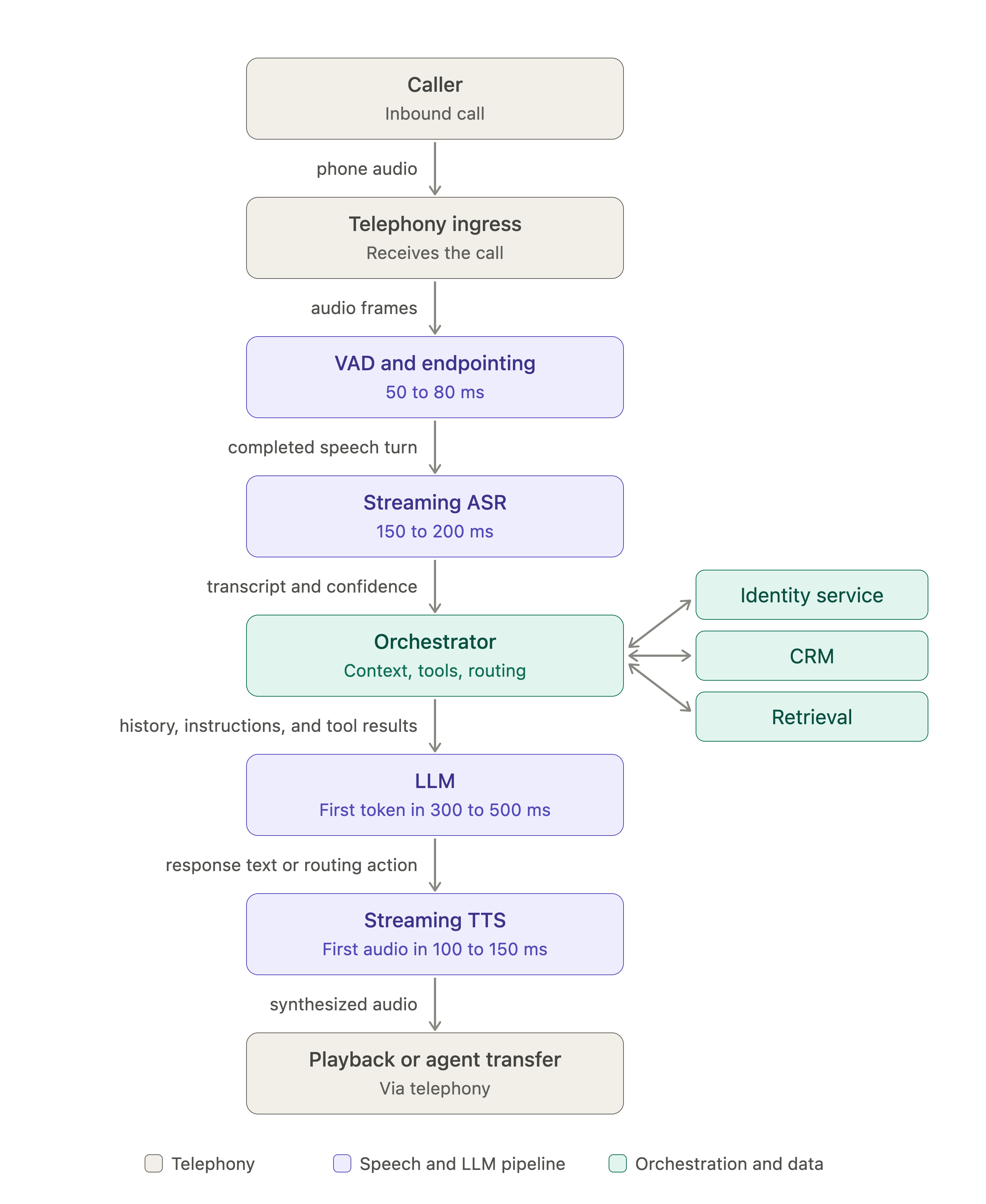
On an inbound call, telephony receives the caller’s audio and voice activity detection determines when the caller has finished speaking. Automatic speech recognition converts the audio into text, then the orchestrator sends account details to an authentication service. After authentication, the LLM identifies the request, and the orchestrator either retrieves an answer or routes the caller to an appropriate queue with the transcript and customer context.
OUTBOUND CALL
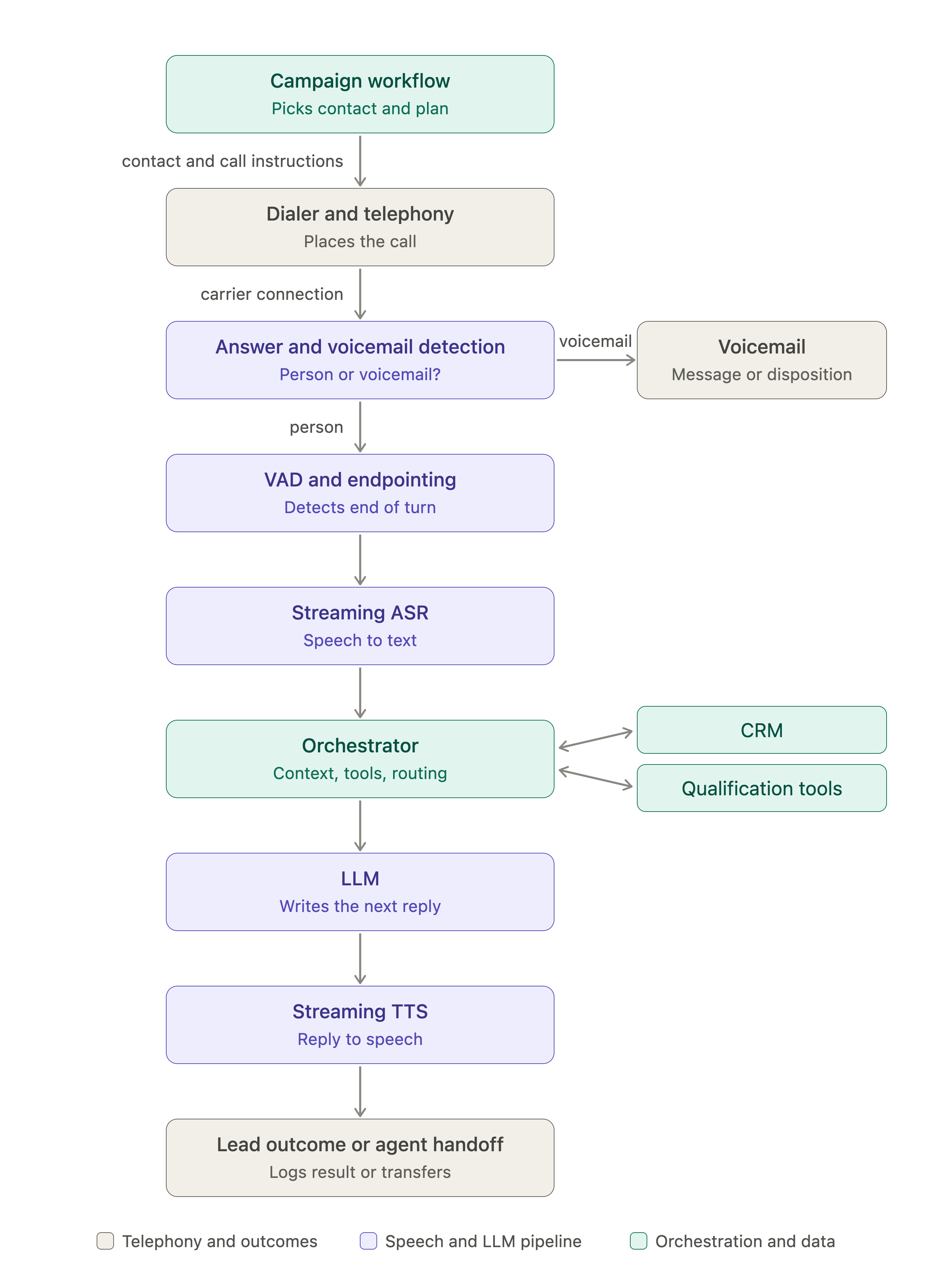
During an outbound call, the dialer places the call before the conversational loop begins. Answer detection sends voicemail to a separate workflow and passes a live answer into the speech pipeline. The orchestrator records qualification answers in the CRM, while the LLM chooses the next approved question. A qualified lead can then reach a human agent with the transcript and captured fields.
Production systems often target roughly 50 to 80 ms for endpointing, 150 to 200 ms for ASR, 300 to 500 ms for the LLM’s first token, and 100 to 150 ms for initial TTS audio. Streaming lets stages overlap, so their individual times do not simply add together. Published architecture latency budgets suggest an end-to-end target of about 600 to 800 milliseconds between the end of caller speech and the start of the AI system’s response audio. Network delays and tool calls can extend that time.
Endpointing often breaks first. A short threshold cuts off account numbers, while a long threshold creates an awkward pause. Barge-in handling must stop TTS when the caller interrupts and return the new audio to ASR. Buyers should measure both median and p95 response times because averages can hide a small set of multi-second delays (latency measurement guidance).
Cascaded pipelines versus native speech-to-speech models
Native speech-to-speech models prioritize low latency and natural turn-taking, while cascaded pipelines prioritize component choice and control. Moshi provides a concrete native example because it processes audio directly and supports simultaneous listening and speaking. Published comparisons report about 200 milliseconds of end-to-end latency for Moshi. A cascaded design instead combines streaming speech recognition, a text LLM, and streaming text-to-speech. Inworld estimates response times of roughly 300 to 800 milliseconds for optimized cascades and 160 to 320 milliseconds for native models.
Cascaded pipelines usually suit compliance-heavy contact-center flows better because they expose what each component received and produced. For example, an orchestration layer can record the transcript, block prohibited language, require customer verification, and log the CRM action before text-to-speech reads a response. Those controls do not make a deployment compliant by themselves, but they give auditors and operators more evidence to inspect.
Native models can preserve vocal signals that transcription may discard, including hesitation and tone. They can also handle interruptions more naturally because one model follows the audio stream directly. Buyers should still verify language coverage, tool support, deployment options, and audit logging. Moshi, for example, has narrower language and voice support than many component-based pipelines, and buyers must operate its open model or use a service that hosts it.
A cascaded design fits workflows that require model substitution, structured tool use, or traceable decisions. A native design fits interactions where response speed and fluid turn-taking outweigh the need to inspect and govern each intermediate stage.
Proprietary and open-source models
Proprietary and open-source models create different cost and control profiles at each stage of the ASR, LLM, and TTS pipeline. Proprietary APIs usually charge by usage and place infrastructure management with the provider. Open models give you more deployment control, but your staff must operate the supporting infrastructure.
Open ASR models illustrate why benchmark accuracy does not equal production readiness. Whisper supports 99 languages, but it does not stream natively and may hallucinate during silence or non-speech audio. Faster-Whisper improves speed, although it still approximates streaming through audio chunks. Canary targets high recognition accuracy but requires NVIDIA hardware and internal expertise. Parakeet emphasizes batch throughput, while Vosk supports real-time offline recognition with lower accuracy than larger models.
Live agents impose requirements that standard transcription benchmarks often omit. An ASR model must detect speech boundaries quickly and recognize expected entities such as account numbers after a relevant prompt. Background noise, interruptions, and telephone audio can further change performance. You should therefore test open and proprietary ASR models with recorded calls and task-specific vocabulary.
The same component-level decision applies to LLMs and TTS models. You might self-host an LLM for data control while using a managed voice API, or reverse that arrangement. For TTS, review voice usage rights alongside latency and speech quality. Open-source licensing never removes the need for legal review, infrastructure planning, and production testing.
General-purpose and specialized models
A general-purpose LLM can handle intent detection, routine questions, summarization, and familiar workflows when the prompt, retrieval source, and tool permissions constrain its responses. For example, an LLM can identify a billing question, retrieve the relevant policy, and call an approved account tool without domain-specific training.
Specialized models become useful when a component repeatedly fails under real call conditions. A specialized ASR model may recognize accents, account numbers, or industry vocabulary more accurately. Domain-tuned language models can improve intent classification and terminology handling, while specialized TTS models can provide clearer pronunciation for product names or multiple languages.
Aggregate word error rate can conceal costly recognition mistakes because WER treats every error equally. Common words dominate the score, so a model may achieve a low WER while mishearing customer names or medical terms. In one worked example, ASR changed “reschedule” to “schedule,” which could trigger the wrong appointment action despite an otherwise readable transcript. The resulting transcription had a 25 percent WER, but the operational risk came from one incorrect verb. Buyers should therefore measure recall for high-stakes terms alongside overall WER.
Specialization should remain a component-level choice. You might pair a general-purpose LLM with domain-aware ASR and multilingual TTS, then retain the same orchestration and workflow logic. Component-level testing lets you replace the weak model without committing the entire conversational AI system to one specialized provider.
Hosted APIs versus self-hosted deployment
Hosted APIs reduce deployment work, while self-hosting gives you more direct control over infrastructure and governance. A provider-managed API handles inference capacity, model serving, updates, and much of the failover work. Self-hosting moves those responsibilities to your infrastructure, security, and operations staff.
Hosted deployment usually shortens time to production because the provider supplies the runtime and absorbs burst demand. An Augment Code infrastructure comparison estimates that managed deployments can reach production in under three months, while on-premises deployments may require six months or more for infrastructure buildout and operational preparation. Actual timelines depend on integrations, security review, and testing requirements.
Self-hosted cost estimates must include staff and unused capacity. Hardware-only comparisons omit platform engineering, site reliability engineering, security operations, monitoring, redundancy, and peak-capacity reserves. Low GPU utilization can erase apparent savings, while predictable high-volume workloads may make dedicated infrastructure more economical.
Hybrid deployment can preserve selected controls without moving the entire stack on-premises. For example, you can keep workflow state and customer records inside your environment while sending stateless inference requests to a hosted model. You can also run a smaller local model for privacy-sensitive tasks and route harder requests to a cloud model.
Data location requires a separate compliance review. Public cloud services can involve third-party subprocessors and jurisdictional exposure even when a provider offers regional hosting. Your review should trace where audio, transcripts, prompts, logs, and backups travel, then assign ownership for access records, deletion, incident response, and audit evidence.
Model-agnostic versus single-provider architecture
An agent calibrated to a specific model version may behave differently after an upstream change. A provider can replace or deprecate that version, which may alter instruction following, tool selection, response timing, or tone without any change to your workflow. Provider-controlled model updates can therefore break assumptions embedded in prompts, call routing, and handoff rules.
A single-provider architecture can reduce initial integration work because one vendor supplies compatible interfaces and support. However, workflow logic often becomes tied to that vendor’s APIs, model behavior, and data formats. Switching providers may then require new prompts, tool definitions, error handling, and regression tests. A provider outage can also stop the application if the architecture has no fallback model or service.
Model-agnostic orchestration places a stable control layer between the workflow and each model endpoint. Adapters normalize inputs and outputs, while routing rules select a model based on language, cost, latency, or task requirements. A normalized interface can let you replace a speech recognition model without rebuilding lead qualification logic. Routing rules can also send overflow traffic to another LLM when the primary endpoint reaches a quota.
Model portability still requires testing. Two LLMs may interpret the same prompt differently, and two speech models may produce different transcripts for names or account numbers. A model-agnostic design limits the engineering changes involved, but you still need versioned test cases and production monitoring before moving traffic.
SigmaMind AI provides one example of this architecture. Its orchestration supports proprietary and open-source options across speech recognition, text-to-speech, and LLM layers, so contact centers can choose different components for different workflows. SigmaMind AI explains the pattern in more detail in its guide to model-agnostic orchestration for conversational AI.
Comparing the model and deployment choices at a glance
An enterprise evaluation framework for contact centers
Vendor demos often use clean audio, controlled prompts, and a narrow workflow. You should evaluate conversational AI models with production-like calls and complete customer tasks under expected peak load.
- Measure end-to-end latency at p50 and p95. Start the clock when the caller finishes speaking and stop it when the first agent audio becomes audible. Report p50, which represents the median, and p95, which exposes slower responses that can disrupt turn-taking. An average alone can conceal those delays. For example, 94 turns at 800 milliseconds and six at four seconds produce a 992-millisecond average. Under the nearest-rank method, the p95 is four seconds. Segment results by language, call route, region, workflow, and provider. Measure interruption stop time separately to test whether the agent yields when a caller speaks.
- Score completed tasks above component accuracy. Word error rate measures transcription errors, but it treats minor wording changes and consequential mistakes equally. Create human-verified transcripts, submit identical audio to each candidate, and apply the same text normalization rules. Add entity recall for names, account numbers, dates, and domain terms because low aggregate error can still conceal failures on rare but important vocabulary. Then score whether the system authenticated the caller, selected the correct workflow, completed the requested action, and transferred with accurate context. Use task completion as the primary outcome, then compare the cost and latency required to achieve it.
- Test every supported language with native and code-switched calls. Build a dataset for each target locale using actual accents, telephone audio, background noise, local terminology, and expected levels of formality. Native speakers should create part of the dataset rather than translating every English prompt because translated prompts may not reflect how customers naturally describe problems. Include mixed-language utterances such as English-Spanish or Hindi-English calls, and label language changes within each utterance. Score transcription, intent recognition, task completion, pronunciation, and response naturalness separately by locale.
- Calculate cost per successful task. Itemize telephony, speech recognition, text-to-speech, model tokens, orchestration, recording, storage, monitoring, and support. Hosted pricing can vary with call duration and generated tokens, as reflected in official Twilio voice pricing and OpenAI API pricing. A self-hosted estimate should include GPU capacity, idle resources, redundancy, engineering labor, networking, and regional deployment. Compare costs at expected average traffic and peak concurrency rather than using a single per-minute quote.
- Test reliability through failures and load spikes. Run concurrent calls at the expected peak, then introduce model timeouts, tool failures, packet loss, and carrier disconnects. Measure dropped calls, incorrect repeated actions, recovery time, fallback success, and task completion under load. Review p95 results by carrier and region because an acceptable global median can conceal a failing telephony route. Require vendors to provide raw traces and metric boundaries so your evaluators can reproduce every reported result.
Compliance, observability, and the ability to change models later
Compliance reviews should follow every component that receives, stores, or transmits regulated data. For healthcare workflows involving protected health information, obtain a Business Associate Agreement before data flows. Confirm that the agreement covers the conversational AI provider and relevant subprocessors because HHS requires business associates to extend appropriate safeguards downstream. A general claim of “HIPAA compliance” cannot replace the contract.
Payment workflows require a documented PCI DSS scope. Map whether telephony services, speech recognition, recordings, transcripts, logs, or model providers encounter cardholder data. The PCI Security Standards Council document library provides the current PCI DSS materials, but you should confirm the applicable controls with a qualified assessor. Routing payments through a separate compliant channel and preventing sensitive values from entering transcripts can reduce exposure.
The NIST AI Risk Management Framework provides a governance baseline for identifying and managing AI risks. NIST describes the AI RMF as voluntary guidance, not a certification or legal requirement. Ask vendors that claim NIST AI RMF support to map specific risks to controls, tests, owners, and review records rather than presenting a generic compliance badge.
Observability should identify which component caused a failed interaction. A shared call identifier and timestamped traces can connect telephony events with speech recognition output, retrieved records, model responses, tool calls, and synthesized speech. Access controls, redaction, and retention rules should protect those traces because debugging data can contain regulated information.
Component-level portability limits the operational impact of provider changes. Stable interfaces should keep workflow logic, business rules, and tool connections separate from individual speech and language models. You can then run regression tests against a replacement model before changing production traffic, rather than rebuilding the customer workflow.
Observability verifies whether compliance and performance controls work in production. Model portability lets you replace a component when its risk, cost, or quality no longer meets your requirements. Together, those controls keep the evaluation framework enforceable as providers and model versions change.
Call quality monitoring and conversation accuracy scoring
Production monitoring should test completed conversations rather than repeat pre-deployment model benchmarks. You should score transcripts against your policies, required disclosures, routing rules, and expected tool actions. Human reviewers should inspect a representative sample because word error rate treats every transcription error equally, even when one incorrect account number causes more harm than several filler-word errors. Domain-term recall can expose failures that aggregate word error rate hides.
Task completion measures whether callers achieved the intended outcome. Track successful authentication, resolved requests, and correct transfers as separate outcomes. Containment measures how often the AI resolves an interaction without human help, but a contained call should count as successful only when the customer completed the task. Repeated questions, abandoned calls, or incorrect confirmations can otherwise inflate the containment rate.
Call-quality monitoring should combine outcome scores with conversation mechanics. Track interruption handling and premature cutoffs. Measure response latency at p50 and p95 because averages can hide a small group of severely delayed turns. Component traces should identify whether the delay came from speech recognition, a tool call, response generation, speech synthesis, or the telephony route. Latency distributions should also be segmented by provider and region when diagnosing regressions.
Drift detection should compare production metrics with the launch baseline after every model, prompt, workflow, or integration change. You should also segment results by language and call type to catch failures hidden by global averages. Segmented production results show whether the accuracy, latency, and reliability measured during selection persist after deployment.
Where SigmaMind AI fits in this architecture
SigmaMind AI sits mainly in the orchestration, workflow, and telephony layers of a conversational AI system. The hosted platform connects speech recognition, language, and text-to-speech models while managing call logic, tool use, transfers, and monitoring.
Its model-agnostic approach lets you combine proprietary and open-source models across speech recognition, language generation, and voice synthesis. You can change a component to improve language support, latency, or cost without rebuilding the surrounding call workflow. SigmaMind AI also supports single-prompt agents and multi-step workflows. Its workflow controls can coordinate function calls and expose traces for operational review.
Telephony integrations connect those workflows to existing contact-center infrastructure. SigmaMind AI integrates with VICIdial, Five9, NICE, Genesys, Twilio, and SIP-based systems. In an inbound flow, the platform can authenticate and qualify a caller before transferring the call with its conversation context. In an outbound flow, it can detect voicemail, apply qualification logic, and hand a qualified lead to a human agent.
SigmaMind AI combines hosted orchestration with proprietary and open-source model support. Its workflow controls and telephony integrations let contact centers apply those models to existing inbound and outbound call processes. The broader conversational AI agent platform comparison explains how to assess SigmaMind AI alongside other platform approaches.
FAQs
What are the main types of conversational AI models? Conversational AI models include general-purpose language models, specialized dialogue models, speech recognition models, text-to-speech models, and native speech-to-speech models. Enterprises can also choose between proprietary and open-source models, as well as hosted and self-hosted deployments.
Is ChatGPT conversational AI or generative AI? ChatGPT is a generative AI application designed for conversation. Its underlying language models generate responses, while the chat interface supplies conversation history and instructions that support multi-turn exchanges.
Which model is best for voice conversations? Native speech-to-speech models are a strong fit when low latency and natural turn-taking are the priorities. Cascaded speech recognition, language model, and text-to-speech pipelines are a stronger fit when a contact center needs component control, detailed traces, or model substitution. Test the relevant options with real phone audio and representative tasks in every required language.
How should enterprises choose a conversational AI model? Enterprises should measure end-to-end latency, task completion, recognition of important terms, multilingual performance, reliability, compliance controls, and cost per completed task. Buyers should also test whether they can trace failures and replace a model without rebuilding workflows. Production-like calls provide more useful evidence than isolated model benchmarks.
Conclusion
A conversational AI model is one choice within a broader system decision. A portable architecture reduces the work required to replace a model or provider while preserving workflow logic and telephony integrations.
Readers evaluating complete products can review SigmaMind AI’s conversational AI agent platform comparison. Readers who need more detail on component portability can explore model-agnostic orchestration for conversational AI.
Evolve with Sigma Mind AI
Build, launch & scale AI agents
Related Blogs
Ready to transform your call center?

More Conversations.
Less Manual Work.

Building from San Francisco, CA