
Best Conversational AI Platforms for Customer Service in 2026
Compare the best conversational AI platforms for customer service in 2026 — SigmaMind, Decagon, Sierra, Ada, Intercom Fin, Retell AI, CloudTalk, and Bland AI.
IN this article

Evolve with Sigma Mind AI
Build, launch & scale AI agents
Customer service AI platforms at a glance
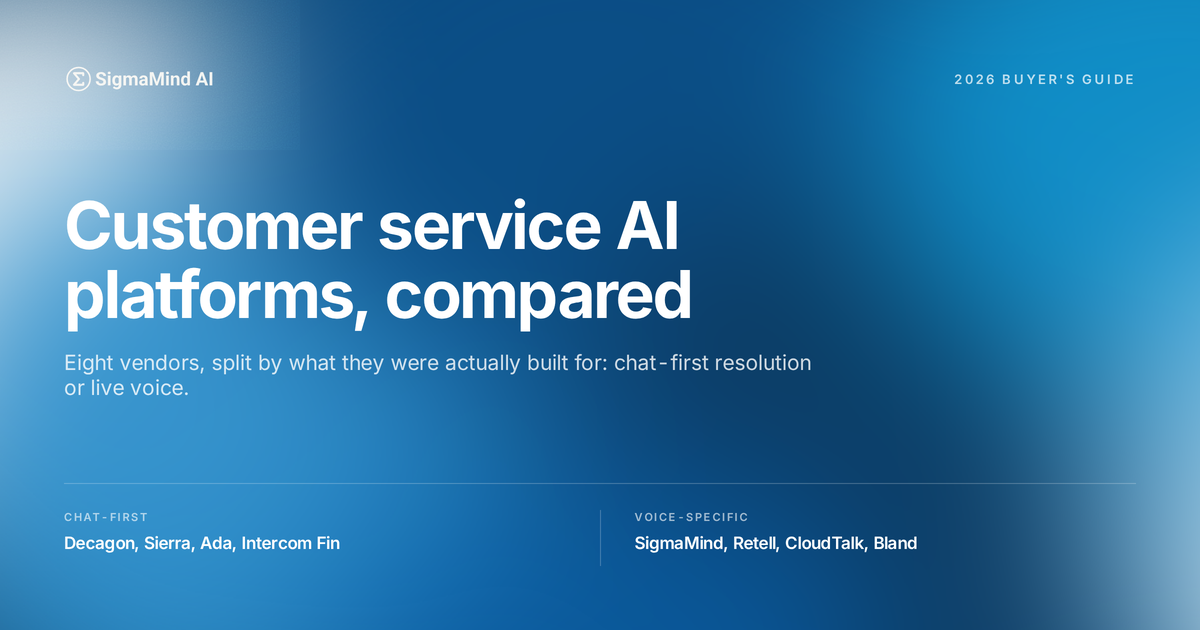
Customer service AI platforms fall into two broad groups. Autonomous-resolution platforms focus on completing service requests across digital channels, although some also support voice. Voice-specific platforms focus on live calls, telephony integration, and lead qualification. Start with your primary workload, then compare products within the relevant group.
How to choose between autonomous-resolution and voice-specific AI platforms
Choose the platform category based on the workload you need to automate. Viewpoint Analysis separates autonomous resolution products from voice platforms because each category should be assessed using different criteria. Autonomous-resolution platforms focus on completing service requests without human intervention, most often across chat and email. Voice-specific platforms manage live calls and phone routing, and transfer callers through telephony systems.
For autonomous service, examine how each vendor defines a resolution. Review whether transfers and unresolved conversations, including reopened or abandoned ones, count against the resolution rate. Per-resolution pricing remains difficult to compare when vendors apply different definitions.
For voice service, test response latency under realistic call conditions and ask which company controls the telephony layer. Passing audio between a carrier, an AI platform, and external model providers can add latency at each connection. Direct SIP or PBX support also determines how easily the platform fits your existing call center.
Compare total operating cost rather than the advertised unit price. Per-minute fees may exclude telephony and AI processing costs such as transcription and model usage, while per-resolution plans may sit alongside platform or seat fees. Low entry rates can rise through these additional charges.
AI-native autonomous customer service platforms
Decagon, Sierra, Ada, and Intercom Fin compete primarily on autonomous customer service. Decagon, Ada, and Intercom Fin remain strongest in digital workflows, while Sierra reports substantial voice adoption. Compare each product's channel-specific performance rather than assuming that autonomous resolution refers only to chat and email.
Adding voice to a digital support platform does not establish its performance on live calls. Evaluate carrier connectivity and call latency separately, along with transfer and phone-system support. Viewpoint Analysis treats autonomous resolution and voice automation as distinct categories, and vendors that lead one category may not lead the other.
Decagon
Decagon is an autonomous customer service agent platform for large organizations with high volumes of repeatable digital support work.
Best for: High-volume, digital-first support teams seeking end-to-end autonomous resolution.
Decagon targets companies that want AI agents to resolve repeatable support requests across chat and email. Its agents use company knowledge and conversation history to answer questions, process refunds, update orders, and complete other backend tasks. Decagon lists Notion, Duolingo, Rippling, and ClassPass as customers. Buyers should request references from customers with comparable support volumes and workflows.
Agent Operating Procedures let support managers describe workflows in natural language instead of coding each decision path. Watchtower monitors resolution and fallback rates so managers can identify workflows that need review.
Voice remains a newer layer in Decagon's product. Decagon launched its voice agents through an ElevenLabs partnership in February 2025, while its core workflows and customer base grew around chat and email. Its voice performance requires separate validation. Contact centers should test call latency and conversation handling, including interruptions and escalations under realistic traffic before treating it as a telephony replacement.
Decagon also requires a separate helpdesk for human-agent work. Companies typically connect Zendesk, Salesforce Service Cloud, Freshdesk, or HubSpot, which adds software cost and operational complexity. [An Assembled comparison reports that some Decagon handoffs may provide incomplete context](https://www.assembled.com/page/decagon-ai), which can require customers to repeat information. A comparison published by Cresta, a competing vendor, says Decagon transfers context but does not continue assisting the human agent after handoff. Buyers should verify both behaviors in a pilot. The separate helpdesk requirement and uncertain handoff behavior make Decagon better suited to autonomous digital resolution than to operations that rely on frequent collaboration between human and AI agents.
Sierra
Sierra is a multichannel enterprise customer service platform whose Agent OS orchestrates specialized agents across multiple language models.
Best for: Large enterprises that prioritize multi-model orchestration across digital and voice channels.
Sierra gives customer service managers one orchestration layer across digital and voice channels. Its Agent OS coordinates specialized agents across multiple language models, reducing dependence on any single model. Agent Studio and Voice Sims provide deployment controls for complex service workflows.
Sierra reported that voice overtook text as its primary channel by September 2025. My AskAI reports voice delays above 700 milliseconds, but its article is not a controlled, independent latency benchmark. Buyers should therefore test Sierra with their own call flows, routing rules, and supported languages before rollout.
Sierra provides phone agents and IVR connectivity, but its contact center integrations require closer review. Sierra uses APIs or its Agent SDK to connect with helpdesks such as Zendesk and Intercom. It also supports Salesforce but focuses on customer support rather than outbound sales or collections, according to a HappyRobot review.
Sierra fits enterprises that prioritize multichannel orchestration and controlled autonomous resolution. Contact centers focused on low-latency calls and lead qualification through existing telephony may need a more voice-specific platform.
Ada
Ada is an enterprise customer service automation platform for structured workflows across messaging, email, and voice.
Best for: Omnichannel, compliance-heavy enterprises that need governed service workflows.
Ada centers on digital support and structured service workflows. Its Playbooks guide multi-step tasks such as identity verification, order lookups, and refunds, while integrations retrieve customer data and execute approved actions. Ada offers products for messaging, email, and voice. For regulated deployments, Ada lists HIPAA, SOC 2, GDPR, and AIUC-1 among its compliance and certification credentials.
Treat an Ada deployment as an enterprise implementation project. You may need to prepare knowledge sources, connect business systems, and assign staff to maintain workflows. Ada does not publish pricing or offer a self-service trial. Featurebase describes quote-based, consumption-based contracts, so buyers should confirm how Ada counts a resolved interaction before estimating costs.
Ada’s voice offering requires additional diligence. Ada does not publish benchmarks for telephony integration depth, call routing, latency, or voice accuracy. Contact center buyers should ask Ada to demonstrate connections to their existing carrier, routing rules, transfers, and call-quality monitoring before treating its omnichannel coverage as equivalent to a telephony-native platform.
Intercom Fin
Intercom Fin is an AI customer service agent for resolving requests and completing support tasks across chat, email, and voice, either with Intercom's helpdesk or connected external systems.
Best for: Teams prioritizing chat and email resolution with a published per-resolution price.
Fin centers its commercial model on autonomous digital resolutions. Coworker.ai reports that Fin charges $0.99 per successful chat or email resolution. Customers can use Fin with Intercom’s helpdesk or connect it to external platforms such as Salesforce and Zendesk.
Fin supports multi-step service tasks across chat, email, and voice. Its Procedures feature lets the agent handle account updates and support tasks such as refunds or troubleshooting. Intercom also provides simulation and QA tools for regression testing. Its Apex Flash model is intended for voice interactions, but buyers should test latency under their own call conditions. Intercom reports a 76 percent average resolution rate, though independent benchmarks may use different definitions and test conditions.
Fin Voice requires a sales conversation, and Intercom does not publish its pricing. Independent comparisons with telephony-focused vendors on call latency, transcription accuracy, transfer handling, and interruption handling also remain limited. Fin therefore suits buyers whose main workload sits in chat and email, but voice-heavy contact centers will need a pilot and a detailed quote before comparing total cost and call performance.
Voice-specific platforms built for the call center
Voice platforms differ in how much telephony and contact center functionality they provide. SigmaMind AI focuses on operational voice workflows for contact centers. Retell AI, Bland AI, and Vapi provide developer-oriented voice platforms, while CloudTalk combines telephony with a broader call center suite. Synthflow AI emphasizes SIP and PBX connectivity.
Compare response latency and call routing first. Then assess carrier connections, audio handling, and the engineering work required for deployment. A telephony-oriented architecture may connect more directly to existing phone infrastructure than a chat-first product, but buyers should verify each provider's built-in capabilities.
SigmaMind AI
SigmaMind AI is a voice-specific platform for contact centers deploying AI agents alongside existing telephony systems. It supports contact centers that want to automate repetitive calls and lead qualification while retaining their established phone operations.
Best for: Contact centers that need voice automation and lead qualification within an existing telephony environment.
SigmaMind AI says its platform supports automated lead qualification alongside existing telephony systems. SigmaMind AI says its integrations let contact centers retain established routing while voice agents handle repetitive qualification calls. Buyers should confirm compatibility with their carriers, routing rules, and transfer paths during a pilot.
SigmaMind AI combines agent configuration, predeployment testing, and postdeployment monitoring in one voice workflow. Agent Builder configures a voice agent for a qualification process, while Playground tests its behavior before deployment and Analytics tracks live-call performance. The App Library provides templates for common use cases.
Retell AI and Bland AI give technical users infrastructure for building customized calling systems, while CloudTalk starts with a phone suite and adds AI features. SigmaMind AI packages agent configuration, testing, deployment, and monitoring for call center workloads.
SigmaMind AI works best when phone automation and lead qualification drive the purchase. Buyers should ask how the platform connects with their current carriers, routing rules, CRM records, and human escalation paths during evaluation. SigmaMind AI publishes pay-as-you-go pricing starting at $0.04 per minute plus provider costs, with no subscription or concurrency fees, and offers custom enterprise pricing for high-volume deployments.
Retell AI
Retell AI is a developer-oriented voice infrastructure layer for teams building phone agents with their own integrations, models, and orchestration choices.
Best for: Developer-led teams that want flexible voice infrastructure rather than a finished contact center application.
Retell's APIs, webhooks, simulation tools, and model options let you control how agents respond and connect with business software. CRM updates and appointment booking typically require external integrations, so contact center operations need additional development and middleware.
Retell does not own the underlying telephony network. Calls run through Twilio or your SIP trunk, so outside providers partly determine performance and costs. For Twilio, you can use Retell’s managed service or your own account. Retell supports multiple voice and language model configurations, but each added provider can create another contract and technical dependency. Teams that want less infrastructure assembly should compare Retell’s provider dependencies with a platform that packages telephony integration and agent operations, such as SigmaMind AI.
Retell’s published pricing can make developer-led pilots easier to estimate. The base voice engine starts at about $0.07 per minute, with no required monthly platform fee on the pay-as-you-go plan. Your total rate also includes carrier charges and fees for the selected model and voice service, so production costs exceed the advertised base price.
CloudTalk
CloudTalk is a packaged, AI-enabled call center platform combining core telephony, dialers, analytics, and business-software integrations.
Best for: SMB and mid-market teams that want telephony and CRM tools in one subscription.
Its built-in telephony features include call routing, queues, IVR, recording, live monitoring, transfers, and several dialer modes. AI add-ons provide call summaries, scoring, sentiment analysis, lead qualification, and automated voice agents.
CloudTalk reports integrations with Salesforce, HubSpot, Zendesk, Intercom, Pipedrive, and Microsoft Dynamics. These integrations can reduce implementation work if your sales or support operation already uses a supported system.
Annual plans start at $25 per user each month, with higher tiers adding analytics, integrations, and expanded customer support. Per-seat pricing gives buyers a familiar budgeting model, but costs rise with the number of human users. CloudTalk suits companies that want phone, CRM, and dialer tools in one suite. Buyers seeking a deeply specialized AI agent platform may find its AI tools secondary to the broader call center product.
Bland AI
Bland AI is an API-first voice automation platform for technical teams that want granular control over call logic, integrations, and infrastructure.
Best for: Engineering-heavy teams seeking configurable call flows and dedicated or self-hosted infrastructure control.
Its API-first platform lets teams define call routing and build structured call flows that trigger external tools with Conversational Pathways. Enterprise customers can also deploy dedicated servers and GPUs within their own infrastructure. This deployment model gives customers direct control over security controls and system monitoring. Orvera’s review positions Bland AI as infrastructure for developer-led deployments rather than a finished contact center product.
Technical control increases the implementation burden. Operations staff may need developer support to build complex Conversational Pathways integrations, modify production workflows, and conduct manual QA.
Bland AI’s pricing can also make budgets difficult to forecast. Published plans combine subscription tiers with usage charges, transfer-time fees, and minimum charges for some failed or unanswered calls. Enterprise features and higher call limits require custom pricing. Vida also flags paid add-ons and sales-gated costs.
Bland AI may fit teams whose engineers need control over infrastructure and call logic. Contact center operators seeking low-maintenance deployment should account for the ongoing engineering and manual QA work.
Vapi
Vapi is a usage-based platform for developers building custom phone agents.
Best for: Developers seeking a usage-based entry point for custom voice-agent projects.
Vapi's published pricing includes $10 in starting credit, followed by a $0.05-per-minute platform fee. Confirm which telephony and AI-provider costs the quoted platform fee excludes before comparing Vapi with fully configured alternatives.
Synthflow AI
Synthflow AI is a voice automation platform with SIP and PBX integration for teams connecting AI calling to existing phone infrastructure.
Best for: Teams that prioritize SIP/PBX connectivity when adding voice automation.
Cekura notes Synthflow's SIP/PBX integration and a vendor-reported 99.99% uptime claim. Buyers should verify the applicable service terms, routing support, transfer behavior, and total pricing in a pilot because the available research does not establish a comparable public price.
Call quality monitoring and conversation accuracy scoring
A repeatable QA process should verify human and AI agent performance after deployment.
Automated QA can score every transcribed interaction, while manual QA usually covers a sample. Coval estimates that contact centers review only 2 to 5 percent of calls, which may leave recurring problems or infrequent compliance breaches undetected. Cekura estimates that an analyst may need 12 to 15 minutes to evaluate a six-minute call and can score roughly 35 calls per day. Human reviewers can instead investigate exceptions and verify that the automated model applies the scorecard correctly.
Large language models can support conversation scoring, but buyers should validate each model and rubric against expert review. In one benchmark of language-model evaluators, GPT-4 matched expert preferences 85 percent of the time after researchers excluded tied votes. Human experts agreed with each other 81 percent of the time under the same measure. The benchmark did not test contact center calls directly, so vendors should validate their scoring against a blinded sample of your conversations and report agreement for each scorecard criterion.
Human-agent QA and AI-agent QA serve different purposes. Human-agent QA identifies coaching needs by evaluating accuracy, compliance, and resolution quality. AI-agent QA finds regressions caused by prompt changes or new model versions. Require each vendor to replay fixed scenarios several times before deployment. Repeated tests reveal whether the agent behaves consistently across identical inputs. SigmaMind AI buyers can use Playground to replay fixed scenarios before deployment, then use Analytics to compare live-call results with those tests.
A QA system should score the caller's experience and cite transcript evidence for each result. Ask each vendor to show how its scorecard checks authentication and required disclosures, with transcript evidence for every result. Voice testing should separately measure response latency and whether interruptions, transcription, and tool calls work as intended. Broader conversation-quality signals can include talk-to-listen ratio, sentiment changes, empathy markers, and whether the call was resolved, escalated, or transferred.
Buyers should also require scorecard versioning, reviewer calibration, dispute handling, and searchable recordings. Real-time monitoring should flag high-severity events such as missing consent or exposed payment data. Post-call analytics should identify recurring failure patterns that require coaching or updates to prompts and workflows.
Matching the platform to the problem you're solving
Choose an autonomous-resolution platform when most customer requests arrive through chat or email and you want the AI to complete them without human intervention. Choose a voice-specific platform when live calls, lead qualification, telephony compatibility, and reliable transfers drive the purchase.
After shortlisting vendors by channel, run a pilot with representative service workflows before comparing secondary features. For voice platforms, require each vendor to demonstrate routing, transfers, CRM data exchange, call recording, and QA scorecards with your existing telephony system. If you are evaluating high-volume voice automation, consider SigmaMind AI’s Agent Builder and Analytics for predeployment testing and live-call monitoring of lead-qualification workflows.
FAQs
What separates autonomous-resolution platforms from voice-specific platforms?
Autonomous-resolution platforms complete service requests without human intervention, usually through digital channels, while voice-specific platforms focus on live calls and telephony. SigmaMind AI belongs to the voice-specific group because it connects call handling with lead qualification. Buyers can judge it on call latency, transfers, routing, and phone-system compatibility.
How does conversation accuracy scoring work, and how accurate is it?
Conversation accuracy scoring compares transcripts and call events against a defined rubric. When assessing SigmaMind AI or another vendor, test the scoring with your own calls because a general benchmark in which GPT-4 matched expert preferences 85 percent of the time after researchers excluded tied votes did not evaluate contact center calls directly. Regular human calibration helps identify errors caused by unclear criteria or inaccurate transcription, including accent-related errors.
How does outcome-based or per-resolution pricing work?
Per-resolution pricing charges when the AI completes an interaction that meets the vendor’s resolution rules. When comparing SigmaMind AI with outcome-priced vendors, buyers should ask whether transfers count as resolutions and how the vendor treats repeat contacts or abandoned conversations. A written definition makes projected costs easier to compare.
What does telephony integration depth mean for an existing call center?
Telephony integration depth describes how directly a platform works with carriers, phone numbers, routing, transfers, recordings, and existing call-center software. Buyers should evaluate SigmaMind AI against the specific phone system and transfer paths already in use. Deeper compatibility reduces custom middleware and preserves existing call flows.
Evolve with Sigma Mind AI
Build, launch & scale AI agents
Related Blogs
Ready to transform your call center?

More Conversations.
Less Manual Work.

Building from San Francisco, CA