
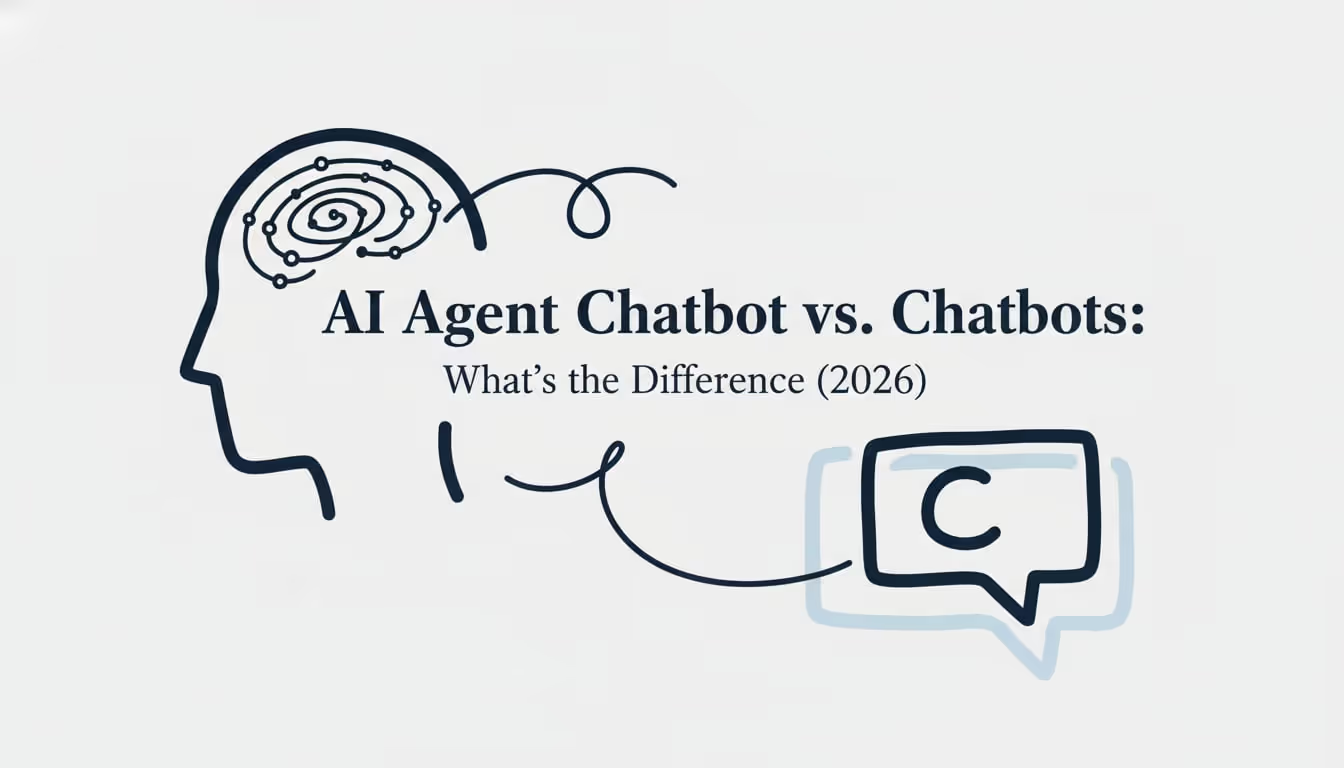
What's the difference between AI Agent Chatbots vs. Chatbots?
Discover how an AI Agent Chatbot goes beyond conversation to act: autonomy, tool use, and multi‑step workflows. See use cases and how to choose the right one.
IN this article

Evolve with Sigma Mind AI
Build, launch & scale AI agents
It feels like “AI” is everywhere, but when you dig in, the terms get confusing. You hear about AI chatbots and AI agents, often used interchangeably.
So, what is an AI Agent Chatbot? And where does it differ from a Chatbot? Is there even a difference?
Understanding this is crucial for any business looking to automate, improve customer service, and scale operations. This guide breaks down everything you need to know about the modern AI agent chatbot, from core definitions and key differences to real world use cases and how to choose the right solution for your needs.
What is an AI Chatbot?
An AI chatbot is a program designed to simulate human conversation through text or voice. Think of it as a digital front desk clerk. Traditional chatbots operate on a set of predefined rules and scripts. They recognize specific keywords and respond with pre written answers to guide you through a limited menu of options, like answering frequently asked questions on a website.
Modern AI chatbots are smarter, using generative AI and large language models (LLMs) to hold more natural, free flowing conversations. They can be connected to a company’s knowledge base to answer detailed questions about products or services. However, their primary role is to converse and provide information, not to perform actions on their own.
--> Learn more about how to automate customer support with bots
What is an AI Agent?
An AI agent is a leap forward. It’s a more advanced, autonomous system that not only understands conversation but can also make decisions and execute complex, multi step tasks with minimal human input. An AI Agent Chatbot doesn’t just talk about a solution; it actively works to implement it.
Think of an AI agent as a virtual employee. You give it a goal, and it figures out the steps to achieve it. It can connect to other software, use tools, and update systems to complete a task from start to finish. This ability to act is what fundamentally separates an agent from a chatbot.
What is the difference between an AI Agent and a Chatbot?
While the terms are sometimes used interchangeably, their capabilities are worlds apart. A chatbot talks, but an AI Agent Chatbot talks and does.
Here’s a simple breakdown:
- Autonomy: This is the biggest differentiator. A chatbot follows a script. An AI agent operates independently, analyzing a situation and determining the best course of action on its own.
- Goal Orientation: Chatbots are interaction oriented; their goal is to answer a question. AI agents are outcome oriented; their goal is to complete a task, like processing a refund or booking an appointment.
- Task Complexity: Chatbots handle simple, single turn questions well. AI agents are built to manage complex, multi step workflows that require context and decision making.
- System Integration: A chatbot might pull from a knowledge base. An AI agent is designed to integrate deeply with external systems like CRMs, helpdesks, and databases to perform actions like updating a customer record or placing an order.
How long does it take to build an AI agent?
The timeline varies greatly. A simple, single prompt agent might be prototyped in minutes. A complex, production ready ai agent chatbot that integrates with multiple enterprise systems could take several weeks or months to develop, test, and deploy. Platforms with no code agent builders and pre built integrations that can significantly accelerate this process.
The Powerhouse Capabilities of an AI Agent
What makes an AI Agent Chatbot so much more powerful?
It comes down to a few key capabilities that enable true automation.
Can an AI Agent make decisions by himself?
An AI agent doesn’t need its hand held.
You can give it a high level objective, like “schedule a meeting with the marketing team next week,” and it will autonomously check calendars, find a suitable time, send invites, and confirm, all without step by step instructions. This is possible because agents can independently assess a situation and execute a plan, a stark contrast to a chatbot that sticks to a predefined script.
Tool Use and System Integration
This is where the magic happens. An AI agent’s ability to use “tools” (connecting to software via APIs) is what allows it to perform real work. It’s the difference between a support bot telling you how to request a refund and an agent that says, “I can process that for you right now,” and then actually does it by connecting to your e-commerce and payment systems. This integration turns conversation into action.
For an AI voice agent platform like SigmaMind AI, this is a core feature, allowing developers to build agents using the App Library that connect to Shopify, Zendesk, Google Calendar, and more to complete workflows during a single call.
Multi Step Task Execution with AI
Real world tasks are rarely a single step. An AI agent excels at managing sequences.
For example, processing an insurance claim might involve verifying the customer’s policy, assessing the submitted documents, checking for fraud flags, and scheduling an adjuster visit. An agent can manage this entire chain of events, remembering context from one step to the next to ensure a smooth process.
Memory and Context Retention
Have you ever had to repeat your account number three times to a bot? That’s a failure of context. Modern AI agents have robust memory. Powered by LLMs with large context windows (some models can remember hundreds of thousands of words), they can recall details from earlier in the conversation and even from past interactions. This “stateful” memory is crucial for handling complex tasks and providing a personalized, coherent experience without asking the same questions over and over.
Personalization and Adaptability of AI Agents
A one size fits all approach doesn’t work in customer service. A staggering 71% of consumers expect personalized interactions. AI agents deliver this by adapting to the user. They can access CRM data to greet a customer by name, reference their order history, and tailor the conversation. They can also detect a user’s sentiment (like frustration) and adjust their tone to be more empathetic, creating a more human like and effective interaction.
Real World Use Cases of AI Agent Chatbots
So, how does this technology translate into business value?
Here are two major areas where the modern ai agent chatbot is making a huge impact.
Use Case: AI Agents in Customer Support
AI support agents are the most common application, and for good reason.
- 24/7 Instant Service: AI agents eliminate wait times, offering immediate support around the clock, in any language.
- End to End Resolution: Instead of just deflecting simple questions, agents can resolve complex issues. One e‑commerce brand used an agent to handle over 4,000 refund requests per month, cutting the resolution time from days to under 60 seconds and saving 43% in costs. Read the case study.
- Intelligent Handoffs: When an issue is too complex, the agent can perform a “warm transfer” to a human. This means it passes along a full summary of the conversation, so the customer never has to repeat themselves.
The Finnish fintech company Klarna provides a powerful example. Its AI assistant handled 2.3 million conversations in its first month, doing the work of 700 full time human agents and will deliver annualized savings of USD 40m.
Use Case: AI for Workflow Automation
Beyond customer conversations, AI agents are workhorses for internal and back office processes.
- HR Onboarding: An agent can automate the entire onboarding checklist: sending offer letters, creating IT accounts, scheduling orientation and AI Agents for appointment scheduling, and adding the new hire to payroll systems.
- IT Operations: An AI can monitor systems, detect anomalies, create incident tickets, and even run basic remediation scripts, alerting a human only when necessary.
- Finance and Invoicing: Agents can read incoming invoices, match them to purchase orders, get approvals, and schedule payments in the accounting software, automating a tedious and error prone process.
These automation capabilities are projected to add immense value. One Capgemini study estimated that AI agents are poised to deliver up to $450 billion in economic value by 2028 through revenue gains and cost savings.
What industries benefit most from an AI agent chatbot?
Nearly any industry with high‑volume, repetitive customer interactions or internal workflows can benefit. Key sectors include e‑commerce (refunds, order tracking), healthcare (appointment scheduling, reminders), finance (loan pre‑qualification, fraud detection), real estate (lead qualification), and telecommunications (technical support, billing inquiries). fs Explore AI Agents for e‑commerce.
How to Choose: Do You Need a Chatbot or an AI Agent?
Making the right choice depends entirely on your goals.
- Choose a Chatbot if: Your primary need is to answer common questions, provide basic information, and handle a high volume of simple, repetitive queries. If you have a limited budget and need a quick solution, a chatbot is a great starting point.
- Choose an AI Agent if: You need to automate complex, multi‑step processes, require integration with other business systems, and want to provide a deeply personalized, end‑to‑end resolution for users. An ai agent chatbot is a strategic investment in deep automation. Learn more about the SigmaMind AI platform.
Many businesses start with a chatbot and gradually enhance its capabilities, evolving it into a true agent over time.
Implementation, Training, and the Human Touch
Implementation and Training
Implementing a basic chatbot can be done in days using no code platforms. Building a robust AI agent is a more involved process, often requiring developer expertise to handle integrations and complex logic. The training data also differs; a chatbot might just need an FAQ document, while an agent may be trained on thousands of conversation logs and workflow examples to learn decision making.
Do I need to be a developer to create an AI agent?
Not necessarily. The rise of no code and low code platforms allows business users and conversation designers to build sophisticated AI agents using visual drag and drop interfaces. However, for deep system integrations or highly custom logic, developer involvement is often required to connect APIs and write specific functions.
Platforms like SigmaMind AI are designed to bridge this gap, offering a developer‑first platform with a no‑code Agent Builder and deep APIs. This allows teams to prototype and deploy production grade voice agents much faster than building from scratch.
Should AI Agents replace human support teams?
Full automation doesn’t mean firing your human team. The most successful AI deployments use a “human in the loop” model. The AI handles the bulk of routine tasks, but a human can seamlessly take over for complex or sensitive issues. This hybrid approach combines the efficiency of AI with the empathy and critical thinking of people, leading to the best outcomes. For this to work, the AI Agent can transfer conversations to humans giving full context.
Agent Security and Guardrails
With autonomy comes responsibility. An AI agent with the power to act must be governed by strict security and guardrails. This includes data privacy compliance (like SOC 2), action restrictions (e.g., requiring human approval for refunds over $500), and content filters to ensure the agent behaves ethically and safely.
Hybrid Models
The most effective solutions are often hybrid, blending rule based systems for predictability with AI for flexibility. A system might use a fixed decision tree to guide a core process but leverage an LLM to understand a user’s free form responses at each step. This gives you the reliability of rules with the natural feel of AI.
The Future of the AI Agent Chatbots
The evolution is happening fast.
Here’s what’s next:
- More Human Like Interaction: As AI models advance, agents will become even better at understanding nuance, emotion, and complex context, making conversations feel incredibly natural.
- The Decline of Apps: Why tap through ten screens when you can just tell an assistant what you want? Gartner predicts that by 2027, mobile app usage will drop by 25% as people turn to AI assistants as their primary interface for getting things done.
- Proactive Assistance: Future agents won’t just be reactive. They’ll be proactive partners, anticipating your needs, managing your schedule, and automating tasks in the background before you even ask.
The ai agent chatbot is evolving from a simple tool into a true digital workforce. Businesses that embrace this technology will be able to offer faster, smarter, and more personalized service at a scale never before possible.
Ready to see what a true AI agent can do for your business? Sign up for free to build and test a voice agent that completes real work, not just chats.
Evolve with Sigma Mind AI
Build, launch & scale AI agents
Related Blogs
Ready to transform your call center?

More Conversations.
Less Manual Work.

Building from San Francisco, CA